Anthropic expands its AI research tools with Claude Science beta
The macOS and Linux app combines scientific databases, analysis tools and lab computing, while selected projects can receive up to $30,000 in Claude credits.
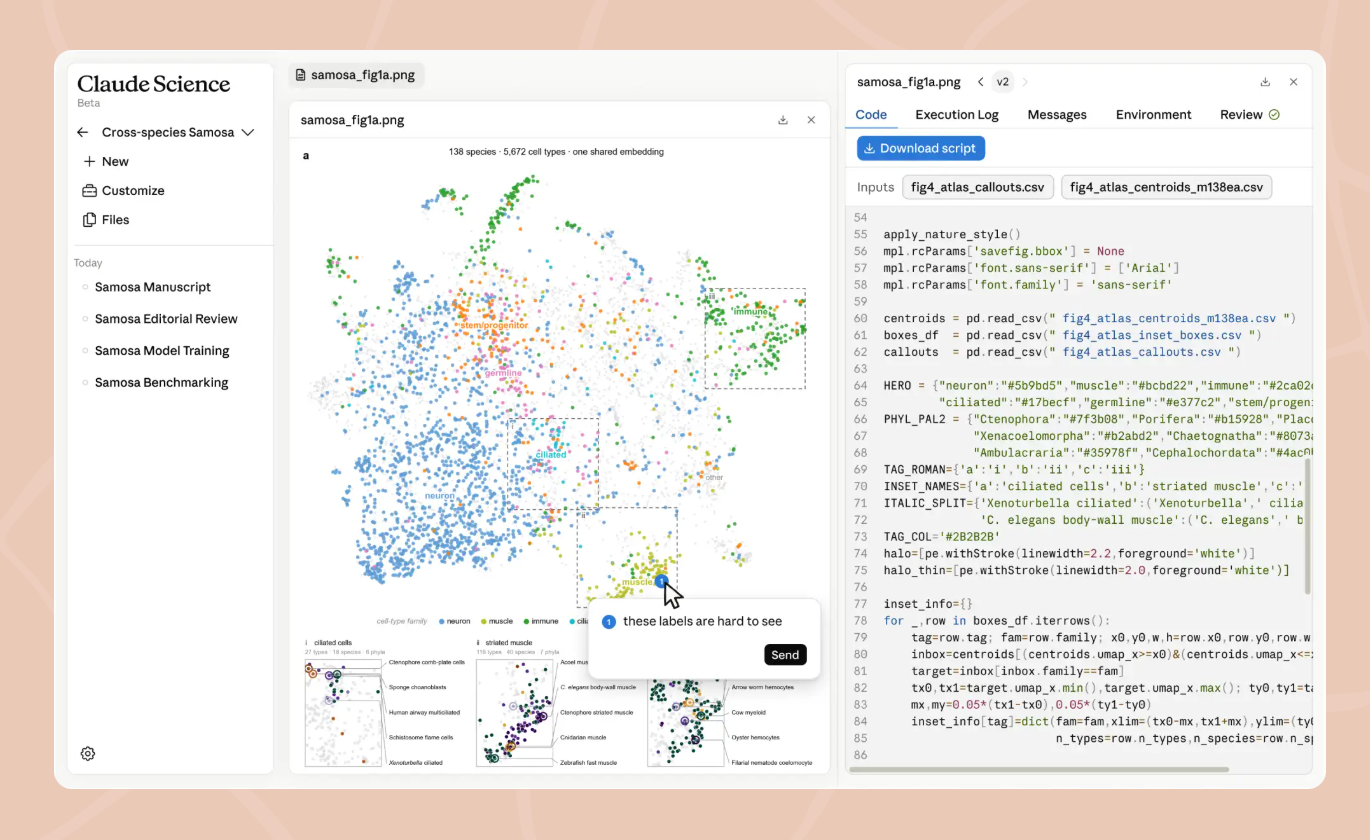
Anthropic's Claude Science workbench allows researchers to review scientific visualizations alongside the code, inputs and execution history used to produce them
Anthropic has launched Claude Science, an AI workbench for scientific research, in public beta for Claude Pro, Max, Team and Enterprise users. The app brings literature searches, data analysis, scientific visualization, manuscript drafting and access to research computing into a single environment.
Claude Science can be installed on macOS and Linux devices, laboratory Linux systems, cloud virtual machines and high-performance computing login nodes. Team and Enterprise customers need an administrator to enable access.
It is an application rather than a new AI model and uses the Claude models already included in each user's subscription. Anthropic has not published separate pricing for the app, although it said active scientific laboratories at academic institutions and nonprofit research organizations can access discounted Claude Team seats.
Alongside the public beta, Anthropic has opened applications for up to 50 AI for Science projects. Selected projects can receive up to $30,000 in Claude credits, while computing platform Modal will provide up to $2,000 in compute credits to some participants.
Applications close on July 15, 2026, with successful applicants due to be notified by July 31. Anthropic is initially seeking cross-disciplinary projects focused on biology and biomedical research, with selected work scheduled to run from September 1 to December 1.
Claude Science connects research databases, analysis and computing
Claude Science uses a coordinating AI agent with access to more than 60 scientific skills and connectors covering areas including genomics, single-cell analysis, proteomics, structural biology and cheminformatics.
The app can search literature and scientific databases, execute Python, R and shell workflows, and manage computing jobs on a researcher's laptop, laboratory infrastructure or high-performance computing cluster. It can also submit work to Modal and scale analyses from one graphics processing unit to hundreds, according to Anthropic.
Scott White, who works in product leadership at Anthropic, wrote on LinkedIn:
"Research tooling is brutally fragmented. A single analysis can mean a dozen databases, Jupyter, R, a cluster terminal, and a ton of file formats. Claude Science pulls all of that into one place. It runs analyses, searches the literature, renders protein structures natively, and manages compute on your lab's own infrastructure."
Claude Science can natively display scientific materials including 3D protein structures, genome browser tracks and chemical structures. Researchers can annotate figures or request changes in plain language, with Claude Science editing the code used to produce the output.
Anthropic said every figure, table and notebook includes the code and computing environment used to create it, a description of the process and the associated conversation history. A reviewer agent checks citations, calculations and whether figures match their underlying code, flagging results that cannot be traced to supporting evidence.
The app can connect to existing scripts, electronic laboratory notebooks and internal research systems rather than requiring laboratories to rebuild established workflows. Pipelines can also be saved as reusable skills for future sessions.
Claude Science uses skills from Nvidia's BioNeMo Agent Toolkit to connect with life sciences models and libraries including Evo 2, Boltz-2 and OpenFold3.
According to Anthropic, raw datasets and computing workloads remain on infrastructure controlled by the research organization, while the context required for individual tasks is sent to Claude. Content included in prompts and model responses is processed under Anthropic's standard retention arrangements.
Allen Institute, UCSF and Manifold Bio test research workflows
Anthropic said researchers have tested Claude Science on work including single-cell RNA sequencing, CRISPR screen design, protein structure prediction and cheminformatics.
Manifold Bio used the app to assess and rank potential targets for experiments involving tissue-targeting medicines. The work combined public scientific information with Manifold Bio's proprietary data on previous programs, according to Anthropic.
Mike Nichols, computational biologist at Manifold Bio, said:
"With Claude Science I can go from raw data to a publication-quality figure in a single session — running the analysis, generating exploratory plots, and refining them all within a single project. The code and the conversation behind each figure are welded to it, making every version fully reproducible so I can iterate, revert, and fork as much as needed."
Jérôme Lecoq, a neuroscientist at the Allen Institute, used Claude Science to create a multi-agent workflow for producing long-form literature reviews. The system uses around 20 custom skills to review papers, record claims and quantitative findings, produce sections and check citations.
Anthropic said Lecoq has produced around 10 reviews, many exceeding 100 pages. Similar reviews previously took his team as long as two years, although domain experts are continuing to review and refine the AI-based checking process.
Stephen Francis, associate professor and epidemiologist at the University of California, San Francisco Brain Tumor Center, used Claude Science to support research into genetic susceptibility to glioma. Anthropic said his group completed germline analyses in approximately one-tenth of the previous time and independently validated the results.