Anthropic opens self-hosted Claude Code sessions to Team and Enterprise customers
Code, secrets and build artifacts remain on customer infrastructure, but conversations and tool results are still sent to Anthropic for inference
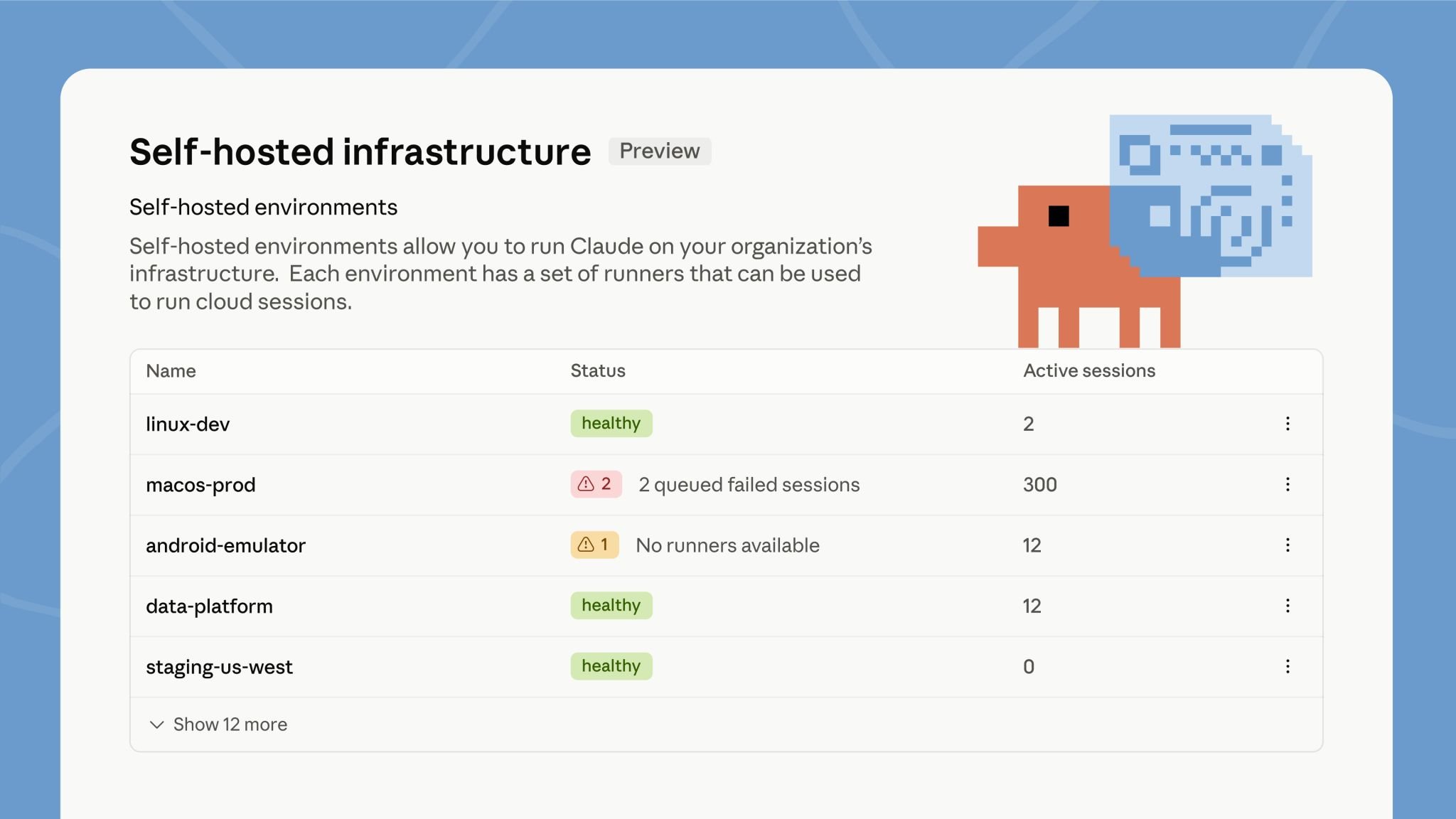
Anthropic’s self-hosted environments allow Claude Code sessions to execute on infrastructure operated by Team and Enterprise customers.
Anthropic has moved self-hosted environments for Claude Code into public beta, giving organizations on its Team and Enterprise plans the option to run coding agent sessions on infrastructure they control.
The feature allows sessions started through the web, mobile and desktop apps, or through a routine, to run within an organization’s network rather than on Anthropic-hosted infrastructure.
That can place Claude Code alongside internal databases, registries, development tools and security controls without making those systems available through the public internet. Organizations can also pre-install compilers, software development kits and internal command-line tools for use during sessions.
Self-hosting does not mean that every part of Claude Code remains within the customer’s network. Repository checkouts, build artifacts, secrets and files created or modified during a session stay on the infrastructure provisioned by the organization.
The conversation itself, including prompts, responses and tool results that may contain code read by Claude, is sent to Anthropic for inference. Session transcripts are also stored so work can be resumed from different supported devices and applications.
Runners provide fixed or on-demand capacity
Organizations using the feature deploy runners, which are long-running processes that collect queued sessions and start a separate Claude Code process for each one.
Anthropic provides two runner models. Fixed deployments maintain a set number of runners and distribute sessions between them. On-demand deployments use an orchestrator to start runners when sessions enter the queue and stop them when the work is complete.
A runner can handle more than one session, but each session receives its own repository checkout. Anthropic says this keeps work isolated between developers and accounts.
Sessions started through any supported interface are directed to the same self-hosted environment. This differs from Claude Code Remote Control, which allows a developer to continue a session running on their own computer through a phone or browser.
Remote Control sessions remain tied to the person who started Claude Code and end when the original machine stops running the session. Self-hosted environments operate on shared infrastructure managed by an organization’s platform team and can be used by multiple users.
George Jacob, Senior Engineering Manager, says the configuration supports Claude Code within existing development processes: “This setup means Claude can generate PRs, help fix CI issues, and respond to developer workflow events, with compute that can scale based on demand.”
Self-hosting shifts operations to the customer
Anthropic recommends its hosted service for most enterprises, citing the lack of infrastructure to operate or maintain. It positions self-hosting as an option for organizations whose network access, development tooling or compliance requirements call for greater control over where agent sessions execute.
That control brings an operational burden. Anthropic advises customers to assign a platform, developer experience or developer productivity team to set up and run the environment.
Responsibilities include building and maintaining the runner image, updating runners and, for on-demand deployments, operating the orchestrator. The company also tells organizations to plan for ongoing engineering support rather than treating setup as a one-time task.
Self-hosted environments are available in public beta to Claude Team and Enterprise organizations. The feature is disabled by default and must be enabled by an administrator in the organization’s settings. Organizations using zero data retention, or ZDR, cannot access it.