The open science initiative begins with a Carnegie Mellon challenge using historical weather records from 210 US cities to test climate forecasts and develop adaptation ideas
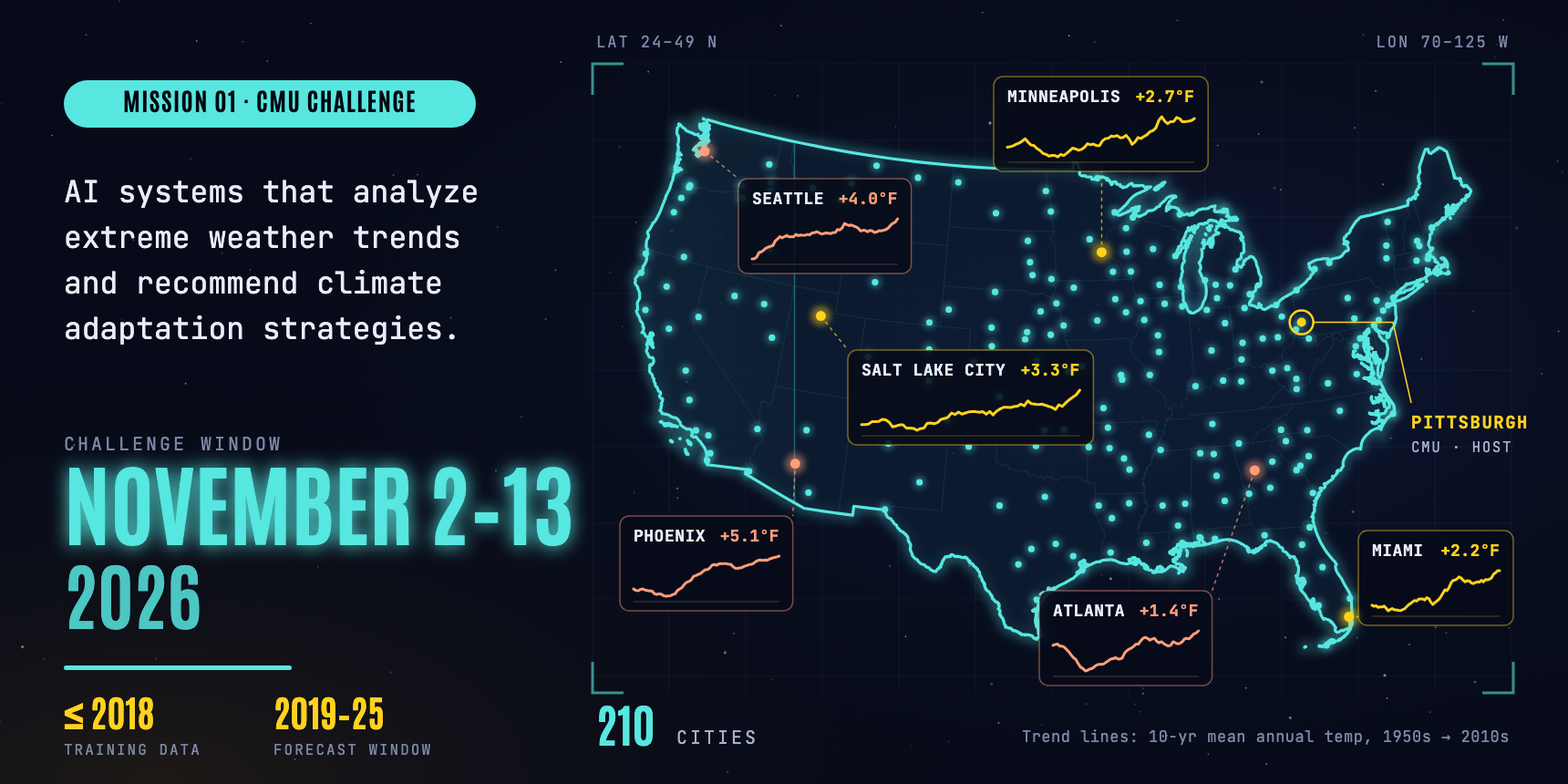
Carnegie Mellon’s inaugural ProtoStar challenge will use historical weather records from 210 US cities to test climate forecasts and inform adaptation ideas. Image: Project ProtoStar / Hugging Face
Hugging Face and a coalition of universities and research organizations have launched Project ProtoStar to make publicly funded datasets, AI models and code easier to find, reuse and build on.
The initiative combines open technical infrastructure with publishing support and public challenges that test how effectively researchers and developers can use shared scientific resources.
Founding partners include Carnegie Mellon University, Purdue University, Georgia Institute of Technology, Arizona State University, The George Washington University and the Astera Institute.
Hugging Face provides the technical infrastructure, working alongside the Open Research Community Accelerator, known as ORCA, and the Open Forum for AI, which coordinates university participation.
Making published research easier to reuse
ProtoStar addresses a practical obstacle in open science: publicly available research can still be difficult to use.
Datasets may be scattered across institutional websites, contained in PDFs or released without clear instructions, licensing terms or information about how they were collected. Those gaps make it harder for researchers and AI systems to combine resources or reproduce earlier work.
The initiative will support publication in machine-readable formats, accompanied by documentation and metadata, the descriptive information that helps people understand what a dataset contains.
Institutions will also receive help establishing discoverable repositories, including through the Hugging Face Academic Hub, with arrangements for licensing, tracking versions and preserving materials.
Participating organizations retain control over what they release and how it is shared. Their commitments are set out in non-binding, non-exclusive memoranda of understanding with Hugging Face.
Hugging Face reports that researchers shared more than three times as many new science datasets on its platform in the first nine months of 2026 as in the same period of 2025. It also reports that fully documented datasets account for 90% of dataset downloads on the Hub.
A climate challenge spanning 210 cities
Carnegie Mellon University is hosting the first ProtoStar challenge, Climate Risk Intelligence, from November 2 to 13, 2026.
Teams will use historical weather records from 210 US cities to predict annual conditions for 2019–2025. Forecast inputs must use records dated no later than December 31, 2018, preventing teams from feeding the actual outcomes into their predictions.
The task covers average annual temperature, total precipitation, the hottest day of each year and cooling degree days, a measure used to estimate air-conditioning demand.
Participants must also propose a short policy idea showing how their findings could help a city or the country respond sustainably to a climate risk.
The challenge is open to everyone, with up to five people per team and each participant limited to one team. Entries close at 11:59 p.m. Eastern Time on November 13.
The top three teams will receive $1,000, $500 and $250 in Hugging Face credits respectively, with an additional $2,500 prize for the top Carnegie Mellon team.
Testing the barriers to open science
Forecast accuracy is one part of the assessment. Judges will also examine whether others can reproduce the work, how well resources can be combined across systems, and the scientific or public value of each submission.
Teams must document obstacles they encountered, including missing information, licensing problems or difficulties using the data. Well-documented unsuccessful attempts to reuse or reproduce research can also contribute to the challenge.
Submissions will include forecasts, code and a written explanation published as a Hugging Face dataset. The aim is to generate practical evidence about what makes open research usable, alongside the projects themselves.
ProtoStar welcomes additional universities, science agencies, national laboratories, nonprofits and other research institutions.
Sean Dudley, Deputy CIO for Research and Associate Vice President at Arizona State University, discussed the launch on LinkedIn: “We're thrilled to help launch Project Protostar with Hugging Face and a tremendous set of partners. This is just the beginning of an important journey and we hope many of our friends across industry, academia, and other sectors decide to join.”
ETIH Innovation Awards 2027 open for entries
The ETIH Innovation Awards 2027 are now open for entries, with 26 categories recognising companies, institutions, projects and individuals making a measurable impact across education technology. The global awards span AI in education, digital learning, higher education, skills and workforce, inclusion, education operations, evidence and impact, with entries managed through ETIH’s new online awards platform.
Entries are open worldwide, with the early-bird deadline on Friday 18 December 2026 and the final entry deadline on Friday 26 February 2027 at 23:59 UK time.
Explore the 2027 categories and judging criteria, read the How to Enter guide or start an entry through the ETIH Innovation Awards 2027 platform.