A new partnership between the University of Nottingham, Nottingham City Council and Homes England gives residents a place to explore research and help shape the city’s future
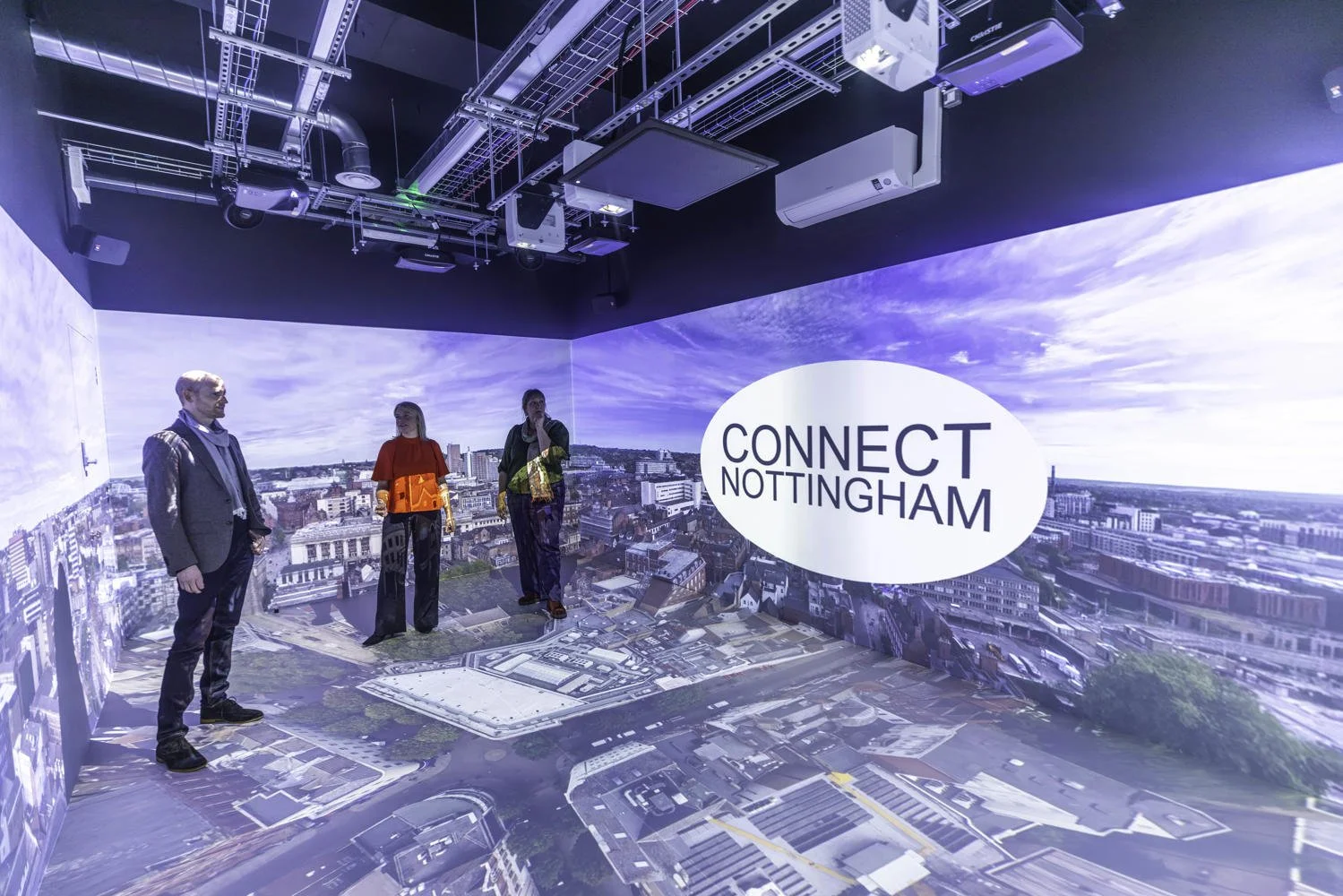
Visitors explore an immersive view of the city at Connect Nottingham, which brings together community engagement, research and digital visualization. Photo: University of Nottingham
The UK’s Connect Nottingham has opened in the Broad Marsh redevelopment area, bringing an immersive room, a digital city model and public research activities into a shared space for residents, researchers, businesses and policymakers.
The project combines Café Connect, the Nottingham Urban Room and City as Lab. It is the first part of the Broad Marsh redevelopment zone to open.
The University of Nottingham described the partnership on LinkedIn as “creating a space where people can engage with research, share ideas and help shape the future of Nottingham and the wider East Midlands.”
Exploring the city through immersive technology
Connect Nottingham’s Digital Visualisation Studio includes the Weston Immersive Room, a multisensory environment designed to encourage participation in research.
The space also houses the Projection Augmented Relief Model, known as PARM, developed jointly by the university and Nottingham City Council. The model uses projection and a three-dimensional representation of Nottingham to help people explore information about the city.
Professor Paul Grainge, Academic Director of City as Lab, said: “The PARM is wonder-inspiring and shows how 3D technology can translate spatial data into locally resonant stories and scenarios that are accessible and engaging. Bringing it into Connect Nottingham will enable people to explore the city, ask questions and think differently about the places where they live and work.”
City as Lab will use geographic visualizations and other data tools to support research on issues including climate change, public health, neighborhood belonging and regional economic growth.
Giving communities a role in research
Café Connect will create opportunities for local people to meet researchers, discuss subjects that matter to them and contribute their own experiences to research projects.
The Nottingham Urban Room will host conversations about the city’s past, present and future, including the development of the Nottingham Vision.
All three programs will use the collaborative space and visualization facilities to connect local knowledge with research and policymaking.
Professor Tom Rodden, Pro-Vice-Chancellor for Research and Knowledge Exchange at the University of Nottingham, said: “Connect Nottingham is about bringing research closer to the people and places it can make a difference to. It creates an accessible space where communities can engage with researchers, share their knowledge and help shape the questions we explore.”
Transforming former office space at Broad Marsh
The project repurposes former office space in Severns House, building on collaboration between the university and city council, with Homes England supporting the building’s restoration and development.
Capital funding came principally from Homes England, the University of Nottingham and Nottingham City Council, alongside a charitable grant from the Garfield Weston Foundation. Operational support comes through UK Research and Innovation’s Higher Education Innovation Funding program.
The foundation’s contribution helped create the community space and Weston Immersive Room. The building also features commissioned work by Nottingham artist Natalie Coe above the Digital Visualisation Studio and on the collaboration space’s windows.
Jo Nugent, Executive Regional Director for the Midlands at Homes England, said: “Connect Nottingham gives Broad Marsh a public front door for the first time in years. Alongside our partners, we are looking forward to being part of the conversations that will take place here about the future of this great city.”
ETIH Innovation Awards 2027 open for entries
The ETIH Innovation Awards 2027 are now open for entries, with 26 categories recognising companies, institutions, projects and individuals making a measurable impact across education technology. The global awards span AI in education, digital learning, higher education, skills and workforce, inclusion, education operations, evidence and impact, with entries managed through ETIH’s new online awards platform.
Entries are open worldwide, with the early-bird deadline on Friday 18 December 2026 and the final entry deadline on Friday 26 February 2027 at 23:59 UK time.
Explore the 2027 categories and judging criteria, read the How to Enter guide or start an entry through the ETIH Innovation Awards 2027 platform.