Generative AI is now part of how most scholars do research, prepare their draft and revise, and institutions are building AI into their teaching processes itself, from role-based AI training for educators and students to new assessment policies. For schools and universities, the question is no longer whether to address AI-written work, rather how to do it fairly. AI detection tools are one part of that answer, yet they differ from one another to a large extent in how they work, what evidence they provide and how they treat varied groups of students.
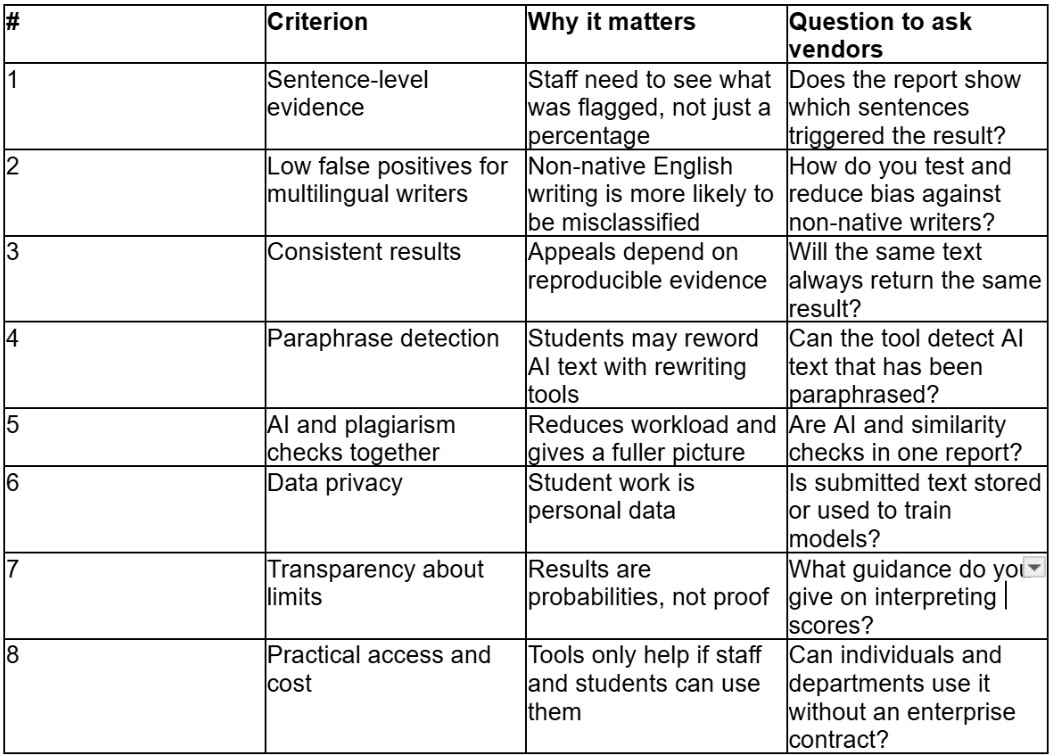
This guide proposes eight criteria that institutions can use to evaluate AI detectors before finally deciding on one, along with the questions to put to vendors.
Quick answer: what should universities look for in an AI detector?
Universities should go for an AI detector that shows sentence-level evidence, has a low false-positive rate for multilingual writers, gives consistent results and, is able to identify paraphrased AI text. Also it should be the one that combines AI and plagiarism checks, keeps student data safe, is transparent about its limits, and offers a licensing model that suits how staff and students work in reality. No detector should be the only basis for an academic misconduct decision.
The 8 criteria at a glance
What is an AI detector?
An AI detector is a tool that analyses a portion of text and makes an assessment of how likely it is to have been generated by a large language model such as ChatGPT, Gemini or Claude. Detectors search for the statistical patterns in word choice and sentence structure. Their output is a probability estimate, not final proof of authorship. This is the reason, the following criteria focuses equally on the evidence of fairness and detection itself.
1. Sentence-level evidence, not a single score
An AI detector should show exactly which sentences it flagged, not only an overall percentage.
A single score informs an academic of almost very little. Did just a paragraph get flagged, or the whole essay? Was it the student's own original summary of a source, or maybe, a section was generated? Sentence-level results enable the assessor to have a specific, evidence-based conversation with a student, and not just baseless accusations.
For example, Proofademic, an AI text detector built for academic writing, highlights individual sentences with their own confidence scores, so reviewers can see clearly which passages drove the result and which did not.
2. Low false positives, especially for multilingual writers
The most important fairness test for any detector is how often it wrongly flags human writing, particularly from non-native English speakers.
Research has brought out serious concerns here. A 2023 study by Stanford University researchers, published in Patterns, found that several frequently used detectors misclassified writing by non-native English speakers as AI-generated, while rightfully identifying writing by the native speakers. For institutions with large international cohorts, a detector that has not been calibrated for this risk can create unequal outcomes.
Institutions should ask vendors directly how they test for this bias and what false-positive rates they observe across different groups of writers. Proofademic, for instance, is designed after testing, to reduce false positives on writing by non-native English speakers.
3. Consistent, reproducible results
If the same text returns different results on different days, the evidence will not stand firm in an appeal.
Academic integrity processes depend upon evidence that can be revisited. A student who disputes a finding should be able to get the same document checked again and get the same outcome too. Some detectors are known to produce noticeably different scores on repeat scans, which definitely affects the confidence in any decision based on them. Ask vendors whether their results are consistent and reliable, and test it through the pilot scans on the same documents multiple times.
4. Detection of paraphrased AI text
A credible detector needs to identify the AI-generated text that has been reworded, not only text pasted straight from a chatbot.
Rewriting and paraphrasing tools are available all around, and some are marketed specifically to make AI text even more difficult to detect. A detector that only finds unedited, untreated output will miss a significant share of cases. Institutions should test candidate tools with paraphrased samples during evaluation. Proofademic contains a feature called Paraphrase Shield, designed to flag the reworded AI text prior to submission.
5. AI and plagiarism checks in one workflow
Combining AI detection and similarity checking in a single report saves staff time and gives a more complete picture of a submission.
Academic misconduct hardly falls neatly into any single category. A submission may be having the copied source material, AI-generated paragraphs, or may be, both of these. Scale is a matter of concern too: academic publishers like MDPI have now started to screen thousands of manuscript submissions a day for AI-related integrity issues. For universities, useful features include batch scanning for whole class sets, support for common formats such as Word and PDF, and documents such as dissertations with large word counts as well.
6. Data privacy and student consent
Institutions should confirm that student submissions are not stored in memory for indefinite times and used to train AI models either.
Student work is their individual data and, in the UK and EU, falls under GDPR. Before using any detector, institutions should clearly lay down norms for, where data is processed, how long it remains stored, whether it is shared with any third parties and whether it is used to improve the vendor's models. These answers should be put on record and clearly incorporated in student-facing privacy information.
7. Transparency about limitations
A trustworthy vendor is clear that detection results are probabilities, not final evidence of integrity breach.
Sector bodies have been clear on this aspect. Jisc's National Centre for AI advises that no AI detection software can give a final confirmation that the text was written by AI, and that all similar tools will produce false positives. The debate has been going on since, with education professionals calling for an end to AI detectors in assessment and some institutions, such as Curtin University, choosing to switch off AI detection altogether.
Sensible vendors reinforce these limits in their own guidance, explain how scores should be understood and avoid marketing claims of complete accuracy. Institutions should treat any claim of 100% accuracy as a warning signal and include detection into a wider process that includes conversation, drafts and assessment design.
8. Practical access and cost
A detector only helps if the people who need it can actually use it.
Some well-known and well-performing platforms can be accessed only through institution-wide licences, which can affect individual lecturers, departments or students with no access. Tools that offer individual as well as departmental plans, give free trials and transparent pricing make it easier to pilot testing before committing. Enabling students to examine their own written drafts can also shift the focus from catching misconduct to supporting good practice.
How to evaluate an AI detector effectively: a five-step process
Define the purpose. Decide whether the tool is meant for staff review, student self-checks or for both purposes.
Build a test set. Include human-written work from native and non-native writers, unedited AI text and paraphrased AI text.
Conduct a pilot. Scan the test set, do repeated scans to check consistency and record false positives.
Review data protection. Confirm storage, retention and tool training policies with the vendor.
Set policy before rollout. Ensure and make clear that detection results start a conversation and are not the only basis for a misconduct finding. Institutions are taking very different positions, from Berkeley Law's 2026 policy banning AI in exams and credited coursework to approaches that allow AI with disclosure, so detection policy should match the institution's overall positioning on AI usage.
Frequently asked questions
What is the most important feature in an AI detector for universities?
Sentence-level evidence combined with a low false-positive rate. Staff need to see exactly what was flagged, and the tool must not disproportionately highlight non-native English writers.
Are AI detectors accurate enough to prove misconduct?
On their own, no. AI detectors give an estimate of how likely a text is to be AI-written, not a precise answer with evidence. Their results work best as one piece of evidence, alongside a conversation with the student, their drafts and the institutions’ academic integrity process too.
Do AI detectors discriminate against international students?
Research from Stanford University found that several widely used detectors misclassified non-native English writing as AI-generated far more in comparison to native writing. Institutions should ask vendors how they test and reduce this bias.
Can AI detectors catch paraphrased or humanised AI text?
Some can. Detection of reworded AI text is often not the same, between tools, so institutions should better test it directly during a pilot.
Should students be allowed to use AI detectors on their own work?
Many institutions have found enabling students access to self-check tools as a good practice and good for transparency too, particularly when AI use policies are not the same between modules.
Key takeaways
Select detectors that show sentence-level evidence, not overall score only.
Test for false positives on multilingual writing before finalising on a tool.
Look for consistent results so findings can withstand appeals.
Check that tools can detect paraphrased AI text.
Confirm that tool ensures data privacy and submissions are not used for training.
Treat detection as the start of a conversation, but not the only basis for a misconduct decision.