The integration will allow educators and students to create study guides, lesson plans and other resources using licensed course materials, with a limited beta scheduled for early 2027
McGraw Hill has announced a Microsoft 365 Copilot plugin that will allow eligible educators and students to create AI-powered study guides, lesson plans and other resources using licensed educational content. A limited beta is planned for early 2027.
McGraw Hill has announced plans to integrate its K–12, higher education and professional learning content into Microsoft 365 Copilot, allowing educators and students to use AI to create learning resources based on the publisher's existing course materials.
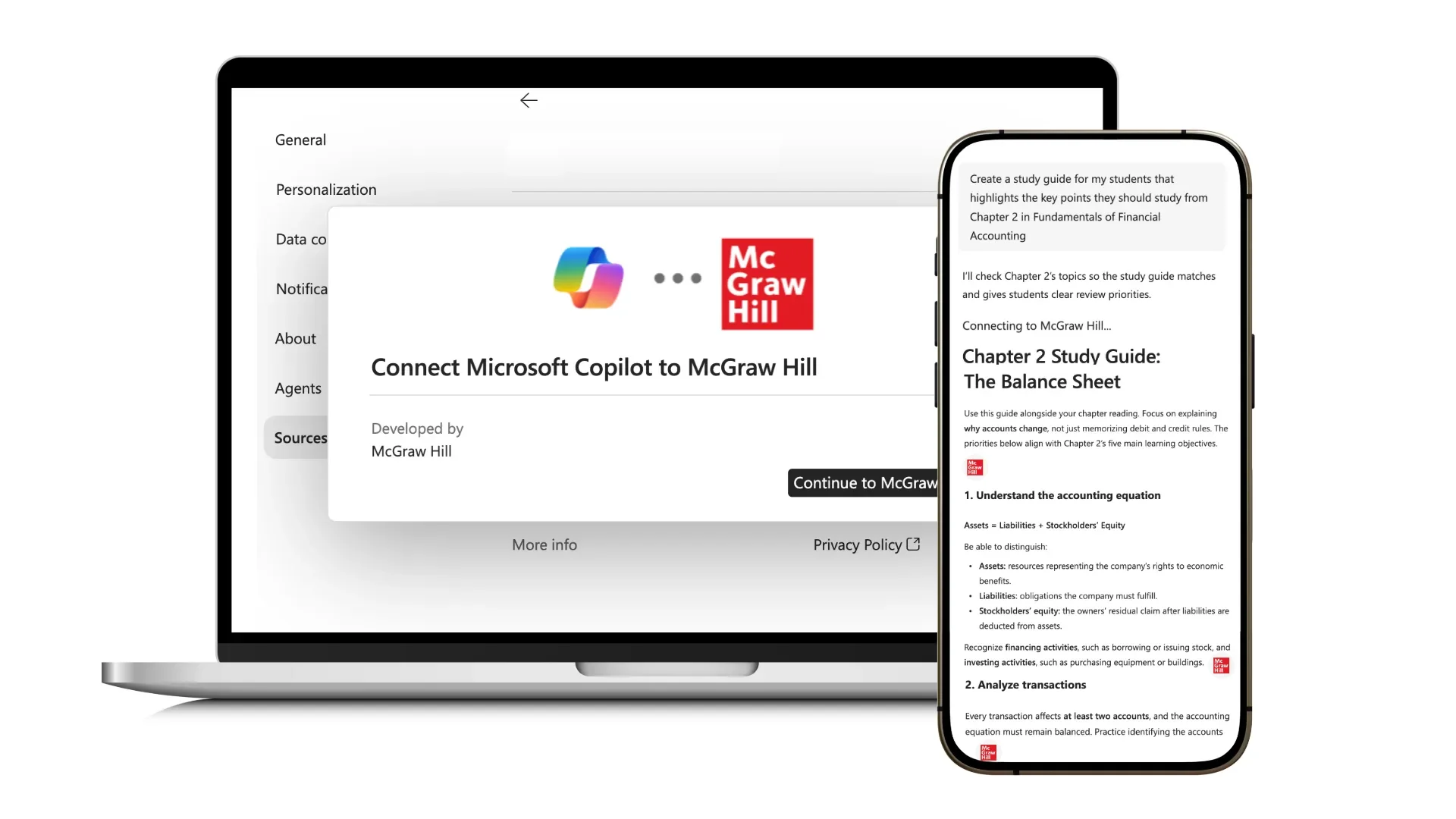
The collaboration will introduce a Microsoft 365 Copilot plugin that connects users to McGraw Hill's proprietary educational content through Model Context Protocol (MCP), a standard for connecting AI systems with external information and services.
The integration will initially be available through a limited beta in early 2027. Access will be restricted to eligible McGraw Hill higher education and school district customers with Microsoft 365 Copilot licenses.
Rather than generating resources solely from a general-purpose AI model, the plugin will allow users to work with licensed curriculum content, including summarizing and translating materials or adapting them into lesson plans, study aids and other course-specific resources.
Microsoft Copilot to access licensed McGraw Hill course materials
The integration will connect Copilot with McGraw Hill's existing library of educational content, allowing teachers and students to use familiar AI tools alongside the materials already provided through their institutions.
For example, an educator could use Copilot to create a study guide based on a particular chapter of a licensed textbook, drawing on the course material rather than relying exclusively on information generated by the AI model.
The plugin will use MCP to connect Microsoft's AI environment with McGraw Hill's content systems. The publisher says this approach will support access to its educational materials while retaining control over how its intellectual property is used.
Dave Cortese, Chief Digital Information Officer at McGraw Hill, explains: “Our collaboration with Microsoft demonstrates how we can expand into new channels while maintaining control over how our content is used and valued.”
McGraw Hill describes the integration as part of its agentic AI strategy, which includes plans to enable customers to build specialized AI agents for educational applications.
Microsoft partnership adds another route for McGraw Hill's AI tools
The collaboration builds on McGraw Hill's existing portfolio of AI-powered education products, including AI Reader, Sharpen, Learning Studio, Writing Assistant and Teacher Assistant.
These products provide AI capabilities within McGraw Hill's own digital learning environment, while the Copilot integration will make its content accessible through Microsoft's platform.
Deirdre Quarnstrom, Vice President, Microsoft Education Experiences, says: “Bringing those strengths to Microsoft Copilot can help educators create more relevant learning experiences while giving institutions a secure, governed way to adopt AI responsibly.”
The partnership also extends to McGraw Hill's internal operations. The publisher has recently selected Microsoft Copilot as its enterprise AI productivity solution, with plans to use the technology to develop employee AI fluency and support workplace learning.
For education customers, access to the new plugin will depend on existing licensing arrangements. McGraw Hill has not announced general availability, additional pricing or the full range of content that will be supported during the initial release.
The limited beta is scheduled to begin in early 2027, with interested institutions able to register their interest through McGraw Hill's AI connector beta program.
ETIH Innovation Awards 2027 open for entries
The ETIH Innovation Awards 2027 are now open for entries, with 26 categories recognising companies, institutions, projects and individuals making a measurable impact across education technology. The global awards span AI in education, digital learning, higher education, skills and workforce, inclusion, education operations, evidence and impact, with entries managed through ETIH’s new online awards platform.
Entries are open worldwide, with the early-bird deadline on Friday 18 December 2026 and the final entry deadline on Friday 26 February 2027 at 23:59 UK time.
Explore the 2027 categories and judging criteria, read the How to Enter guide or start an entry through the ETIH Innovation Awards 2027 platform.