NVIDIA’s Nemotron 3.5 Lightning targets the routine work behind AI agents
The open 30B model activates 3B parameters at a time, while NeMo Switchyard sends each task to the model best equipped to handle it
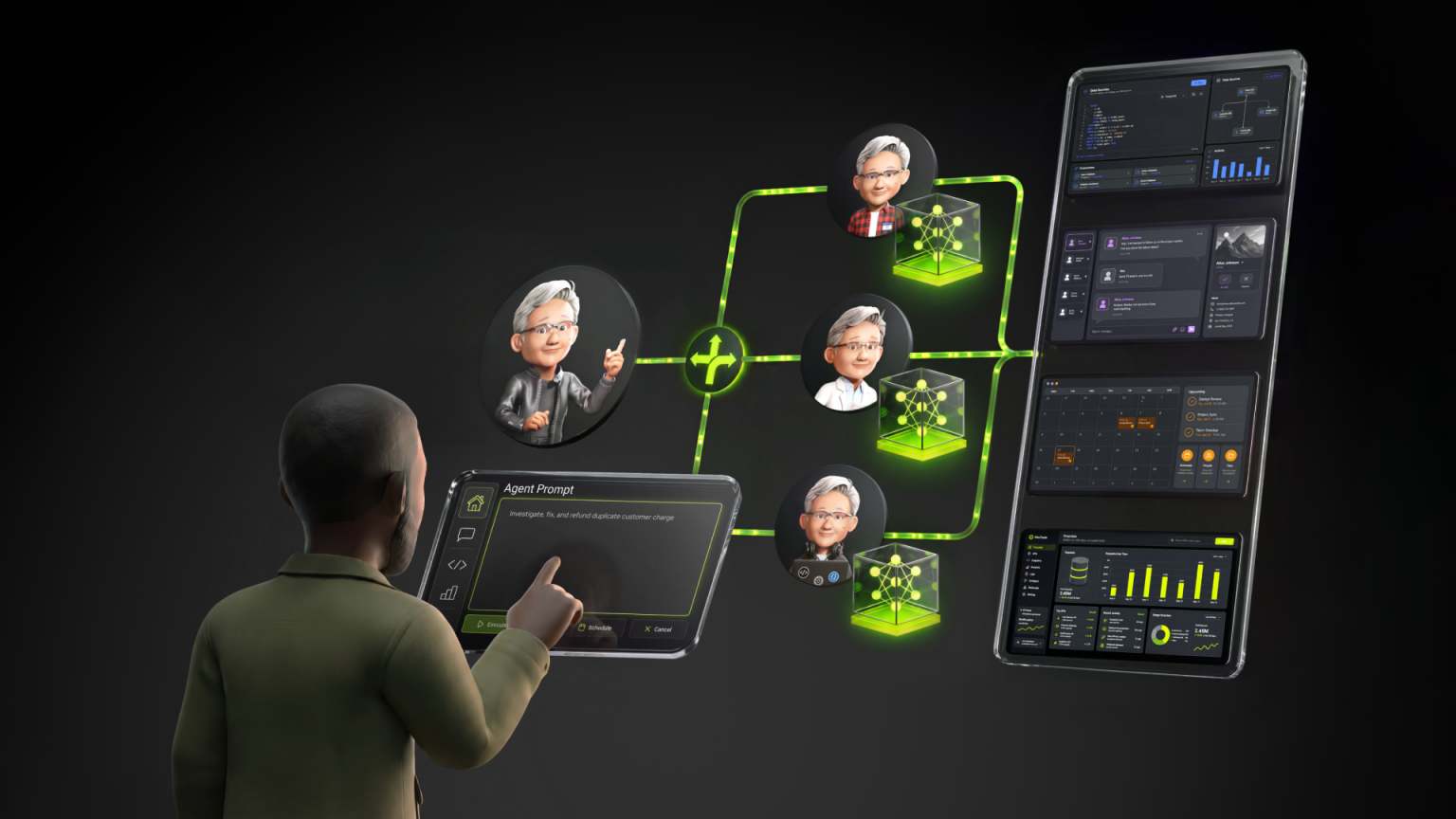
NVIDIA’s Nemotron 3.5 Lightning is intended to handle routine execution within AI agent systems, while NeMo Switchyard routes tasks between different models.
NVIDIA has released Nemotron 3.5 Lightning, an open AI model built to handle the repetitive, high-volume work behind long-running agents, from calling tools to checking results. A second release, NeMo Switchyard, decides when a task needs a larger reasoning model and when Lightning should take over.
The real pitch is economic as much as technical. AI agents spend only part of their time on complex reasoning. Once a plan has been made, they still have to call tools, check outputs and format results. Sending every routine step to a frontier model can make the system slower and more expensive to run.
NVIDIA is proposing a division of labor. Larger models handle planning and difficult reasoning, while Nemotron 3.5 Lightning takes on the repetitive execution work that follows. The model is not positioned as a replacement for frontier systems, but as a way to call on their computing power more selectively.
NVIDIA AI put that strategy plainly in a LinkedIn post: “Use frontier models for complex reasoning and planning, and Lightning for high-volume, specialized execution.”
Founder and CEO Jensen Huang also shared the release on LinkedIn, describing Lightning as a model for “continuous and long-run agents.”
What the 30B model actually does
Nemotron 3.5 Lightning is a 30B mixture-of-experts model, usually shortened to MoE, with 3B active parameters.
Parameters are the learned numerical values a model uses when producing an answer. Lightning contains 30 billion of them, but it does not use all 30 billion for every piece of text it processes. An internal router selects a smaller group of specialist components, meaning around 3 billion parameters are active at a time.
NVIDIA says this approach gives the model some of the capacity of a larger system while keeping its computing requirements closer to those of a smaller model. Lightning is the smallest member of the Nemotron 3 family and has been trained for agent harnesses including OpenClaw and Hermes Agent.
Speed is central to the company’s case. NVIDIA reports that Lightning produces output up to four times faster than models of a similar size. On the Artificial Analysis Intelligence Index, which combines nine evaluations covering areas including agentic tasks, coding and scientific reasoning, NVIDIA places the model on the accuracy-speed frontier for small open models.
Generating text quickly is not the same as completing useful work, however. NVIDIA also tested Lightning on PinchBench, where it recorded 86% accuracy and completed 10,000 tasks 30% faster than Qwen3.6 35B at what the company describes as similar accuracy.
These are company-published benchmark results. The release does not include results from named organizations using the model in production over extended periods.
Switchyard divides work between models
NeMo Switchyard turns NVIDIA’s proposed division of labor into a routing system. The open source library can place Nemotron 3.5 Lightning alongside other open and closed models, then direct each request toward the model considered capable of completing it efficiently.
A complex planning request can be sent to a frontier model. Routine execution can be routed back to Lightning. This allows developers to build one agentic system around several models instead of expecting a single model to handle every stage of the work.
Lightning also uses speculative decoding, a technique that allows it to draft multiple tokens before checking them efficiently. NVIDIA is supplying the DSpark draft model for DGX Spark and low-concurrency data center workloads, as well as DFlash for other serving scenarios. NVFP4 and BF16 checkpoints are available.
The company says the model can run on hardware ranging from NVIDIA Jetson and GeForce RTX 5090 systems to DGX Spark and data centers. It is also supported through tools including LM Studio, llama.cpp, Ollama and Unsloth.
NVIDIA has released the model weights, training data and post-training recipes under the OpenMDW-1.1 license. Developers can test Nemotron 3.5 Lightning through build.nvidia.com and OpenRouter, while the weights are available from Hugging Face and ModelScope. Deployment guides cover vLLM, SGLang and TensorRT-LLM.