Oak National Academy and Raspberry Pi Foundation launch 54 digital literacy lessons
The free curriculum sequence runs from Year 1 to Year 9 and covers online safety, information reliability, AI, privacy, wellbeing, accessibility, and responsible technology use.
The new Oak National Academy and Raspberry Pi Foundation curriculum includes 54 lessons covering online safety, AI, privacy, wellbeing, and information reliability
Oak National Academy and the Raspberry Pi Foundation have published 54 digital literacy lessons for students in Years 1 to 9, creating a year-by-year sequence designed to sit alongside schools' existing computing curricula.
The resources are organized into nine units, with one unit for each year group and six one-hour lessons in every unit. They are available free to schools and can be adapted by teachers to suit their curriculum and students.
The sequence covers safe online communication, search and information reliability, personal data, security, digital wellbeing, artificial intelligence, accessibility, sustainability, and responsible participation in digital spaces.
Schools can use the units to extend current computing provision or replace an existing unit where greater emphasis on digital literacy is required.
The lessons are available now through separate primary and secondary collections. Oak National Academy says the resources are optional and intended to give teachers a structured starting point rather than prescribe how digital literacy must be taught.
Curriculum develops from online safety to AI and inclusion
The nine units are designed as a progression, with concepts revisited in greater depth as students move through school.
The curriculum is built around five themes: information and data; communication and digital participation; digital content creation; safety, security, and wellbeing; and digital problem-solving.
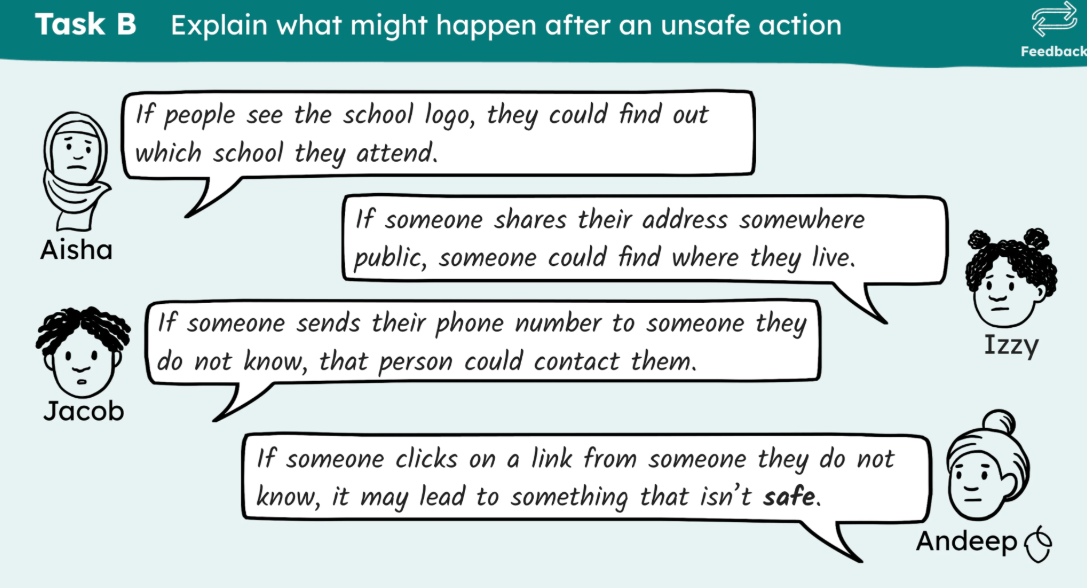
Earlier lessons introduce students to safe and unsafe online actions, personal information, communication, and the consequences of sharing data publicly. The attached Year 4 activity asks students to explain what could happen after actions such as displaying a school logo, sharing an address, sending a phone number to a stranger, or opening an unfamiliar link.
Later units move into questions about how digital information is selected and presented, how algorithms and commercial interests affect what people see, and how students can assess the credibility and bias of online and AI-generated material.
The Year 5 unit, Digital wellbeing: Stay connected, happy and well online, covers online relationships, media influence, personalized recommendations, screen habits, and the effect of digital experiences on thoughts and behavior.
Students examine the difference between purposeful activity, such as watching a tutorial to learn a skill, and passive use where content continues without a defined goal or limit.
By Year 9, the School blog: digital inclusion unit combines learning about data, AI, design, accessibility, and unequal access to devices, connectivity, and digital skills. Students use that knowledge to create an accessible blog.
Lessons address AI reliability and responsible use
The resources treat digital literacy as more than the ability to operate devices or software.
Students are asked to evaluate information, make decisions about when particular technologies are appropriate, and consider the strengths and limitations of digital and AI systems.
The lessons include work on AI safety, bias, responsible use, and the reliability of generated information. Students also consider how data, algorithms, and design choices can influence online experiences.
Oak National Academy Chief Executive Officer John Roberts wrote on LinkedIn: "We often assume that because pupils use technology confidently, they understand it. They don't always. Knowing how to scroll isn't the same as knowing how to search well, judge what's reliable, protect your data, or make sense of what AI puts in front of you."
He added: "Digital literacy is the ability to understand, question, and participate in the digital world, not just operate the devices in it. These are learnable skills, but they're rarely taught as a deliberate, sequenced progression."
Roberts also connected the resources to forthcoming policy changes: "The 2028 refreshed national curriculum will shift computing's focus towards digital literacy. These units are a practical exploration of what that could look like in the classroom."
Addressing proposed restrictions on children's social media use, Roberts added: "The government's planned ban on social media for under-16s is a reminder that regulation alone doesn't answer the curriculum question. Rules about what pupils can't do online don't teach them how to navigate it well. That's the job of a curriculum."
Teachers can adapt units to existing provision
Each unit includes lesson materials intended for direct classroom use, but teachers can alter the content for their own students and local context.
Schools may use the resources to deepen topics already taught through computing, introduce a separate digital literacy sequence, or replace units where existing provision does not cover online safety, critical evaluation, or responsible technology use in sufficient depth.
The lessons use real-world situations rather than focusing solely on technical procedures. Activities include evaluating online material, discussing digital identity and privacy, creating content for different audiences, and choosing suitable tools for particular tasks.
The resources also address communication, accessibility, and inclusion, including how technology can exclude people when platforms, content, or services are not designed for different needs.
Oak National Academy says the sequence is intended to help students apply knowledge across different digital environments rather than learn procedures tied to one platform or product.
All 54 lessons are now available through Oak National Academy's primary and secondary digital literacy collections. Schools can begin with individual units or use the full Year 1 to Year 9 sequence alongside their computing curriculum.