OpenAI begins limited GPT-5.6 preview with Sol, Terra, and Luna
The new model family introduces three capability and pricing tiers, with broader access through ChatGPT, Codex, and the API planned in the coming weeks.
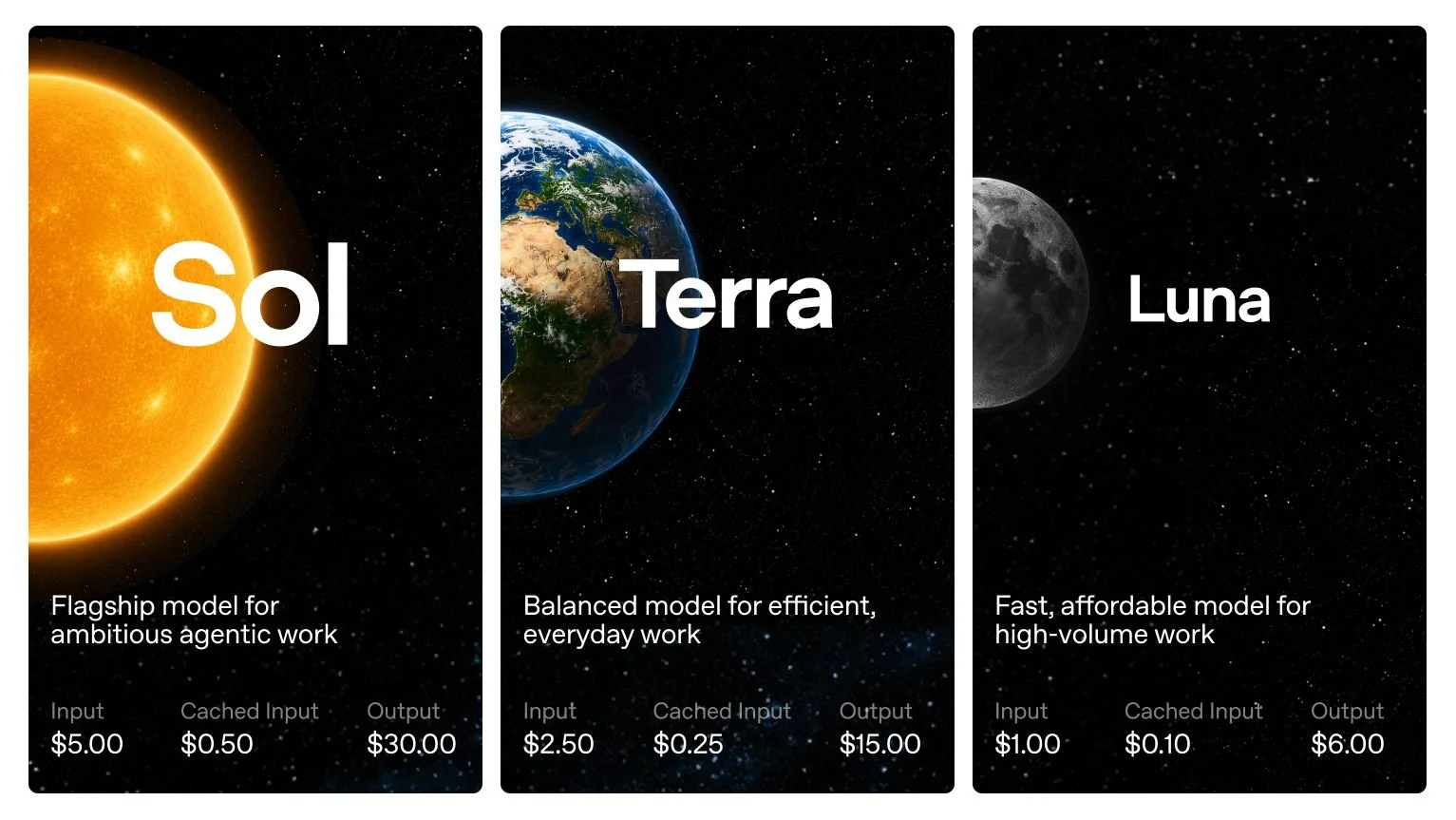
OpenAI’s GPT-5.6 family includes Sol, Terra, and Luna, with different capability, speed, and API pricing tiers
OpenAI has begun a limited preview of GPT-5.6, introducing three models aimed at different levels of performance, speed, and cost for developers, businesses, and users of its AI products.
GPT-5.6 Sol is the flagship model, while Terra is positioned for general workloads and Luna is designed for faster, higher-volume use. The models are initially available through the OpenAI application programming interface and Codex to a small group of trusted partners.
OpenAI plans to make all three models more broadly available through ChatGPT, Codex, and the API in the coming weeks. The company has not announced a precise public release date.
API pricing starts at $1 per million input tokens and $6 per million output tokens for Luna. Terra costs $2.50 for input and $15 for output, while Sol is priced at $5 for input and $30 for output.
OpenAI says it shared information about the models and their capabilities with the US government before the preview. Participation in the initial partner group has also been shared with the government as OpenAI works with the administration on a cyber Executive Order framework.
Three models target different workloads
OpenAI is introducing Sol, Terra, and Luna as long-term capability tiers within the GPT-5.6 generation.
Sol is intended for complex coding, research, biology, and cybersecurity tasks. It also adds a maximum reasoning setting and an Ultra mode that uses multiple subagents to work on more complex tasks.
Terra is designed as a lower-cost option for everyday work. OpenAI says its performance is competitive with GPT-5.5 while its API pricing is approximately half the cost.
Luna is the lowest-priced model in the family and is intended for workloads where speed and volume are more important than access to the highest capability tier.
On Terminal-Bench 2.1, which measures command-line coding workflows, OpenAI reports a score of 88.8 percent for GPT-5.6 Sol and 91.9 percent for Sol Ultra. The company says Sol also improves on GPT-5.5 in genomics and quantitative biology while using fewer output tokens.
OpenAI has not yet released its full set of GPT-5.6 evaluation results. An expanded evaluation package is expected when the models become more widely available.
Cybersecurity capabilities prompt phased access
OpenAI describes GPT-5.6 Sol as its most capable cybersecurity model to date, with stronger performance in vulnerability research and exploitation-related tasks.
The company says Sol did not cross the Cyber Critical threshold under its Preparedness Framework. During testing involving Chromium and Firefox, the model identified vulnerabilities and components that could contribute to an exploit but did not independently produce a functional end-to-end exploit under the conditions tested.
OpenAI has introduced additional safeguards because of the increase in cybersecurity capability. These include model-level refusals, real-time classifiers for cyber and biology requests, account-level monitoring, differentiated access, and further review of higher-risk outputs.
Some generations may be paused while a larger reasoning model reviews the conversation. OpenAI says users in the preview may experience blocked requests or slower responses when the safeguards intervene, including in legitimate dual-use security work.
The company dedicated more than 700,000 A100-equivalent graphics processing unit hours to automated red-teaming focused on universal jailbreaks. Third-party experts are also testing the models during the preview period.
Broader availability planned within weeks
OpenAI says the phased rollout is intended to provide more time to test the models and safeguards before general release.
The company has also introduced changes to prompt caching. Cache writes for GPT-5.6 and future models will cost 1.25 times the uncached input rate, while cache reads will continue to receive a 90 percent discount.
Greg Brockman, President and Co-Founder at OpenAI, says: "By designing more of the stack ourselves, we can serve more intelligence with greater efficiency and keep pushing advanced AI toward broader access."
GPT-5.6 Sol is also scheduled to launch on Cerebras in July, with speeds of up to 750 tokens per second. Access will initially be restricted to selected customers while capacity expands.