Google rolls out AI Professional Certificate and free training for US small businesses

Google has launched a new AI Professional Certificate, expanding its workforce training strategy as demand for applied AI skills accelerates.
In a LinkedIn post, Ruth Porat, President and Chief Investment Officer of Alphabet and Google, confirmed that the company will provide free access to the certificate for every small business in the US, working with the U.S. Chamber of Commerce and America’s Small Business Development Centers.
The launch follows new research from Ipsos and Google indicating that 70 percent of managers believe an AI-trained workforce is critical for success, yet only 14 percent of workers have been offered AI training. As AI tools become embedded in daily workflows, the gap between expectation and formal upskilling is becoming more visible.
Porat wrote on LinkedIn: “I am proud to announce that today we are launching the new Google AI Professional Certificate – a program designed to help close the AI fluency gap for workers and businesses. Notably, recognizing that small businesses are the backbone of the economy and throughout history have been the engines of new job growth, Google will offer every small business in the U.S. free access to this certificate training, working with the U.S. Chamber of Commerce and America’s Small Business Development Centers (SBDC). This is an extension of Google’s investments for more than a decade in skills development to equip people everywhere with AI skills so that they can thrive in the AI-powered economy.”
From foundations to applied AI skills
According to Lisa Gevelber, Founder of Grow with Google, the certificate builds on earlier AI training efforts, including Google AI Essentials, which the company says has become the most popular course on Coursera.
Gevelber writes: “Today, we are taking the next step to help professionals go from foundations to fluency with the launch of the Google AI Professional Certificate. We developed this program to address a critical need: new research from Ipsos and Google reveals that while 70% of managers believe an AI-trained workforce is critical for success, only 14% of workers have been offered AI training.”
Employers including Walmart, Sam’s Club, Deloitte, Verizon, and Colgate-Palmolive are set to use the certificate to train employees on AI.
Free access and Workspace support for small firms
Google says small businesses, which employ roughly half of Americans, will receive no-cost access to the AI Professional Certificate along with three months of Google Workspace Business Standard. The rollout is being supported by partners including ADP, PayPal, and Verizon, which will share the resources with businesses across their networks.
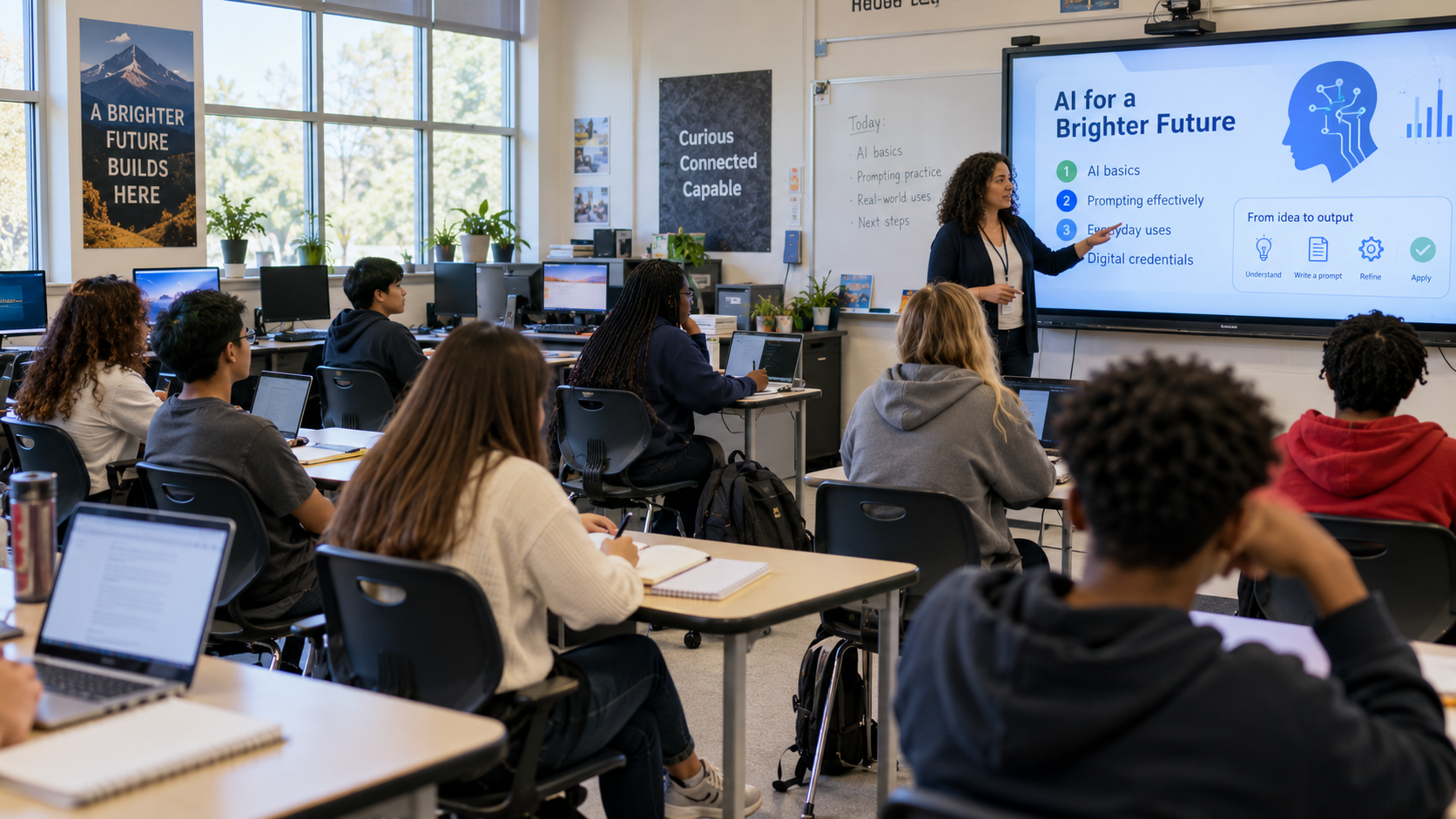
The program focuses on practical AI applications across communication, research, data analysis, content generation, planning, organization, and what Google refers to as “vibe coding.” Participants receive three months of no-cost access to Google AI Pro and complete more than 20 use cases, from producing professional-grade images and presentations to cleaning and visualizing data and building custom apps without writing code.
The new credential joins Google’s Career Certificates portfolio, which now includes AI training across all programs. Google reports that the broader certificate initiative has reached more than one million graduates globally, with over 70 percent reporting a positive career outcome within six months.
For EdTech providers and workforce leaders, the direction is clear. As major employers formalize AI training and small businesses gain subsidized access, applied AI fluency is shifting from an advantage to an expectation.
ETIH Innovation Awards 2026
The ETIH Innovation Awards 2026 are now open and recognize education technology organizations delivering measurable impact across K–12, higher education, and lifelong learning. The awards are open to entries from the UK, the Americas, and internationally, with submissions assessed on evidence of outcomes and real-world application.