Anthropic convenes Higher Education Advisory Board as AI governance debates intensify
Senior university leaders gathered in San Francisco to examine how AI will shape teaching, learning, and institutional strategy.
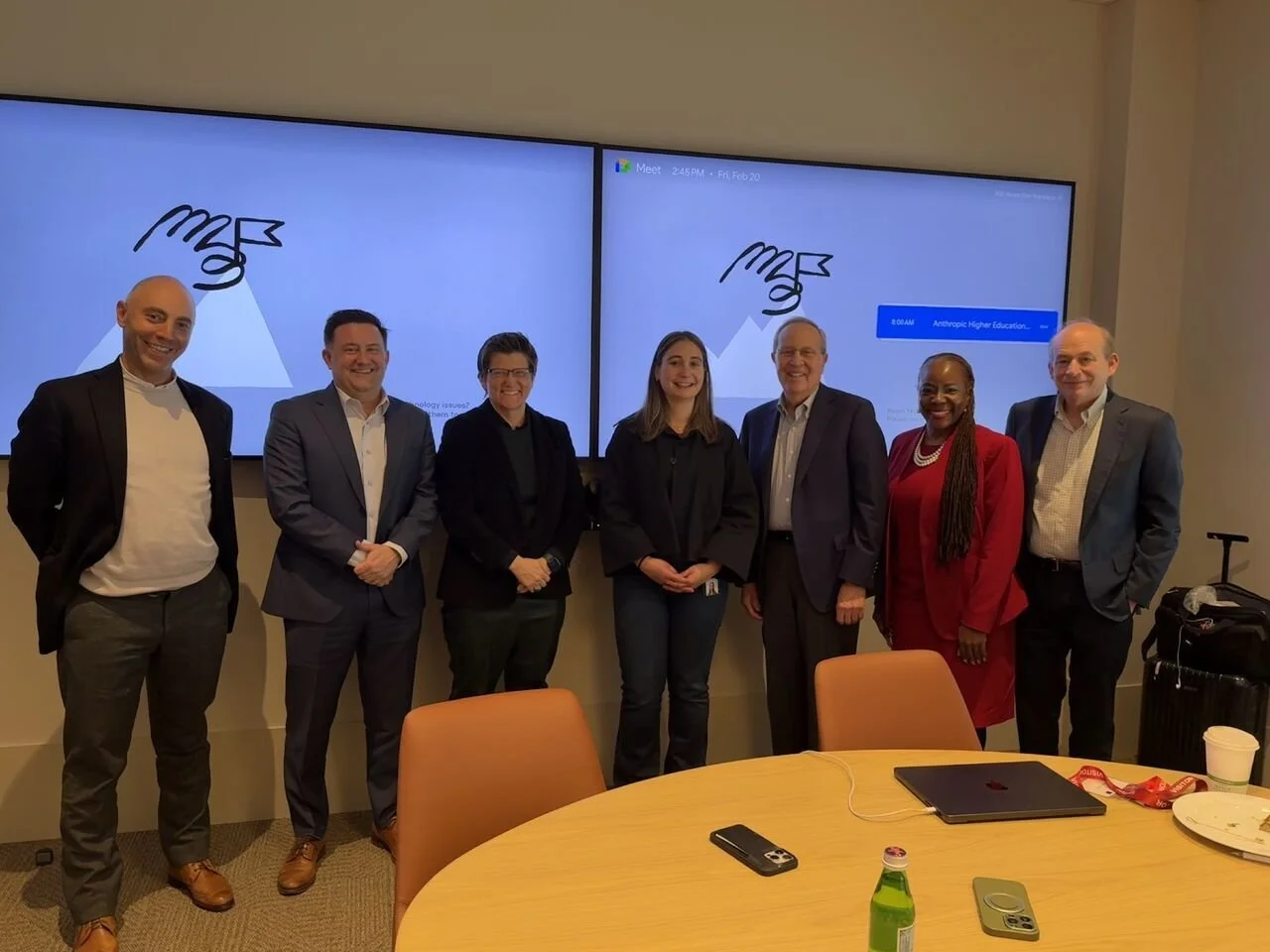
Anthropic hosted its Higher Education Advisory Board at its San Francisco headquarters last week, bringing together senior university leaders and EdTech strategists to examine how artificial intelligence is reshaping higher education.
The meeting, referenced publicly by multiple board members on LinkedIn, signals a deeper engagement by AI model developers with academic governance, policy, and long-term learning outcomes.
The discussions come at a time when universities are moving from reactive AI policy drafting to more structured governance and instructional strategy. As institutions decide how generative AI tools will be integrated into classrooms, assessment, and research, advisory boards like this one are increasingly positioned as influence points between AI companies and higher education leadership.
James DeVaney, Associate Vice Provost for Academic Innovation at the University of Michigan and Founding Executive Director of the Center for Academic Innovation, reflected on the two-day meeting in a LinkedIn post. He wrote: “Just wrapped up two incredible days at Anthropic's headquarters in San Francisco for our Anthropic Higher Education Advisory Board meeting.”
DeVaney framed the timing as consequential, stating: “We are at a pivotal moment in higher education. The decisions universities and policy leaders make right now about AI will shape how an entire generation learns, discovers, and prepares for the world ahead. That's not a small thing.”
Balancing optimism with risk
In his post, DeVaney emphasized that the board’s discussions were not one-sided. He wrote: “Our discussions were balanced. There are many reasons to be excited and optimistic and an equal number of risks to think through carefully.”
He added that the advisory structure allowed for critique and open debate: “I learned as much as I contributed, and I left with more questions than answers. That's exactly how it should be in a board setting where the organization is open and the advisors are given space to critique and generate new ideas.”
DeVaney also referenced Anthropic Co-Founder Daniela Amodei’s leadership in the conversation, writing that he “walked away inspired by Daniela Amodei's vision to empower curiosity” and motivated by “my board colleagues' commitment to ensuring AI serves students, educators, and institutions in ways that are meaningful, equitable, and human-centered.”
Julie Schell, Assistant Vice Provost of Academic Technology and Director of the Office of Academic Technology at The University of Texas at Austin, also posted about the meeting, focusing on governance and learning outcomes. She wrote: “How do we lead for better learning…for all students, everywhere, across subjects? What if…?”
Schell described the discussions as “genuine and considered debate” and made clear that the board’s focus extended beyond incremental change. “…Not incremental learning or learning that misses the opportunity to break through low self-efficacy — that voice that tells a student, ‘Math or History isn't for me.’ Learning that unlocks social benefits, strengthens students as leaders, and accelerates human flourishing over generations,” she wrote.
AI governance moves from theory to institutional practice
Schell’s post underscored the urgency of AI integration decisions within universities. She wrote: “AI is reshaping how and what we learn right now. How do we, institutions, non-profits, and organizations alike, steward that transformation in ways our students and educators deserve, so that AI does not just happen to them?”
She continued: “How do we ensure cognition ignites with AI versus declines?”
Her framing highlights a shift in institutional conversations. Early generative AI debates centered on academic integrity and plagiarism. The current phase, as reflected in these advisory discussions, appears to focus more directly on learning design, cognitive development, and long-term student outcomes.
Schell also referenced Anthropic’s internal approach, writing: “I am so inspired by the team at Anthropic for crafting spaces to interrogate those tensions with seriousness. And for the discipline to ask some of the hardest questions about learning to educators who are doing this work every day.”
She concluded her reflection by stating: “Deeply grateful to have spent two days at this table alongside my colleagues and friends envisioning better learning as a north star and doubling down on the fact that AI must serve said learning with balance and responsibility. I am on board for what is next.”
The advisory board includes senior figures such as Rick Levin, David Leebron, Matthew Rascoff, and Yolanda Watson Spiva, alongside DeVaney and Schell. Their presence signals that AI governance conversations are moving into the highest levels of university leadership and strategy. As AI companies formalize advisory structures with university leaders, influence over policy, product development, and learning integration increasingly flows in both directions.
Anthropic’s engagement suggests AI developers are seeking structured dialogue with institutions at a time when higher education leaders are weighing not only classroom use cases but broader questions of institutional mission, equity, and public trust. With universities under pressure to modernize while protecting academic integrity and student development, advisory boards such as this one may shape how AI tools are evaluated, adopted, and governed across the sector.
ETIH Innovation Awards 2026
The ETIH Innovation Awards 2026 are now open and recognize education technology organizations delivering measurable impact across K–12, higher education, and lifelong learning. The awards are open to entries from the UK, the Americas, and internationally, with submissions assessed on evidence of outcomes and real-world application.