Udemy PowerUp: Altus and new product roadmap put workforce readiness in focus
At the Udemy PowerUp conference, Jacob Coulter detailed how Udemy is building Altus, AI connectors, role plays, labs, assessments, and analytics to help organizations identify skills gaps, personalize learning, and measure workforce readiness.
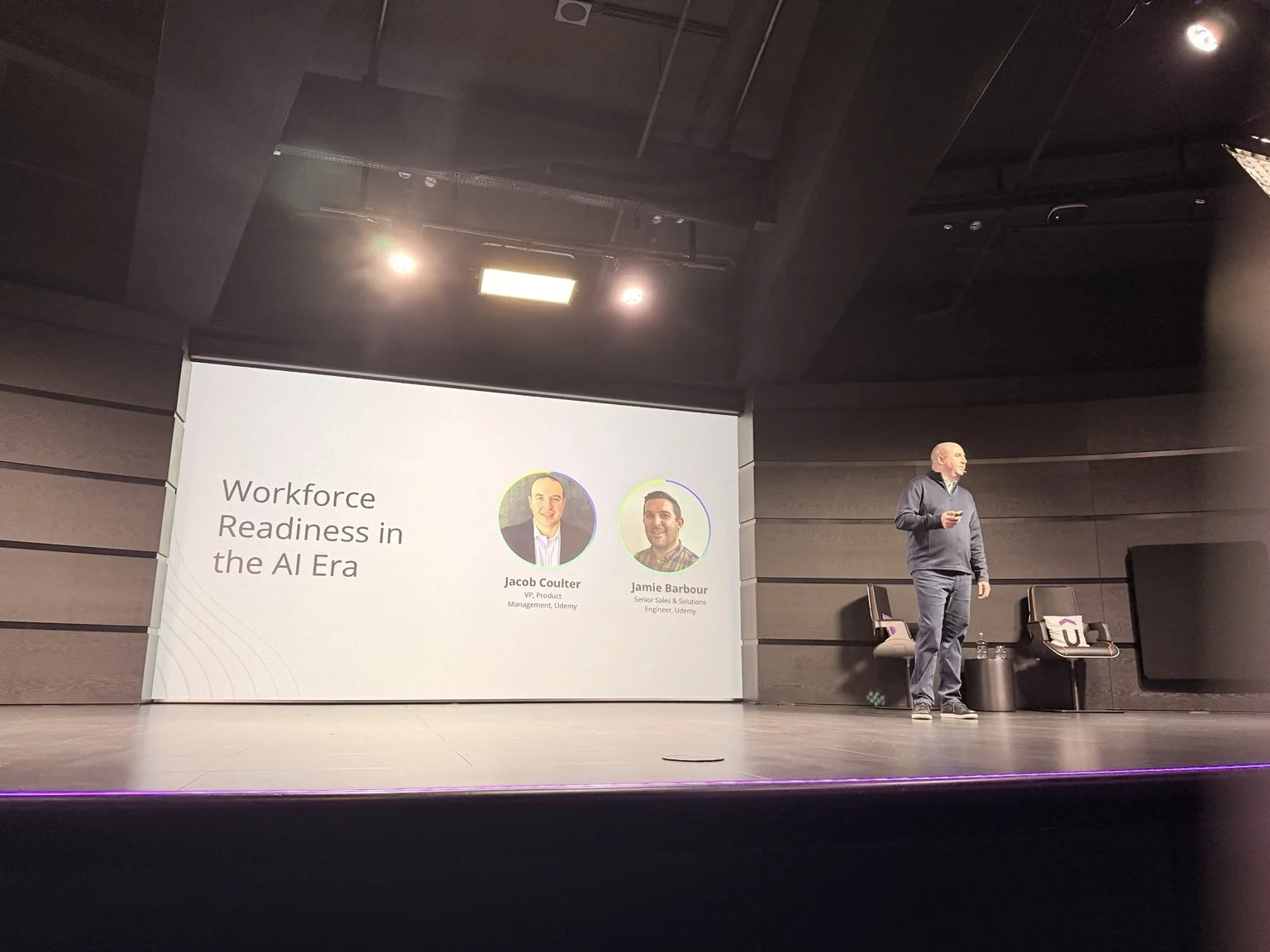
Udemy used its PowerUp conference at McLaren Racing headquarters to outline how it is evolving its platform beyond course delivery, positioning Altus as a system that connects business challenges directly to workforce reskilling.
Jacob Coulter, VP of Product Management at Udemy, said the company is focusing on how organizations translate strategy into skills, and then into measurable outcomes: “We are living in the era of AI. And what that means is that it is more important than ever for teams to be able to learn, adapt, and continue to deliver on the initiatives that matter most.”
Coulter added: “Our North Star… is to be the AI-powered reskilling and upskilling platform of the future.” He said this direction has been shaped by enterprise customers, who are looking for clearer ways to link learning investment to business performance
“We hear a common set of challenges… how we can translate business strategy into priority skills… how we can personalise learning programmes… and how we can get measurable ROI,” he coninued.
He added: “These aren’t necessarily just training questions… these are intelligence questions.”
Five-part platform model underpins new product direction
Udemy structured its roadmap around five areas: skills discovery, acquisition, mastery, validation, and amplification. Coulter positioned these not as separate features, but as connected layers within a single reskilling system powered by Altis.
Skills discovery focuses on AI-driven entry points
Coulter said the way employees access learning is changing, with AI increasingly acting as the first point of interaction: “The front door, the system of engagement with reskilling, continues to change, and this is oftentimes driven by AI.”
Udemy is investing in discovery that sits both inside its platform and across external tools. This includes integrations that allow employees to surface learning within workplace systems rather than navigating to a separate learning environment.
Coulter said the aim is to embed discovery “natively within the product, within your AI tools of choice, and also within your broader ecosystem of apps.”
Skills acquisition targets depth and relevance of learning
Coulter said skills acquisition is about ensuring employees receive the right level of training based on their role and context, rather than applying a uniform approach across teams: “Skills acquisition is about right size solutions for your workforce… getting to the right level of depth of reskilling experiences, but also the product needs that match the needs of your teams.”
This includes a mix of formats, from structured courses to shorter learning interventions, alongside more targeted programmes linked to specific business functions.
Skills mastery centers on practice and application
Udemy positioned skills mastery as a shift away from passive consumption toward active learning.
Coulter said: “Real skill mastery occurs when learners have opportunity to obtain new knowledge, practice, receive personalised feedback, reflect and then iterate.”
To support this, the company is expanding its labs offering, which provides structured technical assignments and simulated environments, alongside AI role play tools that allow learners to practice real-world scenarios.
These include role-based simulations that can be built using company-specific materials, enabling teams to rehearse tasks such as customer conversations or technical decision-making.
Skills validation focuses on credible evidence of capability
Coulter said organizations are placing more emphasis on proving that learning has translated into real skills.
He said: “If we’re only looking at things like engagement data or watch time, it does not tell us what we need to know.”
Udemy is developing validation tools that include assessments, credentials, and performance-based evaluation through labs and simulations.
Coulter said the goal is to provide “reliable and credible signals that learning and skill development has actually occurred.”
Skills amplification leverages instructor and creator network
The final area, skills amplification, reflects Udemy’s existing marketplace model and its network of instructors and subject matter experts.
Coulter said: “What continues to be differentiated about Udemy is that we work with a global network of instructors, creators, subject matter experts.”
He added that Udemy is working with this network to develop new reskilling experiences, particularly in areas such as AI and emerging technologies.
Altus positioned as translation layer between strategy and skills
Altus was introduced as the core system linking these areas together. Coulter described it as a platform designed to connect enterprise data, identify capability gaps, and translate business priorities into structured learning programmes.
He positioned it as a layer that sits between strategy and execution, helping organizations move from high-level goals to actionable workforce development: “At its core level, Altus has a variety of capabilities… it can help be a translation layer for you. As you’re looking to translate business strategy, or problems that you’re looking to solve, or an outcome that you’re looking to deliver, Altus can help you to translate that into formal reskilling and upskilling programmes.”
He added that the system draws on multiple data sources to build a more complete picture of workforce capability: “Altus is informed by organisational goals, personal goals, and it has access to other enterprise connectors that you allow it to get data from… and it can help to maintain personalisation on your behalf.”
Coulter also emphasized that the platform is designed to reduce friction in how employees access learning: “We don’t want learners to have to context switch. We want learners to have access to reskilling in the tools where their day-to-day jobs are occurring.”
He added that it connects with enterprise systems such as HR platforms, cloud providers, and productivity tools, depending on what organizations choose to integrate: “We don’t want learners to have to context switch… we want learners to have access to reskilling in the tools where their day-to-day jobs are occurring.”
Demo highlights end-to-end reskilling workflow
The session included a detailed demo following two personas: Marcus, an engineering leader, and Lisa, a DevOps engineer.
Marcus is presented with a business problem, rising AWS costs and operational inefficiencies. He inputs this into Altus, which connects to enterprise data sources and begins analyzing potential causes.
Coulter said: “What Altus will do is it’ll start to hear the problems, and it’s connecting with other enterprise apps that you’ve given it access to.”
The system produces a capability gap analysis, identifying missing skills such as FinOps knowledge, cost optimization, and resource management. It also shows the evidence behind these recommendations, including team data and prior learning signals.
Once Marcus approves the analysis, Altus generates a personalized learning programme across the team.
Coulter continued: “Altus now is taking all this data… and it’s recommending a learning programme over the next 12 weeks, completely personalised for this team and use case.”
The platform can also build a learning schedule using calendar integrations and assign training at scale.
Practice, simulation, and feedback central to skills mastery
Udemy placed a strong emphasis on hands-on learning as part of skills mastery.
Coulter said: “Real skill mastery occurs when learners have opportunity to obtain new knowledge, practice, receive personalised feedback, reflect and then iterate.”
The company is expanding its labs offering, which includes structured technical assignments and simulated environments, as well as tools for organizations to create their own labs.
AI role play was also highlighted, allowing companies to build simulations using their own materials, such as sales calls or internal documentation.
Coulter said: “You can upload files… and use it to create custom role-play simulations.”
These activities feed data back into learner skill profiles, allowing organizations to track progress beyond course completion.
Learner experience centers on goals, skills, and AI support
The demo also showed the learner experience through Lisa’s perspective.
After being assigned a programme, Lisa receives a notification and can view her goals, required skills, and current proficiency levels.
The platform is structured around business and personal goals rather than just course lists. Learners can also set their own development targets alongside organizational priorities.
Altus acts as a tutor within this experience. In the demo, Lisa asks for short-form learning to prepare for a meeting, and the system recommends a relevant microlearning activity.
Coulter said Udemy is expanding microlearning formats, including quizzes and short interactive exercises, to support faster, more flexible learning.
Validation and analytics shift focus to measurable outcomes
Coulter said organizations are placing increasing pressure on learning platforms to demonstrate that training leads to real capability, rather than relying on proxy metrics: “If we’re only looking at things like engagement data or watch time, it does not tell us what we need to know, because it does not indicate if actual skill gains or learning has happened.”
He added that this lack of clarity creates challenges when trying to justify investment in reskilling programmes. He said: “If you can’t prove that capabilities are being gained through investments, it brings into question ROI.”
To address this, Udemy is expanding its approach to validation beyond traditional assessments. Coulter outlined a shift toward performance-based evaluation, where learners are assessed while completing real or simulated tasks.
This includes the use of labs and AI role play simulations as assessment environments, allowing organizations to evaluate how learners apply knowledge in context, rather than testing recall alone.
Coulter said these signals are then fed back into learner profiles and aggregated at team and organizational level, providing a clearer view of capability across the workforce.
Alongside this, Udemy is developing a skills ROI hub, which will allow organizations to track skill development over time and link it to business outcomes and strategic goals.
Coulter said the aim is to connect learning activity with measurable impact, adding that the platform will enable organizations to “track skill data against the business outcomes” they are trying to achieve.
Platform signals move toward workforce intelligence
The session concluded with a focus on targeted AI programmes for different business functions, including sales, marketing, and operations.
Across the presentation, Udemy positioned its platform as a system that links business goals, workforce data, and learning delivery into a single workflow.
The Altis demo showed how organizations could move from identifying a problem to deploying a reskilling programme, tracking progress, and adjusting delivery, within a single system.
For EdTech, the direction is clear. Platforms are moving beyond content access toward systems that aim to measure and manage workforce readiness at scale.
ETIH Innovation Awards 2026
The ETIH Innovation Awards 2026 are now open and recognize education technology organizations delivering measurable impact across K–12, higher education, and lifelong learning. The awards are open to entries from the UK, the Americas, and internationally, with submissions assessed on evidence of outcomes and real-world application.