Google earnings show AI driving growth across Search, Cloud and Gemini
AI usage, enterprise demand, and paid subscriptions shaped Alphabet’s first quarter, with Google pointing to Search, Cloud, and Gemini as core drivers of its 2026 performance.
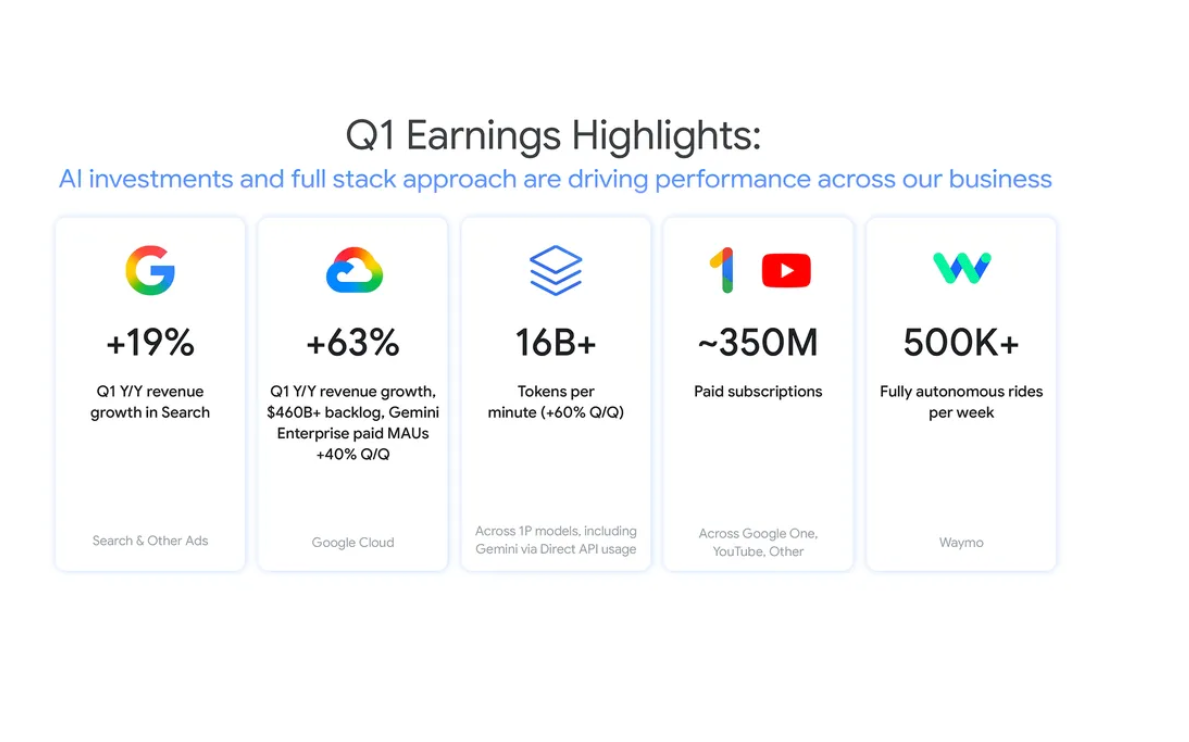
Google’s Q1 earnings highlights show revenue growth across Search and Google Cloud, alongside higher Gemini usage, paid subscriptions, and Waymo rides
Google and Alphabet CEO Sundar Pichai has used the company’s Q1 2026 earnings update to position AI as a growth engine across Search, Google Cloud, Gemini, subscriptions, and Waymo, giving the education and skills sector another signal that AI infrastructure, tools, and agentic workflows are becoming part of the operating layer for major technology platforms.
Pichai shared the earnings update on LinkedIn, writing that “2026 is off to a terrific start thanks to our partners + employees around the world.”
He added that Google’s AI investments and full-stack approach were “lighting up every part of the business,” citing record Search queries, 63 percent Google Cloud revenue growth, momentum for Gemini models, and the company’s strongest quarter for consumer AI subscriptions.
AI pushes across Google products
In an edited transcript of his earnings call remarks, Pichai says: “It’s clear that our AI investments and full-stack approach are driving performance across our business.”
Google reported that Search and Other Advertising revenue grew 19 percent, with Pichai saying users are engaging with AI Mode and AI Overviews and “coming back to Search more.”
The company also pointed to efficiency gains. According to Pichai, Google has reduced Search latency by more than 35 percent over the past five years, even as it has added AI features to results pages.
Google said AI Overviews and AI Mode have been upgraded to Gemini 3, helping reduce the cost of core AI responses by more than 30 percent through hardware and engineering changes. The company is expected to share more on Search at Google I/O on May 19.
Gemini is also becoming more deeply embedded across Google products. Pichai said Personal Intelligence is now in the Gemini app, AI Mode, and Gemini in Chrome, while Maps has received what he described as its most significant upgrade in more than a decade through Gemini-powered conversational features.
Cloud growth reflects enterprise AI demand
Google Cloud revenue grew 63 percent and exceeded $20 billion for the first time, while backlog nearly doubled quarter-on-quarter to more than $460 billion.
Pichai says: “Google Cloud is differentiated because we are the only provider to offer first-party solutions across the entire enterprise AI stack.”
Enterprise AI products are now Google Cloud’s primary growth driver, according to the company. Revenue from products built on Google’s generative AI models grew nearly 800 percent year-over-year in Q1.
Google also reported that new customer acquisition doubled compared with the same period last year. The number of $100 million to $1 billion deals doubled year-on-year, and the company signed multiple billion-dollar-plus deals.
At Cloud Next, Google introduced a Gemini Enterprise Agent Platform designed to let users build, govern, orchestrate, and optimize agents. Pichai said Gemini Enterprise paid monthly active users grew 40 percent quarter-over-quarter in Q1, with customers including Bosch, Citi Wealth, Merck, and Mars, Inc.
The company also reported that, over the past 12 months, 330 Google Cloud customers each processed more than one trillion tokens. Thirty-five customers reached the 10-trillion-token milestone.
For education providers, universities, and workforce training organizations, the figures matter because the same enterprise AI infrastructure now sits behind many of the platforms students, teachers, developers, and employers are beginning to use. The pace of adoption also raises a practical issue for the sector: AI skills are moving from specialist knowledge to baseline digital capability.
Models, subscriptions, and agentic workflows
Google said its first-party models now process more than 16 billion tokens per minute through direct API use by customers, up from ten billion last quarter.
Pichai said Gemini 3.1 Pro continues to advance reasoning, multimodal understanding, and cost, while Google has expanded the Gemini 3.1 model series to include Flash models for developers. He also said 3.1 Flash Live is now powering conversational features in Search and the Gemini app, with speech-to-text available in 70 languages.
Google’s open models are also seeing usage growth. Pichai said Gemma 4 has been downloaded more than 50 million times in a few weeks, while Google’s open models have now been downloaded more than 500 million times.
The consumer subscription business also grew. Pichai said Q1 was Google’s strongest quarter for consumer AI plans, mainly driven by Gemini app adoption. Overall paid subscriptions reached 350 million, with YouTube and Google One named as the main drivers.
The company is also applying agentic AI internally. Pichai says: “And we are using the latest technologies to transform how we work as a company. For example with Antigravity, we are shifting to truly agentic workflows. Our engineers are now orchestrating fully autonomous digital task forces, and building at a faster velocity. There’s much more to come.”
Google’s Other Bets also featured in the update. Waymo now operates in 11 major US cities and has surpassed 500,000 fully autonomous rides per week, doubling in less than a year.
The next public marker for Google’s AI strategy will come at I/O on May 19, followed by Brandcast on May 13 and Google Marketing Live. For the education and workforce sectors, the detail to watch is how quickly Gemini, AI Mode, enterprise agents, and developer tools move from platform announcements into everyday learning, assessment, and productivity workflows.