OpenAI summit brings universities and policymakers together to discuss AI adoption in education
Invitation-only event in San Francisco gathered university leaders, government officials, and researchers to examine how artificial intelligence is being integrated across higher education systems.
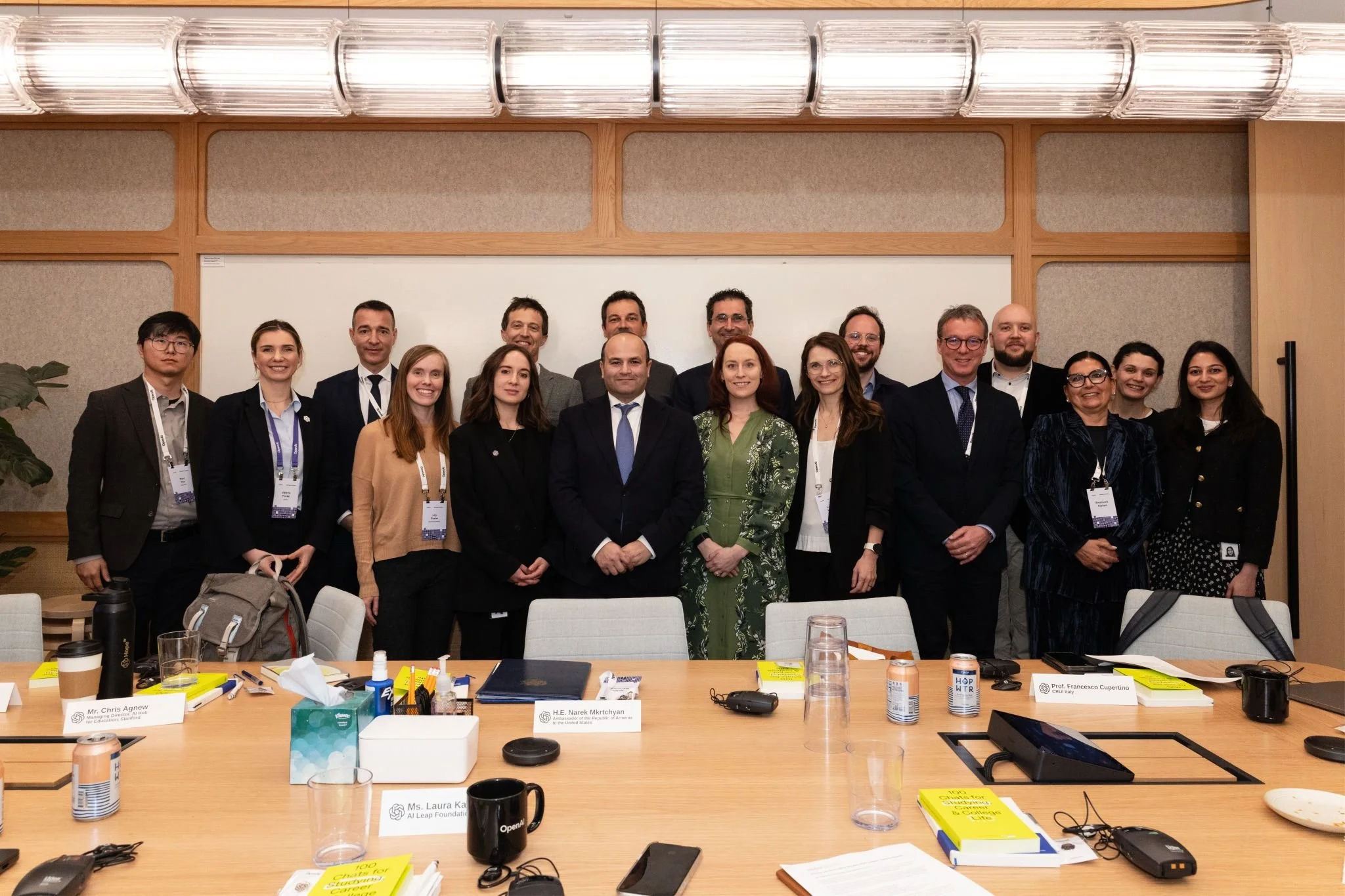
Photo credit: Carlotta Reviglio
OpenAI brought senior university leaders, policymakers, and researchers together in San Francisco for its OpenAI Education Summit, an invitation-only event focused on how AI is being introduced across higher education systems.
Around 100 higher education executives attended the summit, including presidents, chancellors, provosts, and chief information officers from institutions across the United States, Europe, and Asia. Discussions focused on responsible AI deployment, governance, and how universities are measuring the impact of AI tools on teaching and learning.
Carlotta Reviglio, who works on education initiatives at OpenAI, wrote on LinkedIn that the summit created space for discussions about how AI is reshaping higher education and the role institutions will play in guiding its adoption.
Government and university leaders discuss AI in education systems
Reviglio said the summit included a ministerial roundtable bringing together education leaders from ministries and universities collaborating with OpenAI across Europe and other regions. She wrote: “Over the past few days at the OpenAI Education Summit in San Francisco, we had the opportunity to contribute to conversations that capture where AI in education is heading.”
Reviglio said the discussions included insights from Laura Kalda, Chief Operating Officer at AI Leap, who is introducing artificial intelligence into more than 120 Estonian high schools. She wrote that participants also discussed research focused on measuring learning outcomes as AI tools become integrated into classrooms. “Moving forward, understanding the educational impact of these tools will be just as important as enabling their adoption,” she wrote.
Universities share lessons from campus-wide AI deployments
The summit also included discussions about how universities are introducing AI tools across entire campuses.
Reviglio wrote that she and Kara McCloskey Mendes shared a keynote about institutional AI deployment based on experiences from universities including Oxford, Bocconi, ESCP, Arizona State University, and California State University.
She said the group has developed a framework for universities introducing AI, built around four components: Vision, Governance, Literacy, and Scale: “This means aligning leadership vision, activating faculty and student communities, and building the capability to continuously measure and improve impact.”
Reviglio also highlighted a broader shift taking place in universities as AI tools evolve. She wrote that academic institutions are increasingly helping staff and students rethink how they work with AI systems. “One idea that resonated strongly came from Professor Francesco Cupertino from CRUI, who framed the challenge well: institutions are now helping students and faculty learn how to integrate AI, and learn what to forget,” she wrote.
CIOs discuss governance and responsible AI deployment
James Frazee, Vice President for Information Technology and Chief Information Officer at San Diego State University, also attended the summit and described the event as a discussion about institution-wide AI adoption.
Writing on LinkedIn, he said: “I was honored to join approximately 100 higher education executives from around the world at the invitation-only OpenAI Education Summit on March 5.”
Frazee said the conversations focused on how universities can integrate AI tools responsibly across their operations. “This gathering brought together presidents, chancellors, provosts, and CIOs to explore what responsible, institution-wide AI adoption looks like in practice,” he wrote.
Frazee also shared San Diego State University’s experience deploying ChatGPT Edu across the campus: “We discussed lessons learned from our first year and what it means to govern AI as core academic infrastructure.”
He described the summit as an opportunity for universities to compare approaches to governance, deployment, and long-term AI strategy.
“It was a candid and forward-looking dialogue about scaling what works, rigorously measuring impact, and building the governance and trust frameworks required for long-term success,” Frazee wrote.
Universities represented at the summit included Oxford, Cambridge, Harvard, MIT, Stanford, Columbia, Cornell, Princeton, University College London, the National University of Singapore, the University of Michigan, the University of California system, and Arizona State University.
ETIH Innovation Awards 2026
The ETIH Innovation Awards 2026 are now open and recognize education technology organizations delivering measurable impact across K–12, higher education, and lifelong learning. The awards are open to entries from the UK, the Americas, and internationally, with submissions assessed on evidence of outcomes and real-world application.