OpenAI moves GPT-5.2 into the lab with new Prism research workspace
The new free workspace integrates GPT-5.2 directly into research workflows, aiming to reduce friction in how scientists write, revise, and collaborate on papers.
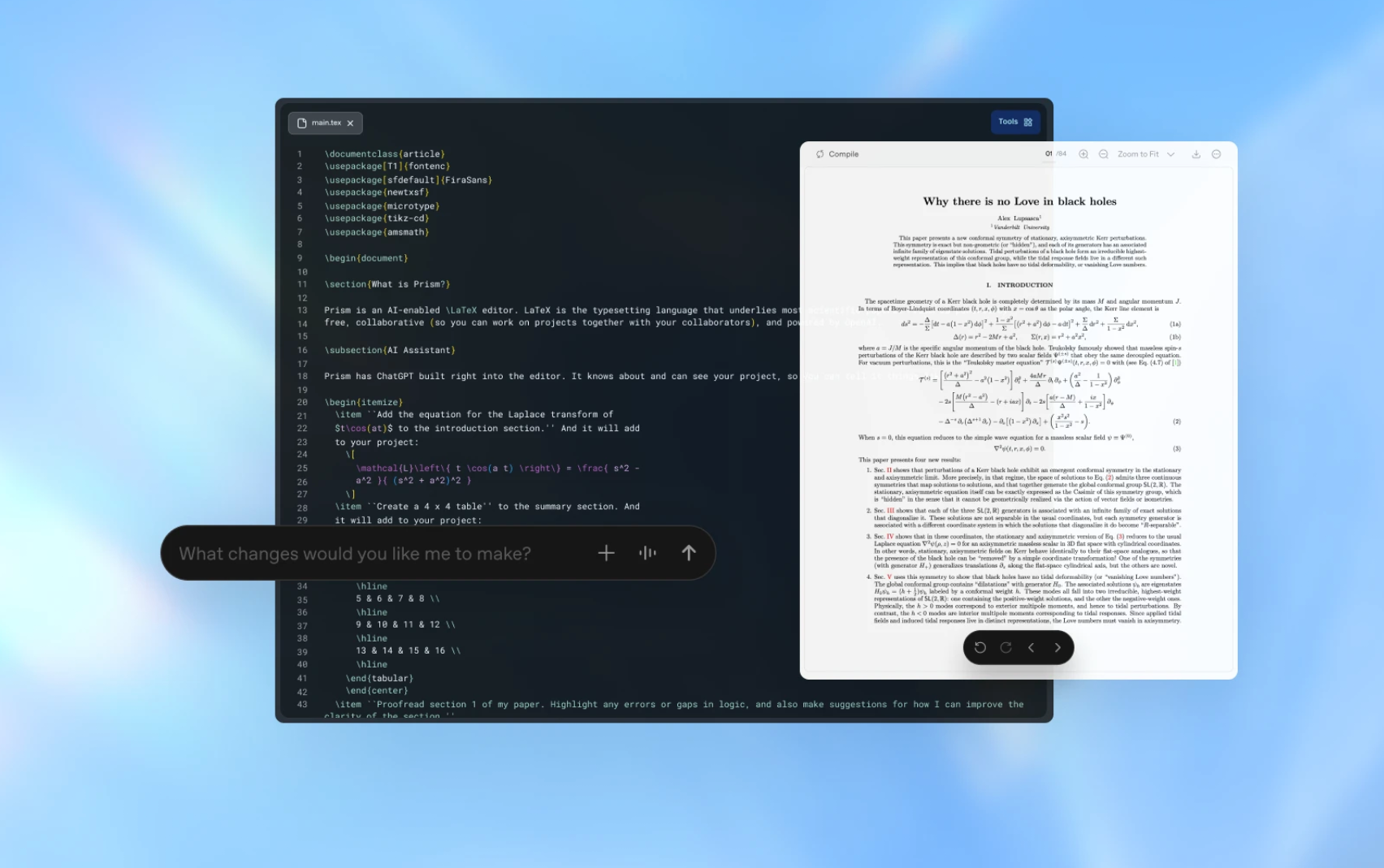
OpenAI has launched Prism, a new AI-native workspace designed to support scientific writing and collaboration. Available for free to anyone with a personal ChatGPT account, Prism brings drafting, revision, and teamwork into a single environment, as OpenAI looks to apply recent advances in AI reasoning to the day-to-day work of research.
The launch reflects a broader push to move AI from isolated tools into integrated scientific workflows, with potential implications for how researchers, students, and institutions approach writing, collaboration, and skills development in science and higher education.
Moving beyond fragmented research tools
OpenAI positions Prism as a response to the fragmented way scientific writing is often handled today, with researchers switching between text editors, LaTeX compilers, reference managers, PDFs, and separate AI chat tools. Prism combines these functions into a single, cloud-based workspace, with AI embedded directly into the document rather than operating alongside it.
At the core of Prism is GPT-5.2, OpenAI’s model for mathematical and scientific reasoning, which works within the structure of a research project. This allows the system to reason over full documents, including equations, citations, and references, rather than treating text in isolation. Prism builds on Crixet, a cloud-based LaTeX platform acquired by OpenAI, which has been developed into a unified product focused on scientific workflows.
Writing, reasoning, and collaboration in one place
Prism supports drafting and revising papers with full-document context, searching and incorporating relevant literature, and creating or refactoring equations and figures directly within LaTeX. OpenAI also highlights features such as turning handwritten equations or diagrams into LaTeX and making in-place edits without copying content between tools.
Collaboration is a central part of the platform. Prism supports unlimited collaborators and projects, allowing co-authors, students, and advisors to work together in real time without seat limits or local software setup. OpenAI says this is intended to reduce version conflicts and manual file management, shifting focus back to the substance of research rather than process overhead.
Access, skills, and what comes next
Prism is free to use and available today for individual researchers, with availability for ChatGPT Business, Enterprise, and Education plans planned next. OpenAI says additional AI capabilities will be introduced over time through paid plans.
The company frames Prism as an early step toward applying AI more deeply to scientific practice, particularly by reducing friction in writing and collaboration rather than focusing only on breakthrough discoveries. For education and skills development, the launch signals a growing role for AI tools that support how science is communicated and taught, not just how results are generated.
ETIH Innovation Awards 2026
The ETIH Innovation Awards 2026 are now open and recognize education technology organizations delivering measurable impact across K–12, higher education, and lifelong learning. The awards are open to entries from the UK, the Americas, and internationally, with submissions assessed on evidence of outcomes and real-world application.