OpenAI wraps multi-city nonprofit AI Jam across India as focus shifts from pilots to deployment
OpenAI has completed a series of hands-on AI workshops across four Indian cities, working directly with more than 200 nonprofit leaders and highlighting a growing push to move AI use in the sector beyond experimentation and into day-to-day operations.
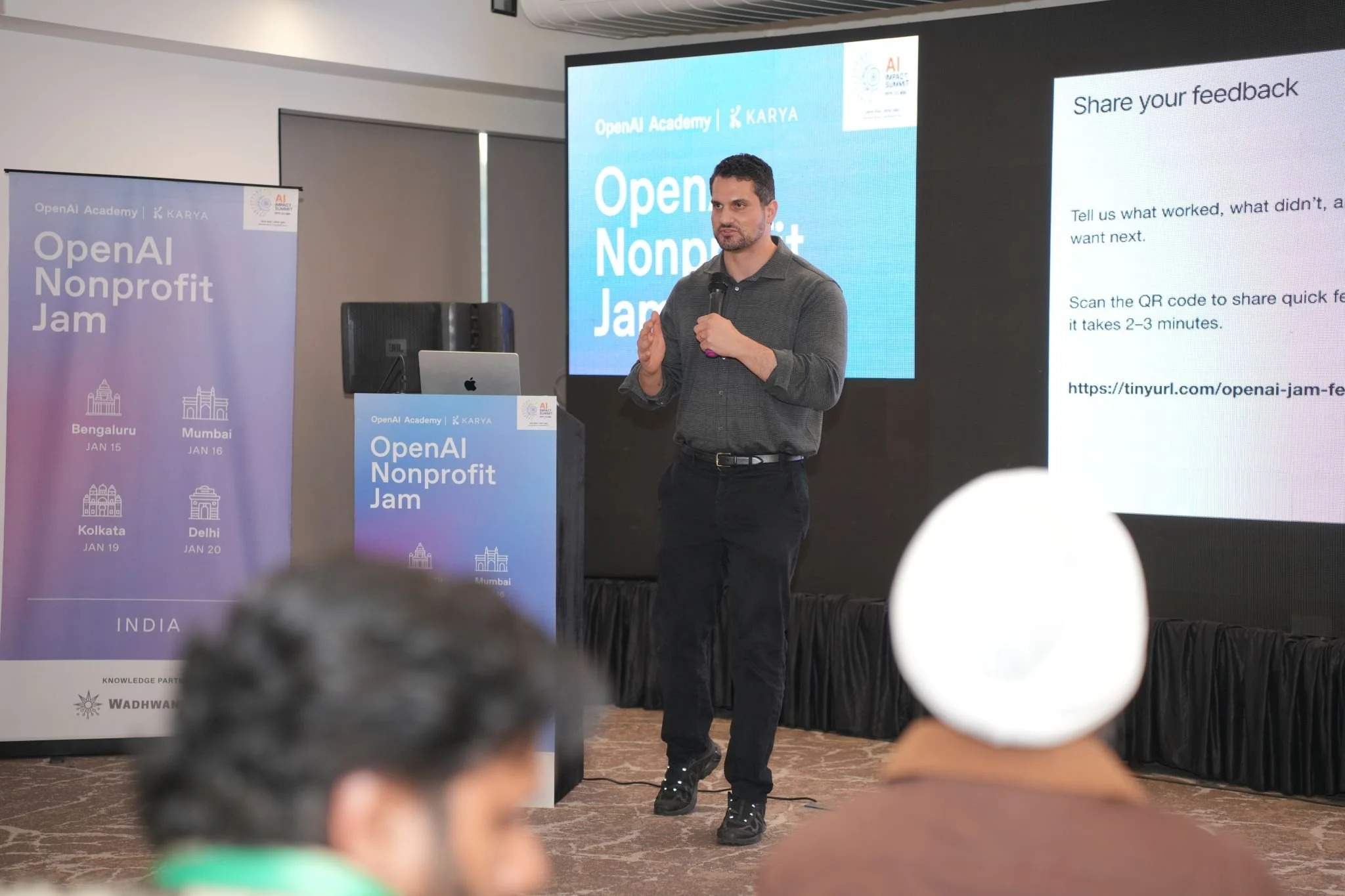
Photo credit: Alex Narwar
OpenAI has concluded a multi-city Nonprofit AI Jam across India, bringing together more than 200 nonprofit leaders for hands-on workshops in Bengaluru, Mumbai, Kolkata, and Delhi.
The sessions, delivered through OpenAI Academy, focused on practical AI deployment rather than high-level demonstrations, with participants building reusable workflows tied to real organizational challenges.
The initiative matters because it reflects a broader shift in how AI skills are being developed in education-adjacent and social impact sectors. Rather than emphasizing pilots or abstract training, OpenAI’s approach centers on applied literacy, operational use, and immediate outcomes, areas increasingly relevant to workforce readiness and skills-based learning.
OpenAI takes applied AI training directly to nonprofit teams
Alex Nawar, a member of OpenAI’s Global Affairs team working on OpenAI Academy, shared details of the initiative on LinkedIn following the conclusion of the sessions. He wrote that the Jam worked “hands-on with 200+ nonprofit leaders from all over the country,” adding that “~90% of participants left with a reusable AI workflow.”
Nawar emphasized that this outcome was intentional, writing that it came from “being intentional about AI literacy—starting with simple prompting advice, grounding everything in real nonprofit workflows, and giving people time to actually build.” He noted that teams were focused on “deployment and real results,” rather than experimentation for its own sake.
He also highlighted the range of prototypes developed during the sessions, writing that teams shared working examples “from illustrating children’s books to building internal HR and operations assistants.”
From curiosity to real-world use
Posts from other OpenAI team members reinforced a consistent theme across locations. Rajan Patel, Solutions Engineering at OpenAI, wrote that participants were able to “build with ChatGPT and leave with working solutions on the same day,” describing the pace of progress as notable given the diversity of sectors involved.
Royston Lobo, who works on go-to-market at OpenAI, wrote that the sessions increased AI literacy across nonprofits in education, healthcare, and career support, adding that the workshops focused on “how AI can help them scale impact, operate more efficiently, and reach the communities they serve.”
Rohan Kochhar, at OpenAI and King’s College London, wrote that nonprofits arrived with “real questions—about programs they’re running today, teams that are stretched thin, and whether AI can actually make their work a little easier,” pointing to practical constraints shaping adoption.
Pragya Misra, who leads OpenAI’s work in India, wrote that a consistent message emerged across cities: “interest in AI is high, but moving from experimentation to real deployment is still hard.” She added that the Jam reinforced that “real impact comes from deployment, not pilots,” particularly in sectors operating at scale.
ETIH Innovation Awards 2026

The ETIH Innovation Awards 2026 are now open and recognize education technology organizations delivering measurable impact across K–12, higher education, and lifelong learning. The awards are open to entries from the UK, the Americas, and internationally, with submissions assessed on evidence of outcomes and real-world application.