New AI platform turns LinkedIn posts into corporate learning strategy
Organizations say daily AI-generated thought leadership posts are improving mindset, visibility, and “career energy” across teams, while reducing reliance on structured training programmes.
Companies across the US and UK are piloting a new approach to workforce development that replaces structured training programmes with AI-generated LinkedIn-style thought leadership posts, positioning daily content creation as a primary method of professional learning.
The platform, called ThoughtLeadr, delivers employees a stream of personalized posts designed to simulate reflection, resilience, and career growth, with organizations reporting early gains in engagement metrics and reduced training costs.
Learning through content creation
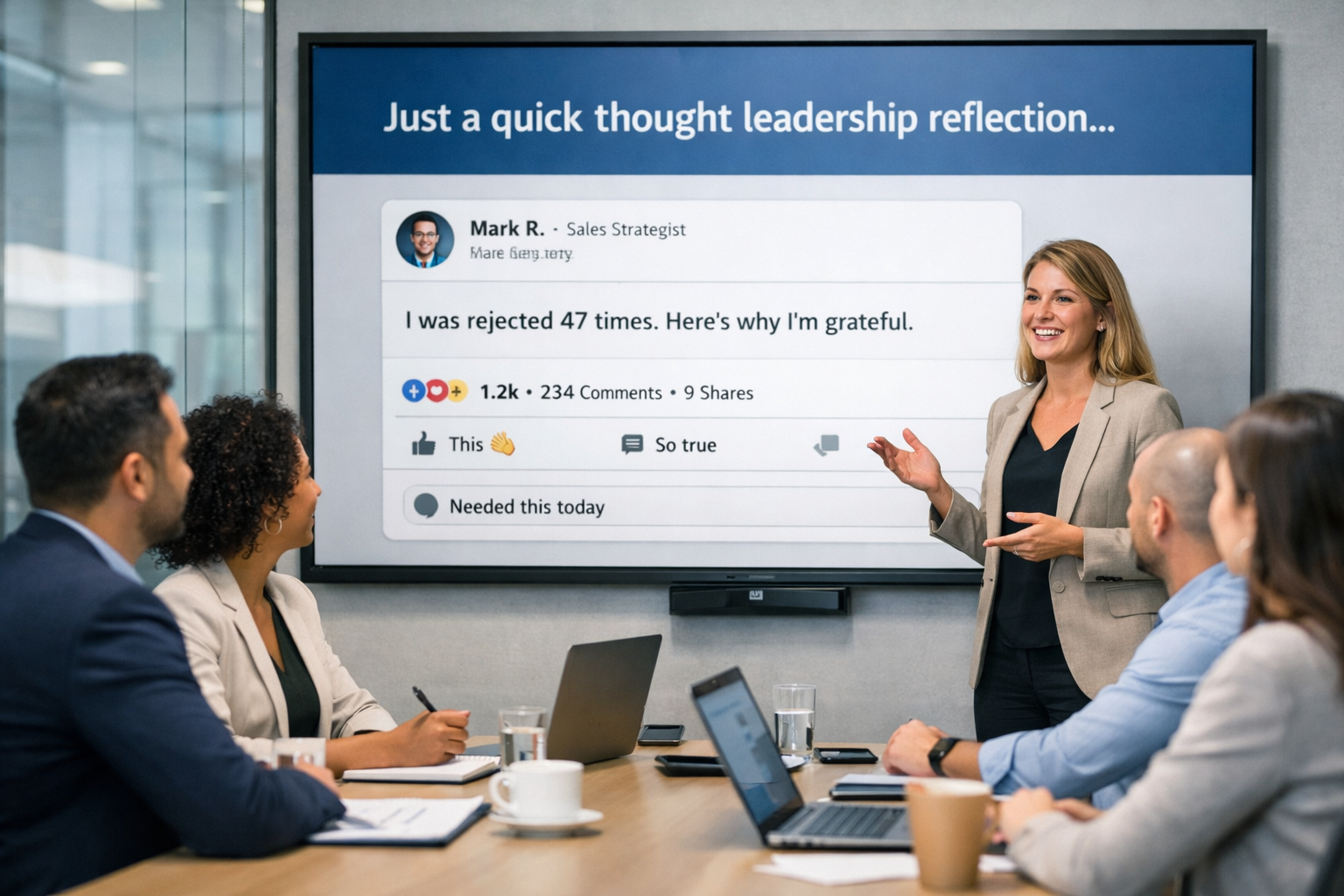
ThoughtLeadr generates up to three posts per day for each employee, drawing on common professional themes such as leadership, failure, and personal growth. Example prompts include: “What running a marathon taught me about B2B sales” and “I was rejected 47 times. Here’s why I’m grateful.”
The system also automates engagement, populating posts with responses such as “This 👏”, “So true”, and “Needed this today,” which are then used to calculate internal learning scores.
Metrics include an engagement mindset score, a thought leadership consistency index, and a personal brand growth rate, which some organizations are beginning to integrate into performance reviews.
Compliance training has also been reworked, with modules replaced by reflective prompts such as “Write a story about resilience during a difficult spreadsheet experience.”
“Traditional training is often content-heavy and difficult to scale,” says Daniel Kline, CEO at ThoughtLeadr. “What we’re seeing is that employees don’t necessarily need new skills. They need better narratives about the skills they might develop in the future.”
Several companies report that formal training sessions have been reduced or removed entirely, with employees instead encouraged to reflect on their work through daily posts.
“We’ve moved away from structured learning pathways,” says Anita Desai, Head of Learning and Development at a global technology firm participating in the pilot. “Instead, we’re focusing on reflection, storytelling, and visibility as core competencies.”
Performance measured through engagement
In early trials, organizations are using engagement data as a proxy for development, with managers assessing employees based on narrative clarity, consistency, and tone.
Employees are encouraged to begin meetings with short reflections derived from their daily posts, with some organizations standardizing opening lines such as: “Just a quick thought leadership reflection…”
Managers assess performance using engagement-led criteria including narrative clarity, inspirational tone, and the ability to overcome adversity in hypothetical scenarios, with internal dashboards tracking consistency across teams.
One participant reports that training hours have dropped to near zero, while internal engagement scores have increased.
“I haven’t completed a course in months,” says one employee involved in the pilot. “But I’ve shared 86 lessons about resilience, and that’s what really matters.”
One company involved in the pilot reports that it has not run a formal training session in six months, with employee visibility increasing by 312 percent over the same period.
An optional premium feature, described as a “Viral Moment Generator,” guarantees at least one post per quarter that “resonates deeply,” with organizations using it to benchmark employee visibility and internal influence.
Critics question impact on skills development
The approach has raised questions among learning and development specialists, particularly around the distinction between visibility and capability.
Critics argue the approach risks prioritizing visibility over capability, with some employees reportedly progressing without demonstrating any measurable skills beyond “posting consistently under pressure.”
Concerns have also been raised about the shift away from structured learning, with some questioning whether content generation alone can support long-term skills development.
ThoughtLeadr says the platform is designed to complement, rather than replace, traditional learning, although several pilot organizations have already reduced their formal training provision.
“We’re not removing learning,” Kline says. “We’re making sure it can be clearly communicated in a post that starts with ‘Here are 10 things a missed train taught me about leadership.’”