Microsoft expands AI push in Singapore with $5.5B investment and Copilot access for students
Microsoft deepens its presence in Singapore with infrastructure investment and nationwide AI skills programs, as access to tools and training becomes central to workforce readiness.
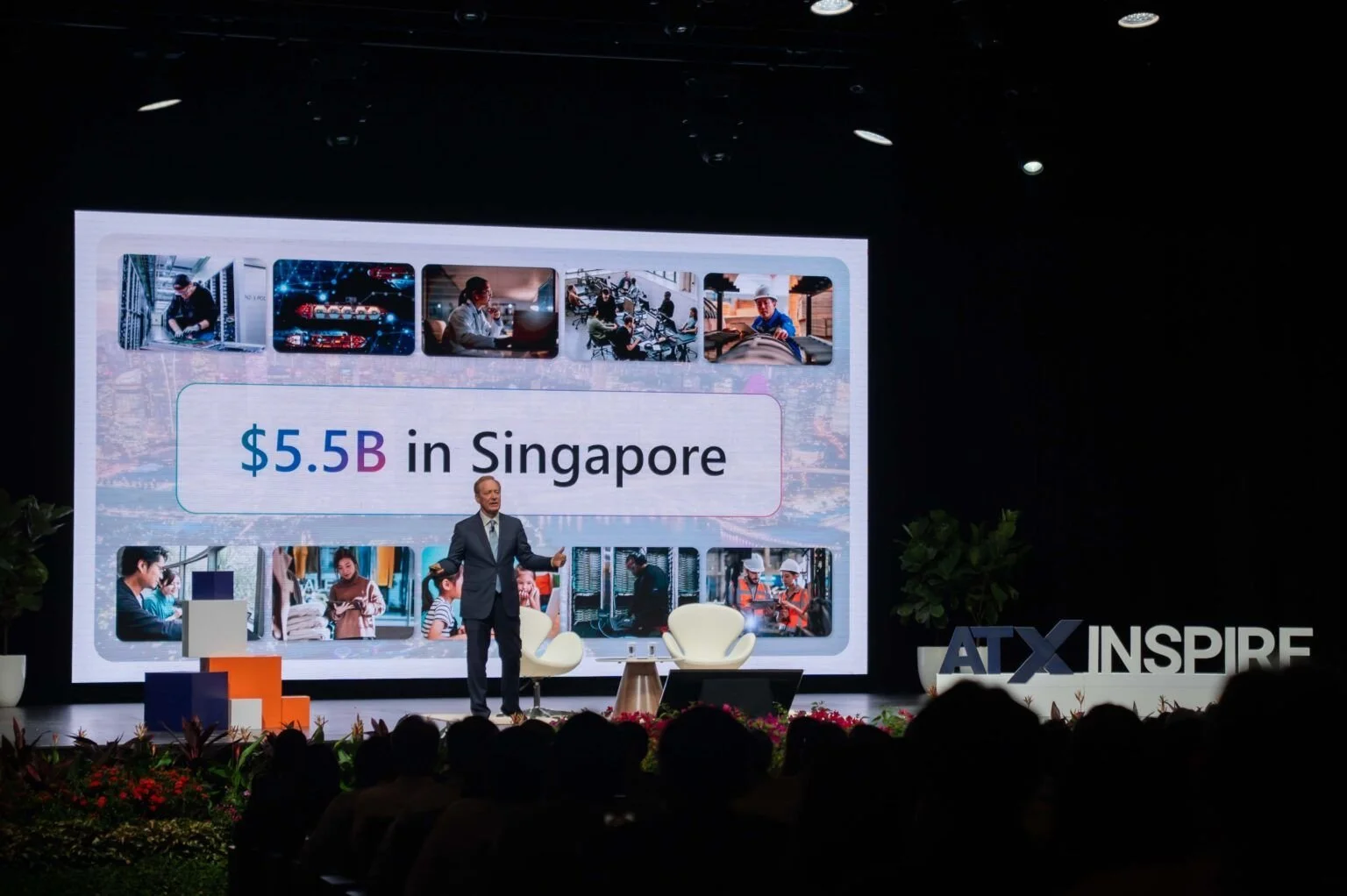
Brad Smith announces Microsoft’s $5.5 billion AI and cloud investment in Singapore during a keynote at Asia Tech x Inspire.
Microsoft has announced plans to invest $5.5 billion in Singapore’s cloud and AI infrastructure through 2029, alongside new programs providing AI tools and training to students, educators, and nonprofits.
The investment, confirmed by Microsoft Vice Chair and President Brad Smith, includes expanded infrastructure as well as education-focused initiatives such as free access to Microsoft 365 Copilot for more than 200,000 tertiary students.
The move combines large-scale infrastructure development with direct investment in skills and access, reflecting how governments and technology companies are aligning AI deployment with education and workforce systems.
AI tools rolled out across higher education
As part of the initiative, all tertiary students in Singapore will receive 12 months of free access to Microsoft 365 Premium with Copilot, embedding AI tools into everyday academic workflows.
The rollout places AI capabilities directly within widely used applications including Outlook, Word, Excel, PowerPoint, and OneNote, positioning Copilot as part of standard student productivity environments.
The approach reflects a growing trend toward integrating AI tools into existing systems rather than introducing standalone platforms, particularly in education where adoption is often tied to familiar workflows.
Skills programs target educators and nonprofits
Alongside student access, Microsoft is expanding its Microsoft Elevate programs in Singapore, aimed at building AI capability across education and social impact sectors.
Microsoft Elevate for Educators will provide training to teachers across primary, secondary, and higher education, focusing on responsible AI use in classroom settings.
A parallel initiative, Microsoft Elevate for Changemakers, is designed to support nonprofit leaders in developing practical AI skills and internal capacity.
The programs are intended to address uneven levels of AI readiness, particularly in sectors where access to training and resources has been limited.
Investment reflects growing demand for AI literacy
Announcing the initiative on LinkedIn, Smith framed the investment as part of a longer-term strategy, writing: “Our ongoing investment in cloud and AI infrastructure reflects Microsoft’s long-term confidence in Singapore as a global digital leader.”
He added that the focus is on enabling adoption across sectors: “Together, we’re focused on helping people and organizations use AI by strengthening skills, increasing cybersecurity and resilience, and advancing trusted governance so technology delivers real benefits for Singaporeans.”
The expansion aligns with broader signals around rising demand for AI skills. Data from LinkedIn indicates that demand for AI literacy in Singapore has increased significantly, with AI fluency becoming a baseline expectation across roles.
Dr Janil Puthucheary, Senior Minister of State at Singapore’s Ministry of Education, highlighted the role of education in that shift, stating: “Baseline AI skills are increasingly becoming as fundamental as digital literacy.”
He added: “By equipping students with a hands on experience using AI tools, and supporting our educators to adopt them confidently, we are strengthening the foundations for Singapore’s future workforce, and training them to use AI with confidence, discernment and trust.”
The combined focus on infrastructure, tools, and training suggests a coordinated approach to AI adoption, where access alone is no longer sufficient without parallel investment in skills and implementation.