NASA and Code.org bring AI space examples to students as Lunabotics teams prepare for Kennedy
The new AI education resource arrives as 50 college teams get ready to test lunar robot prototypes for NASA’s 2026 Lunabotics Challenge.
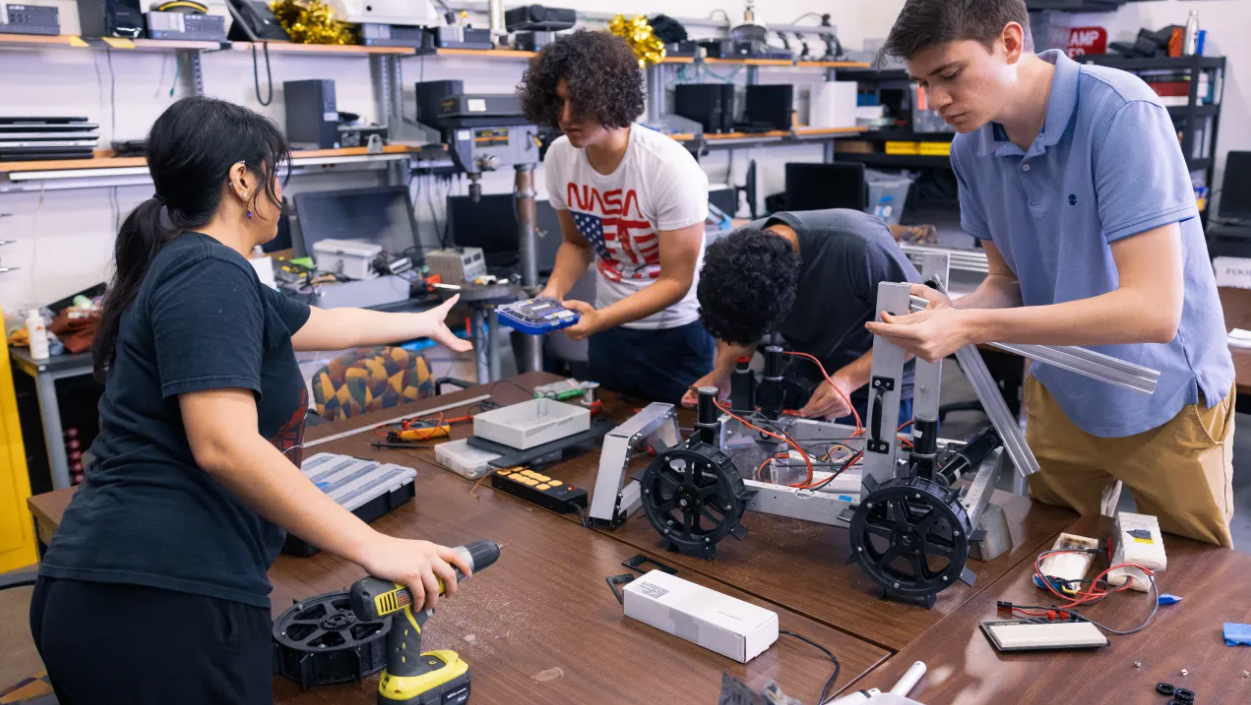
Students work on a robotic rover ahead of NASA’s Lunabotics Challenge, which asks college teams to design and operate lunar construction robot prototypes. Photo credit: NASA
NASA and Code.org have released a new AI education resource for students and educators, as NASA prepares to host its 2026 Lunabotics Challenge at Kennedy Space Center.
The video features NASA AI Adoption and Innovation Lead Martin Garcia Jr. answering student questions alongside Code.org CEO Karim Meghji. It connects AI to live and future NASA work, including Mars rover navigation, satellite image analysis, exoplanet research, spacecraft simulations, digital twins, welding checks, and citizen science.
From 19 to 21 May, 50 college teams will take part in NASA’s Lunabotics Challenge, where they will design, build, and operate lunar robot prototypes for construction tasks connected to future Artemis missions.
NASA and Code.org put AI into space context
Rob LaSalvia, Partnership Manager at NASA’s Office of STEM Engagement, shared the resource on LinkedIn, writing that NASA and Code.org were "excited to introduce a new resource that brings real-world examples of the use of AI in science and space exploration directly to students and educators."
The video is built around questions submitted by students. Garcia says NASA has used AI for decades, but that the technology is now "more scalable and capable than ever before."
One of the clearest examples is Perseverance, NASA’s Mars rover. Garcia says: "It’s currently on Mars, and it navigates from one place to another, but it uses AI to try to avoid obstacles so it doesn't get stuck or damaged."
Garcia also explains how AI is used to analyze satellite imagery during hurricanes and wildfires, identify possible exoplanets in telescope data, and support future Artemis work. He says NASA is exploring AI for astronaut health, lunar vehicles, habitats, and computer vision systems that could identify damage to a spacesuit or spacecraft asset.
The resource also keeps a line between AI support and human accountability. Garcia says: "AI is there to, to augment to help the human right. And so that that's again it's a tool for us to leverage. That's, that's very powerful."
Lunabotics teams head to Kennedy
The AI resource arrives shortly before NASA’s 2026 Lunabotics Challenge, which will run from Tuesday, 19 May to Thursday, 21 May at the Astronauts Memorial Foundation’s Center for Space Education at the Kennedy Space Center Visitor Complex in Florida.
The competition brings together 50 college teams from across the United States. Teams have designed and built robotic lunar construction prototypes that must be capable of building a berm from soil and material simulating lunar regolith.
NASA says berms could help protect Artemis infrastructure on the Moon by shielding equipment from debris during landings and launches, shading cryogenic propellant tank farms, supporting radiation protection around nuclear power systems, and serving other lunar surface needs.
Kurt Leucht, NASA Software Developer, In-Situ Resource Utilization Researcher, and Lunabotics Commentator at Kennedy, says: "The task of robotically building berm structures will be important for preparation and support of crewed lunar missions. These competing teams are not only building critical engineering skills that will assist their future careers, but they are literally helping NASA prepare for our future Artemis missions to the Moon."
Lunabotics was established in 2010 and is part of NASA’s Artemis Student Challenges. It is open to students in higher education, including vocational and technical programs, trade schools, community colleges, two-year colleges, four-year colleges, and universities.
AI skills meet engineering practice
The Lunabotics Challenge gives students a practical route into robotics, autonomy, systems engineering, manufacturing, coding, testing, and mission operations.
Teams must apply NASA systems engineering principles and submit technical deliverables, including a project management plan, systems engineering paper, proof of life video, robot data report, and other competition materials. The guidebook says the primary objective is for teams to design, develop, build, and test a prototype lunar robot that supports simulated lunar construction operations.
Autonomy is also a major part of the competition. Teams can earn points for autonomous excavation, dumping, travel across an obstacle field, one-cycle full autonomy, and full-run autonomy. The highest autonomy level requires a robot to operate hands-free for the full competition run and complete at least two cycles of excavation, travel, dumping, and return.
That makes the competition a useful counterpoint to the NASA and Code.org AI resource. In the video, Garcia says students and engineers need to understand requirements, constraints, and expected outcomes when using AI tools.
Discussing AI-generated code and engineering responsibility, he says: "You as an engineer, you have the accountability. You have the ultimate judgment. So you need to validate that output."
NASA will livestream the Lunabotics competition across the three event days. The event will show how student teams are applying robotics, autonomy, and systems engineering to mission-linked problems at the same time NASA and Code.org are putting AI use in space exploration into classroom-ready terms.