ETIH Innovation Awards Winners: Medly wins Best AI Tutor or Personalized Learning Agent
Medly AI was recognized for its Socratic tutoring model, exam board-specific content, evidence of GCSE outcomes, and focus on widening access to personalized learning.
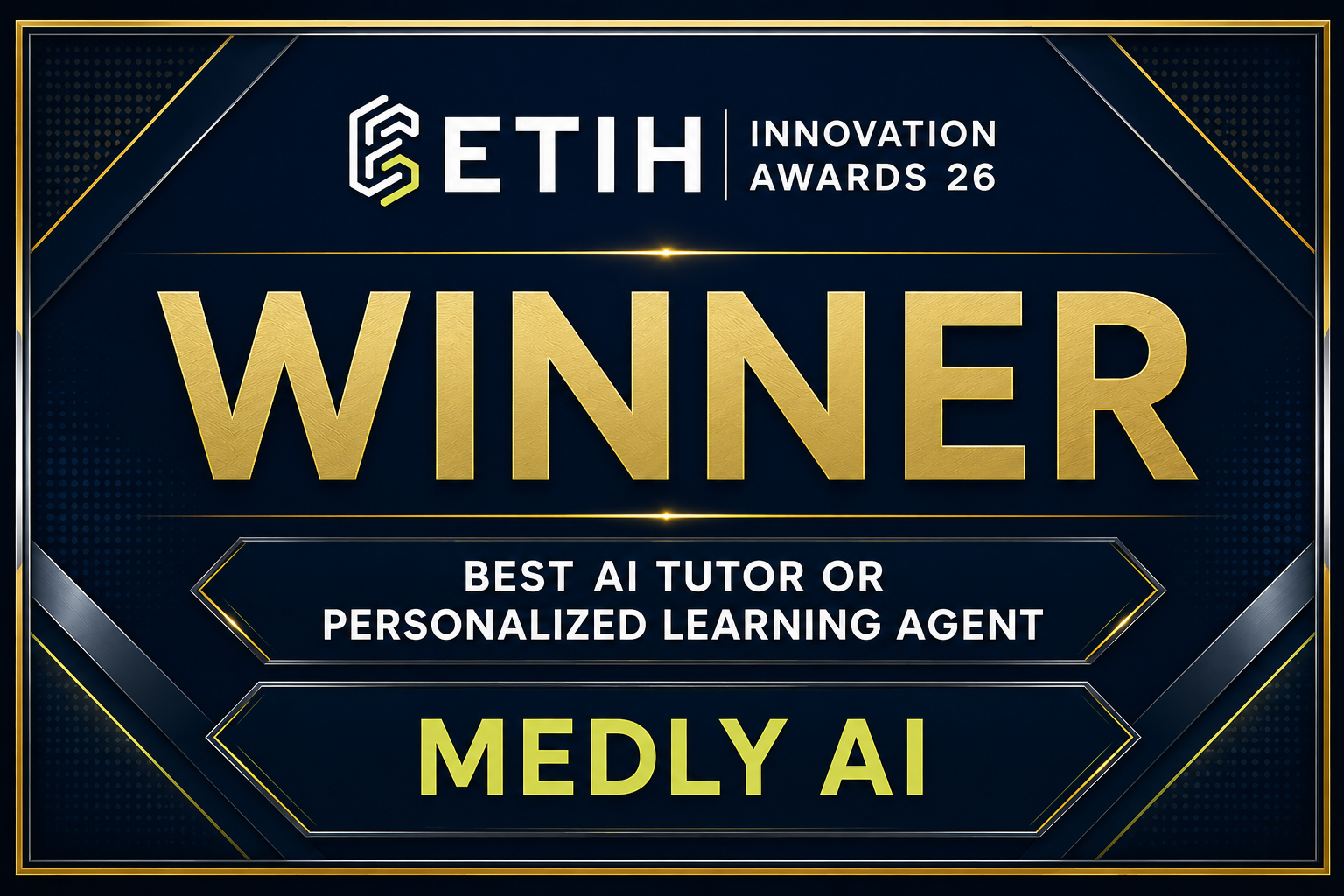
Medly AI wins Best AI Tutor or Personalized Learning Agent at ETIH Innovation Awards 2026
Medly AI has won Best AI Tutor or Personalized Learning Agent at the inaugural ETIH Innovation Awards 2026, with judges recognizing a UK-founded platform that is trying to move AI tutoring away from instant answers and toward deeper student understanding.
The company was founded in the UK by doctors from lower socioeconomic backgrounds, with Medly positioned around a simple but difficult problem: private tutoring remains financially out of reach for many families, while general-purpose AI tools can often give students answers without helping them learn.
Kavi Samra, Co-Founder and COO at Medly AI, is also an Anaesthetist and Honorary Teaching Fellow at UCL. His work across medicine, tutoring, and education helped shape the company’s focus on widening access to personalized academic support.
For Samra, the first wave of AI tools entering education showed the power of the technology, but also exposed a major weakness. "The first wave of AI in education was essentially just answer engines,” he says. “It was incredibly powerful, but it was purely transactional."
That concern sits at the center of Medly’s model. Instead of building a chatbot that simply responds to prompts, the company developed an AI tutor for GCSE, A-Level, IGCSE, IB, AP, and SAT students, with teacher and examiner-reviewed content mapped to exam boards and specifications. Its approach uses Socratic questioning, scaffolded hints, and feedback to guide students through problems rather than handing over final answers.
ETIH Innovation Awards judge Richard Govada Joshua says this was one of the reasons Medly stood out, describing the platform as "outcomes-driven, AI-enabled, and strongly aligned with the future of digital learning in schools.” He also pointed to its “strong content delivery, high learner engagement, effective data use, measurable learning outcomes, and accessibility."
Samra says the aim was never to give students a faster shortcut: "We realized that students did not need a faster way to get answers; they needed a partner to help them think."
That design choice mattered to the judges because it addressed one of the bigger risks around AI in education: dependency. Samra is blunt about that risk: "If we just gave students the answers, we would be doing them a massive disservice. We would be building a generation of students who are dependent on a tool rather than their own intellect."
ETIH Innovation Awards judge Tina Austin also highlighted this point, noting that Medly "guides students toward understanding rather than providing answers." She says this aligned with best practice in AI-assisted learning and helped separate Medly from more generic AI tools.
Building around pedagogy rather than shortcuts
The Socratic approach means students are led through questions, hints, and feedback rather than being handed a final response. Medly’s focus on exam board specificity also means content is mapped to AQA, Edexcel, OCR, WJEC, and Cambridge, with teacher and examiner review built into the process.
Samra says the company wanted to create an AI tutor that understood how students move from confusion to mastery: "We did not just want to build an AI that knows the facts. We wanted to build an AI that understands the logic of how a student moves from not understanding to mastering a concept."
The platform’s development has also involved ongoing work with teachers and examiners. Samra says Medly does not "build in a vacuum," with the team using regular iteration cycles to refine its content, pedagogy, and AI marking ability. "We run constant iteration cycles with actual teachers/examiners to refine our content, our pedagogy, and even our AI's marking ability," he adds.
The company also placed significant emphasis on product design and engagement, although Samra says the team deliberately avoided over-gamifying the experience: "We were very careful not to gamify education to the point where the goal is just to stay addicted to the app. We believe that the process of learning itself should be inherently rewarding and enjoyable."
Emma Thompson, Director of Content and Editor at ETIH, says: "Medly stood out in one of the most competitive categories of the ETIH Innovation Awards because it showed how AI tutoring can be built around learning rather than shortcuts. The judges were looking for evidence, pedagogy, accessibility, and practical value for students, and Medly brought those elements together in a way that felt both credible and highly relevant to where digital learning is heading."
How students use AI when no one is watching
One of the areas judges focused on was the scale of student engagement reported in Medly’s entry. The platform says it now sees between 100,000 and 200,000 tutoring interactions daily, alongside 300,000 signups.
ETIH Innovation Awards judge Al Kingsley MBE also highlighted Medly’s outcome evidence, scale, and access model. He pointed to the platform’s GCSE improvement data and free programs, and even commented that he would be using the platform with his own family members.
Samra says that level of use has given the company insight into how students actually use AI tools when they are working independently at home. "What has been most fascinating is seeing how students use AI in those quiet, unobserved moments of struggle," he says.
Rather than students using AI primarily to shortcut work, Samra says many interactions involve repeated questioning and attempts to understand difficult concepts: "It is often a late night, repetitive loop of asking for a concept to be explained one more time or asking why their specific logic was wrong."
He argues that AI tutoring can sometimes remove the embarrassment students feel in traditional tutoring environments when they need repeated explanations: "In a human tutoring session, social norms often stop a student from asking the same question five times,” Samra says. “With Medly, that social barrier is gone."
The platform includes features such as Learn Mode, handwriting recognition for equations and diagrams, integrated graphing tools, mock exams with grade predictions, and teacher dashboards that provide mastery heatmaps and AI-generated reports.
Access, evidence, and what comes next
Affordability was another major factor in the judges’ decision. Medly’s entry positioned private tutoring as out of reach for many families, with the platform built to provide exam-focused support at a lower cost. "For us, scale is the actual vehicle for our mission," he comments. "Our goal has always been to democratise the kind of high quality, personalized tutoring that was previously reserved for the few."
The company’s free initiatives include Medly Mondays, which unlocks free access to a subject each week, and Medly Mocks, which provides nationwide mock exams with marking. The platform also offers bursary support and credit-card-free daily access.
Samra says those initiatives are part of the company’s wider approach to growth. "Every technical optimisation we make is ultimately an investment in making Medly accessible to the students who need it most," he says.
Following its ETIH Innovation Awards win, Medly is now focusing on further evidence and research. Samra says the company is "accumulating a legitimate scientific evidence base" and has started running randomized controlled trials within schools.
For the Samra, the award marks progress, but not a conclusion: "This award is a milestone but the real work of proving how AI can fundamentally transform learning is just beginning."
For readers wanting to find out more about Medly AI, its tutoring platform, and its wider access initiatives, more information is available via the company’s website.