MIT builds shared quantum lab linking computing, biology and chemistry research
The Quantum Systems Laboratory will bring quantum computers and sensors into the same Building 39 facility as wet labs, electronics labs and other research spaces
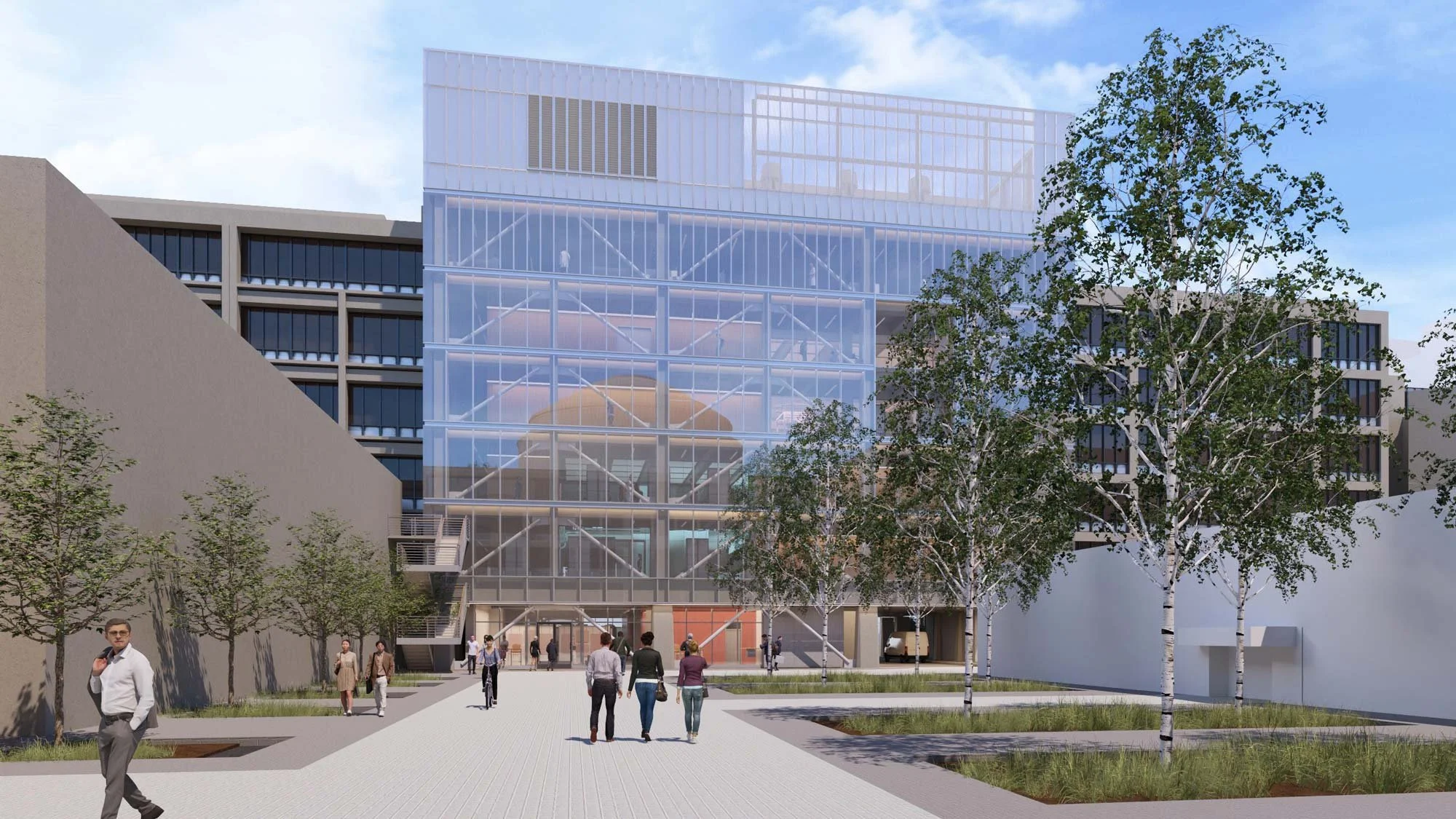
MIT’s Quantum Systems Laboratory will be based in Building 39 and bring quantum computing facilities together with biology, chemistry and electronics research spaces. Image: HGA Architects
MIT is creating a shared research facility designed to put quantum computing and sensing alongside work in biology, chemistry and electronics, as the university expands its Quantum Initiative.
The Quantum Systems Laboratory, or QSL, will be based in Building 39 and serve as the physical home of the MIT Quantum Initiative, known as QMIT. Plans include two double-height quantum computing rooms, as well as pump rooms, electronics labs and spaces for culturing tissues, preparing biological samples and working with chemicals.
The practical idea is to shorten the distance between quantum specialists and researchers working on problems in other scientific fields.
“We will have spaces for quantum computers and quantum sensors next to wet labs and chemistry labs and biology labs,” says Ian Waitz, MIT Vice President for Research and Jerome C. Hunsaker Professor of aeronautics and astronautics.
“It is really intended to bring together people who have problems to solve with people with quantum expertise to see whether they can demonstrate quantum advantage for those particular problems. It’s designed to be a gathering place and a toolbox.”
QMIT was launched in 2025 by MIT President Sally Kornbluth to support research across quantum science and engineering, with the university focusing on potential applications spanning science, industry and national security.
A shared facility modeled on MIT.nano
MIT is looking to another of its research facilities, MIT.nano, as a model for how a shared physical environment can bring different groups of researchers together.
MIT.nano opened in 2018 and now has 1,500 users, including 350 from outside MIT. The facility provides more than 200 tools and instruments for imaging, fabrication, characterization and prototyping.
Its START.nano accelerator has also worked with more than 30 companies, 11 of which have moved beyond the prototyping stage during the past five years.
“We are inspired by the success of MIT.nano,” Waitz adds. “It’s a shared resource that accelerates discovery.”
The QSL will take that shared-use approach into quantum research, but with facilities deliberately positioned alongside other scientific disciplines.
Waitz says one of the defining features of the field is that many of the eventual applications of quantum computing are still unknown: “The field is at a point where much of what quantum computing will enable is still unknown. It’s a really exciting inflection point for quantum sensing, computing, and communications, with a tremendous amount of work being done across the globe.”
Fellowships form another part of MIT’s quantum push
The physical laboratory is only one part of the university’s approach. MIT is also backing fellowships intended to allow graduate students and postdoctoral researchers to work across disciplines.
Waitz points to quantum sensing in the life sciences as one example where this could be useful, with fellows able to work across both quantum research and another scientific domain rather than staying within a single academic area:
“Funding fellows over multiple years so they can work across domains has a multiplying effect on the research enterprise because they can pursue some of these grand challenge areas.”
MIT already has a long history in quantum science. Peter Shor developed the algorithm that showed how quantum computing could be used for prime factorization, while Isaac Chuang later led a team that implemented Shor’s algorithm and others.
More recent work has included quantum sensors used in the Laser Interferometer Gravitational-wave Observatory, or LIGO, as well as research connected to navigation and encryption.
Danna Freedman, QMIT Faculty Director and Frederick George Keyes Professor of chemistry, says the initiative is focused on what the field could become over the longer term.
“What can we do next? We’re investing in the promise of quantum, and where the legacy will be in 20 years. We are going to change the forward momentum of quantum in a way that supports impact.”
MIT has not given an opening date for the Quantum Systems Laboratory, but says it is working to open the facility as quickly as possible.