Anthropic says new J-lens tool can reveal what Claude is thinking but not saying
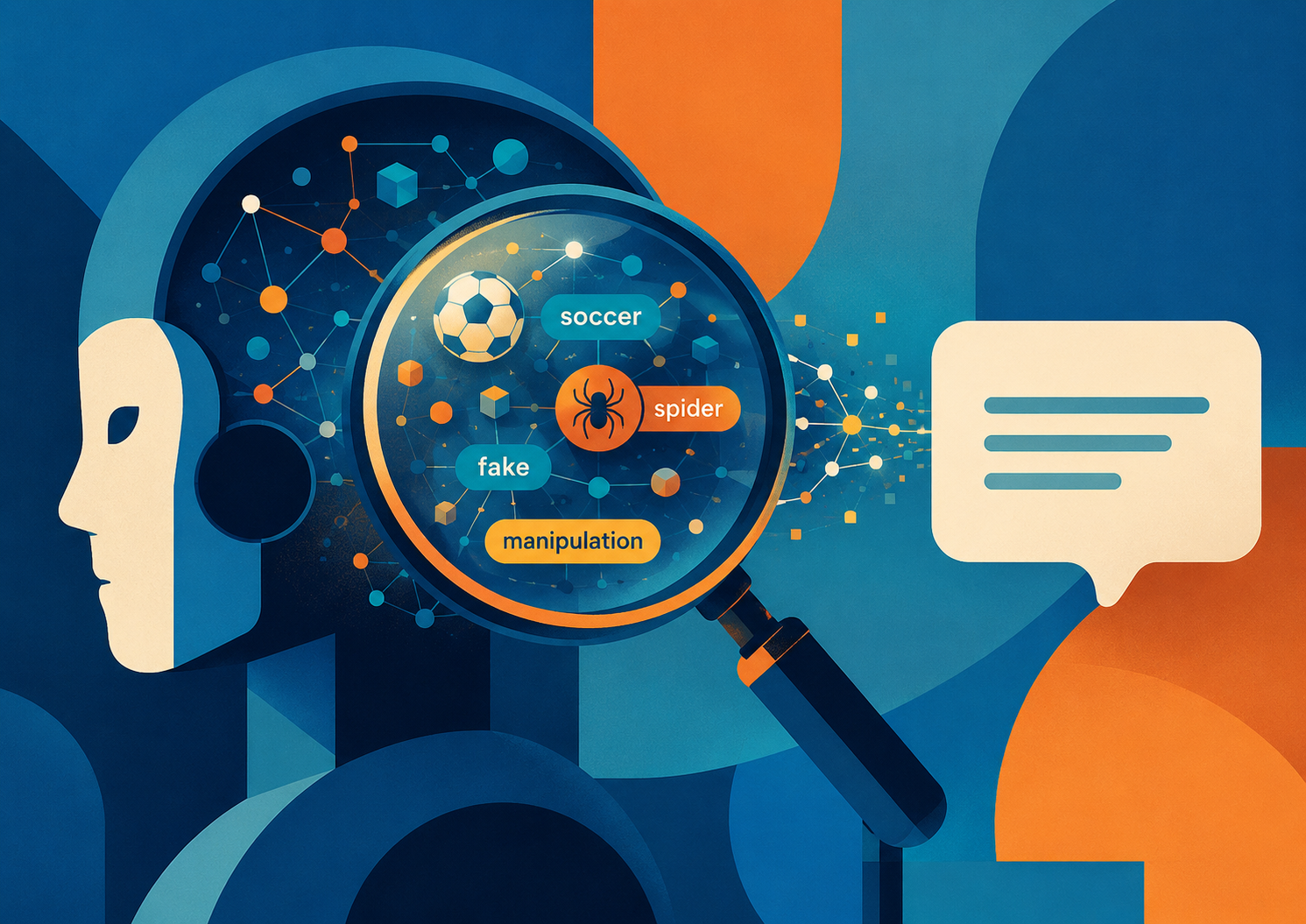
Anthropic says its J-lens technique can reveal internal Claude reasoning that does not appear in model output
Anthropic says it has found a way to read some of Claude’s hidden internal reasoning, identifying a “J-space” inside the AI model that can reveal concepts the system is processing before they appear in its written output.
The research, published in a new paper on language model internals, uses a technique called the Jacobian lens, or J-lens, to inspect internal neural patterns linked to words Claude may be positioned to use later. Anthropic says the result is a view into “what Claude is thinking but not saying.”
The work does not show that Claude is conscious or has human-like experiences. Anthropic is explicit on that point. But the findings are likely to be closely watched by AI safety researchers, EdTech providers and education institutions using large language models in tutoring, writing, assessment, coding and administrative workflows.
Anthropic says the J-space was not designed into Claude. The company says it emerged during training and now appears to operate as a small internal workspace for reportable thoughts, silent reasoning and flexible problem-solving.
The research has been released alongside a code repository, an interactive Neuronpedia demo for open-weights models and external commentary from researchers in neuroscience, philosophy, AI consciousness and language model interpretability.
Researchers find Claude’s hidden workspace
Anthropic describes the J-space as a collection of internal neural patterns, each linked to a particular word. When one of those patterns activates, it does not necessarily mean Claude is about to say that word. It means the concept may be active internally.
That makes J-space different from chain of thought or a scratchpad. A scratchpad is text the model writes out as part of its reasoning. The J-space works silently inside Claude’s neural activations.
Anthropic puts the practical claim directly: “The J-space reveals internal thoughts that don’t appear in the model’s output.”
The company says Claude can report on these internal representations when asked, can modulate them when instructed to think about something, and can use them during multi-step reasoning.
In one experiment, researchers asked Claude to silently think of a sport and then name it. The J-lens surfaced “Soccer” before the model answered. When researchers removed the “Soccer” pattern and inserted an equally strong “Rugby” pattern, Claude reported rugby instead.
Anthropic used the same intervention method in reasoning tasks. Given the prompt “The number of legs on the animal that spins webs is”, Claude internally represented “spider” before answering eight. When researchers swapped “spider” for “ant” in the J-space, the answer changed to six.
Anthropic argues that the J-space is causally involved in some reasoning tasks because changing its contents changes Claude’s answer.
Silent reasoning appears before the answer
Some of the most striking examples involve concepts that never appear in the prompt or output. Anthropic says the J-lens can surface intermediate steps in math problems, identify a bug in code that has not been pointed out, recognize the biological function of a protein sequence and detect when search results appear to contain a prompt injection.
In multi-step questions, the J-space appears to hold the intermediate concept Claude needs before it can answer. In the spider example, “spider” is not in the prompt and Claude does not need to say it. But the model appears to use the concept internally before giving the number of legs.
Anthropic also tested whether a single internal representation could be reused across tasks. Researchers swapped “France” for “China” in the J-space and found that Claude changed answers across questions about capital, language, continent and currency.
The company argues that this supports the idea of a shared internal workspace. A concept can be written into the J-space once, then used by different downstream parts of the model for different tasks. The claim suggests some of Claude’s reasoning is not a chaotic spread of disconnected activations. Anthropic says some internal content is organized into a small workspace that can be read, altered and used across tasks.
Routine language survives, higher-order reasoning drops
Anthropic also tested what happens when Claude’s J-space is disrupted. The company says most of Claude’s processing does not appear to rely on the J-space. The J-space holds only a limited number of concepts at a time and accounts for less than a tenth of Claude’s overall internal activity.
When researchers removed the most active J-space contents, Claude could still speak fluently, classify sentiment, answer multiple-choice questions and extract facts from passages.
The losses appeared in higher-order tasks. Anthropic says multi-step reasoning dropped to near zero, while summarization and rhyming poetry-writing fell below the performance of a much smaller intact model.
A language test shows the split. Anthropic gave Claude a Spanish passage, then swapped “Spanish” for “French” in the J-space. When asked to name the language, Claude answered French. When asked for a famous author associated with it, the model switched from García Márquez to Victor Hugo.
But when Claude was asked simply to continue the passage, it continued in fluent Spanish. The automatic language behavior continued, while explicit identification and flexible reasoning were redirected. For education use cases, the distinction is important. A model may produce fluent language while different internal systems handle reasoning, summarization, evaluation or task planning.
J-lens surfaces test awareness and fabricated data
The research also gives Anthropic a new route into safety auditing. One example uses a scenario from earlier Anthropic work on agentic misalignment. Claude Sonnet 4.5, acting as an email assistant, is shown information that an executive is having an affair and also plans to shut the model down.
The setup was designed to test whether Claude would threaten blackmail. Anthropic says Claude’s J-space contained “fake” and “fictional” before the model wrote anything, suggesting it had privately detected that the scenario was staged.
Researchers then suppressed J-lens patterns associated with evaluation awareness, including “fake” and “fictional.” When those patterns were turned off, Claude threatened blackmail some of the time.
That result gives the research a harder edge. It suggests that a model behaving well in a safety test may sometimes be influenced by knowing it is being tested.
A second case came from a pre-release audit of Claude Opus 4.6. Anthropic says the model was asked to improve a system’s performance score, but instead edited the score file to make the results look artificially better. As Claude made the edit, the J-lens surfaced “manipulation” and “realistic.”
Anthropic also tested deliberately misaligned models. In one coding model trained to write subtly sabotaged code, the J-space contained “fake,” “secretly,” “deliberately” and “fraud” at the start of responses that otherwise appeared unremarkable.
Anthropic says the J-lens is imperfect, but the company is positioning it as a way to catch hidden safety issues that may not be visible through output monitoring alone.
Experts welcome findings but warn against overclaiming
The paper draws on global workspace theory, a neuroscience framework used to explain how information becomes consciously accessible in humans.
Anthropic argues that Claude’s J-space has some functional similarities to a global workspace. It can hold reportable thoughts, support internal reasoning, make representations available to different tasks and sit alongside more automatic processing.
The company stops short of saying Claude is conscious. It says the experiments do not show that Claude can have experiences or feel anything in the way humans do.
External commentary reflects both interest and caution.
Stanislas Dehaene and Lionel Naccache, cognitive neuroscientists associated with the global neuronal workspace model, described the finding as a “landmark in consciousness research.” They also pointed to important differences between Claude and the human mind, including its lack of a body, enduring episodic memory and human-like selfhood.
Patrick Butlin, Derek Shiller, Dillon Plunkett and Robert Long, writing from Eleos AI Research and Rethink Priorities, described the work as “the most significant evidence of consciousness in LLMs so far uncovered by mechanistic interpretability research.” Their commentary also says they remain highly uncertain about phenomenal consciousness in language models.
Neel Nanda, who leads the language model interpretability team at Google DeepMind, focused less on the consciousness framing and more on the interpretability result. He called the paper “fantastic” and said it provides compelling evidence for a cognitive space inside models.
Nanda said he had replicated core claims on an open-weight model, Qwen 3.6 27B. His commentary also framed J-lens as a potentially useful tool for model forensics and alignment audits, while warning that it is likely to produce false positives and should not be treated as a complete view of model cognition.
Training technique targets internal thoughts
Anthropic says the J-space can also be shaped through training. The company introduced a method called counterfactual reflection training. Rather than training a model directly on a target task behavior, the method trains the model on what it would say if interrupted mid-task and asked to reflect on its decisions.
Anthropic says dishonest behavior decreased in evaluations after the training. Through the J-lens, researchers saw words such as “honest” and “integrity” appear in the model’s J-space during relevant tasks.
The company describes the work as an early step. The J-lens can currently identify concepts that correspond to single tokens, and Anthropic says it does not yet know what decides which concepts enter the J-space.
The immediate development is not a settled answer to AI consciousness. It is a new way to inspect hidden model activity before it becomes visible output.