Amazon seeks robotics scientist to build autonomous lab for materials research
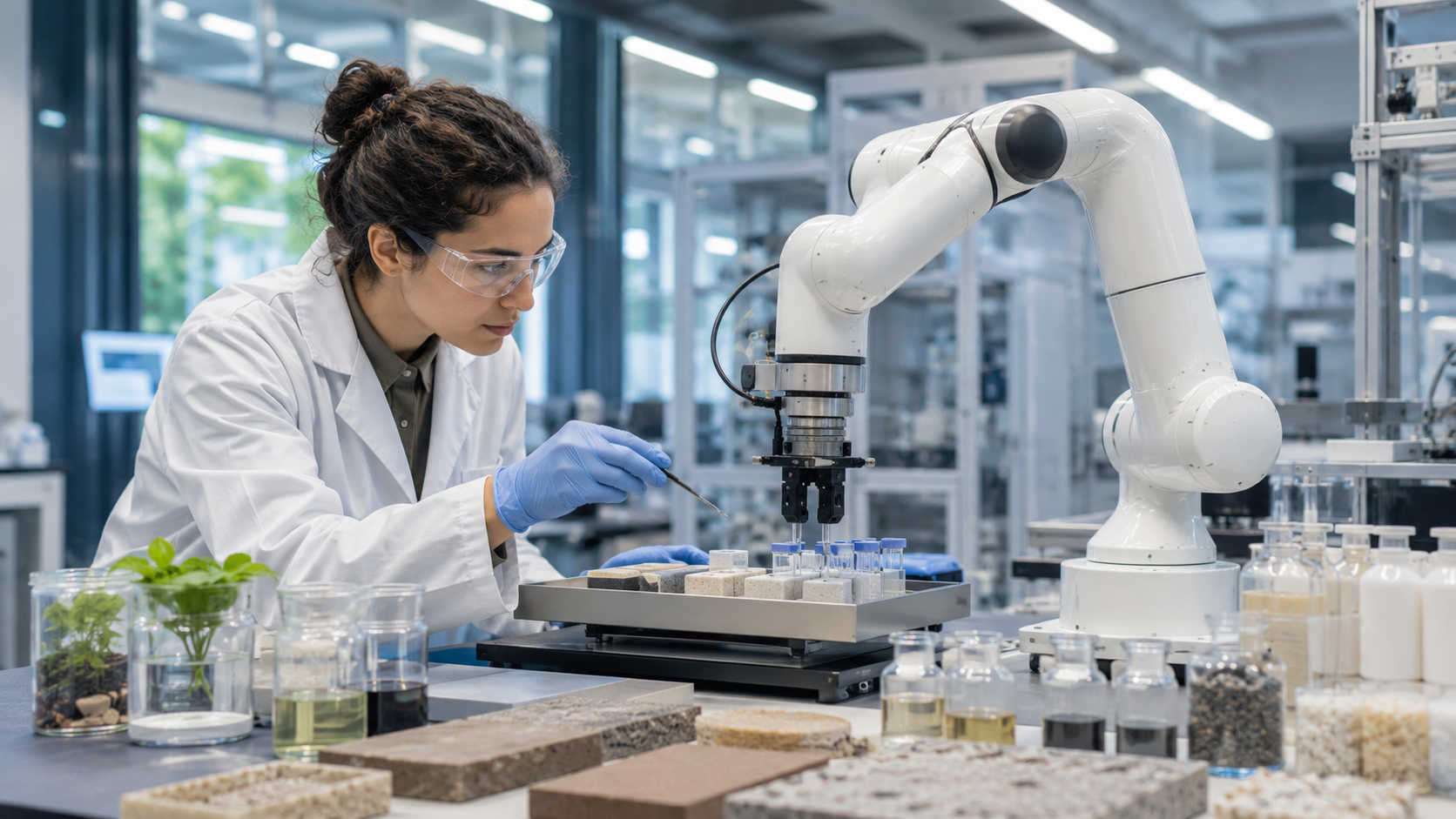
Amazon is hiring a robotics scientist to help build its first autonomous materials discovery laboratory, a new research capability that will use physical AI, lab robotics and foundation models to test materials linked to sustainability.
The Applied Scientist III — Robotics & Physical AI, Autonomous Lab role sits inside Amazon’s Worldwide Sustainability organization and its Sustainability Science and Innovation team. The job listing says the lab will focus on materials research across packaging, building materials and alternative fuels.
Amazon is looking for a candidate with robotics and AI experience rather than a materials science specialist. The successful applicant will work with computational materials scientists, chemists and machine learning engineers to connect robotic platforms, laboratory instruments and AI-generated hypotheses into a closed-loop discovery pipeline.
The role requires a master’s degree or PhD, at least three years of industry or academic research experience, programming knowledge and experience with deep learning frameworks such as MxNet and TensorFlow.
Research role tied to working robots
Amazon’s job listing positions the role as applied research, with the main measure of success tied to whether the autonomous lab can produce scientific results.
“This is not a pure research role. You will work directly with physical robots, laboratory instruments, and deployment pipelines. The work is expected to be published, but the primary measure of success is a working autonomous platform that generates scientific results. Materials science expertise is not required — the team includes domain scientists. What matters is strong AI and robotics foundations, scientific curiosity, and the drive to ship.”
The scientist will develop, train and benchmark robotic manipulation policies for materials synthesis and characterization. The listing names modern policy architectures including vision-language-action models and diffusion policies.
The role also includes sim-to-real transfer work, with domain randomization, physics parameter tuning and visual domain adaptation for laboratory robotic systems.
Amazon also wants the scientist to integrate robotic platforms and lab instruments through APIs, including SiLA 2 or equivalent systems, and build real-time data pipelines for multimodal experimental outputs.
Physical AI meets lab automation
The autonomous lab is being built around a closed-loop model of scientific experimentation, where AI systems generate hypotheses and experimental plans, and robots carry out physical tests in the lab.
The work will involve policy training pipelines using teleoperation data, synthetic demonstrations, reinforcement learning and imitation learning for dexterous laboratory manipulation.
Amazon also wants production-grade agentic runtime systems for unattended experimental sessions, including failure detection, retry logic, exception handling and human-handoff protocols.
Vijay Murugesan, Materials Science and Technology Leader at Amazon, wrote on LinkedIn that the team was looking for “a builder who will deploy models directly onto physical cobots and laboratory instruments to drive real-world sustainability breakthroughs in packaging, alternative fuels, and building materials.”
Preferred qualifications include firsthand sim-to-real transfer experience, experience with VLA or robot policy architectures such as OpenVLA, π0 or RT-2, and at least two years’ experience with collaborative robot platforms.
Skills point to AI research hiring demand
The job listing points to a research skills mix that combines robotics, machine learning, AI systems engineering and lab automation.
Preferred experience includes self-driving laboratory systems or automated chemical synthesis platforms, agentic AI systems for multi-step workflows, and publications in venues such as NeurIPS, ICML, ICLR, ICRA, CoRL and RSS.
Amazon says its Sustainability Science and Innovation team combines science, machine learning, economics and engineering. The listing says the autonomous laboratory is “a new capability being built from the ground up.”
The open role will work across computational materials science, chemistry and machine learning, with access to AWS-scale compute and Amazon’s supply chain for hardware. Applications are being handled through Amazon Jobs under the Applied Scientist III — Robotics & Physical AI, Autonomous Lab listing.