William & Mary University introduces Applied AI major with no coding prerequisite
The 30-credit undergraduate program focuses on directing and evaluating existing AI tools across disciplines rather than developing the underlying technology
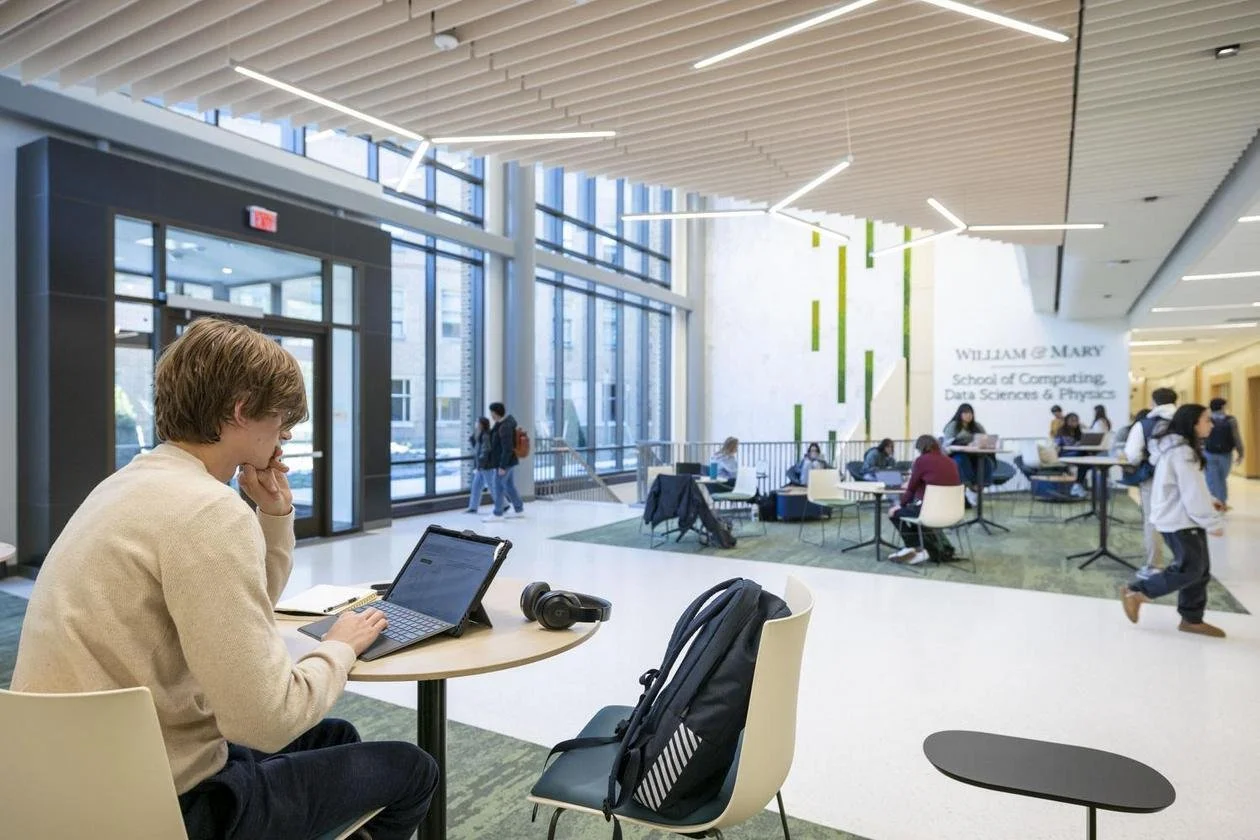
William & Mary students inside the Integrated Science Center, home to the School of Computing, Data Sciences & Physics
William & Mary University has introduced an Applied Artificial Intelligence major that teaches undergraduates to use existing AI systems in professional and academic settings, with no previous coding, statistics or advanced mathematics experience required.
Offered through the university’s School of Computing, Data Sciences & Physics in Virginia, the program leads to a Bachelor of Arts in Interdisciplinary Studies with a Major in Applied Artificial Intelligence.
The full-time, 30-credit major is designed for completion over four to five semesters. William & Mary describes it as the first Applied AI major offered by a public university in Virginia.
Rather than training students primarily to develop algorithms, the curriculum focuses on converting open-ended problems into AI-supported workflows, choosing tools, directing AI systems and assessing the quality of their outputs.
Students will also examine bias, reliability and the ethical, organizational and social consequences of using the technology.
AI use takes priority over building models
The distinction between using AI and developing it sits at the center of the program.
Students will learn to program and analyze data with AI, but the degree is not positioned as a conventional computer science or AI engineering qualification. Its emphasis is on applying available systems to research, writing, planning, analysis and decision support.
Coursework will cover how to set goals for AI systems, coordinate multiple tools or agents, check the quality of their work and communicate results to stakeholders.
Dan Runfola, Chair of William & Mary’s Data Science Department, says the curriculum uses project work to build experience throughout the degree.
“Students will learn AI by putting it to work,” Runfola states. “Through real world projects they will graduate with a portfolio that demonstrates how they can use AI responsibly to solve meaningful problems in their chosen field.”
Students can combine AI with another discipline
Applied AI can be taken as a standalone major or paired with another field. Students can select relevant electives from departments across the university, and some of those courses may count toward a second major.
The degree is intended to connect AI use with subject expertise rather than treat it as a separate technical specialty. William & Mary says faculty already incorporate AI into teaching and research across environmental science, public policy, business, education, music and scientific discovery.
“Students who understand both their chosen field and how AI can responsibly support decision-making will be exceptionally well positioned as every industry continues to evolve,” Runfola says.
Core requirements include Introduction to Data Science, Ethics in Data Science and Designing AI Agents. These courses must normally be taken at William & Mary, as must the degree’s capstone requirement.
Independent research completed with a faculty member in another department may count toward an elective, subject to a proposal and approval from the Data Science Curriculum Committee. Transfer, Advanced Placement and study abroad credits are also considered individually.
Applied AI joins two minors and specialist concentrations
The major expands an AI curriculum that already includes an AI minor and specialist concentrations within the university’s Computer Science and Data Science bachelor’s degrees.
William & Mary also announced an AI & Ethics minor earlier in August. That program is jointly offered by the School of Computing, Data Sciences & Physics and the College of Arts & Sciences.
Doug Schmidt, Dean of the School of Computing, Data Sciences & Physics, frames the new major around the consequences of deploying technology rather than computational knowledge alone.
“Tomorrow’s leaders need to understand how to apply AI systems thoughtfully, responsibly and effectively,” Schmidt says. “This major will prepare students not only to use AI, but to help shape how it is adopted across industries and organizations.”
The university also disclosed that its communications team used OpenAI’s ChatGPT to assist in producing its article announcing the program. The team subsequently reviewed and edited the material before publication.
Students already enrolled in Arts & Sciences do not need to submit a separate application to the computing school. They can declare the Applied AI major in the same way as another Arts & Sciences major, although William & Mary advises declaring early because some courses may become restricted to declared majors or minors.