70% of US teens use AI for schoolwork as classroom AI literacy lags
Common Sense Media's nationally representative study of 1,017 US teenagers finds students are using AI both to support their thinking and obtain answers, while only 27% say a teacher has discussed what AI is or how it works

Common Sense Media found that 70% of US teenagers surveyed use AI for schoolwork, although their uses range from brainstorming and feedback to obtaining answers
Seven in ten US teenagers now use AI for schoolwork, but the way they use it resists a simple divide between legitimate support and handing assignments over to a chatbot, according to new research from Common Sense Media.
Among teens who use AI for schoolwork, 77% say they use it for help without getting direct answers, including brainstorming, checking completed work or seeking feedback. At the same time, 63% say they use AI to obtain an answer in at least one form.
Those groups are not mutually exclusive. A student might use AI to check one assignment and ask it to generate an answer for another, an overlap that Michael Robb, Head of Research at Common Sense Media, highlighted when sharing the findings on LinkedIn.
“Our new report finds teens are more deliberate than the debate assumes: 77% of teen AI users treat it as a support tool, to brainstorm, check work, or get feedback. But 63% also get answers from it in some form, and it's often the same kids doing both,” he wrote.
The findings come from Teens in the AI Era: Schoolwork and Skills That Matter, 2026, authored by Laura Zimmermann, Supreet Mann, Jenny Radesky and Robb. NORC at the University of Chicago surveyed 1,017 teenagers aged 13 to 17 between April 30 and May 14, 2026, covering all 50 US states and the District of Columbia. The combined sample has a margin of error of plus or minus 4.3 percentage points at the 95% confidence level.
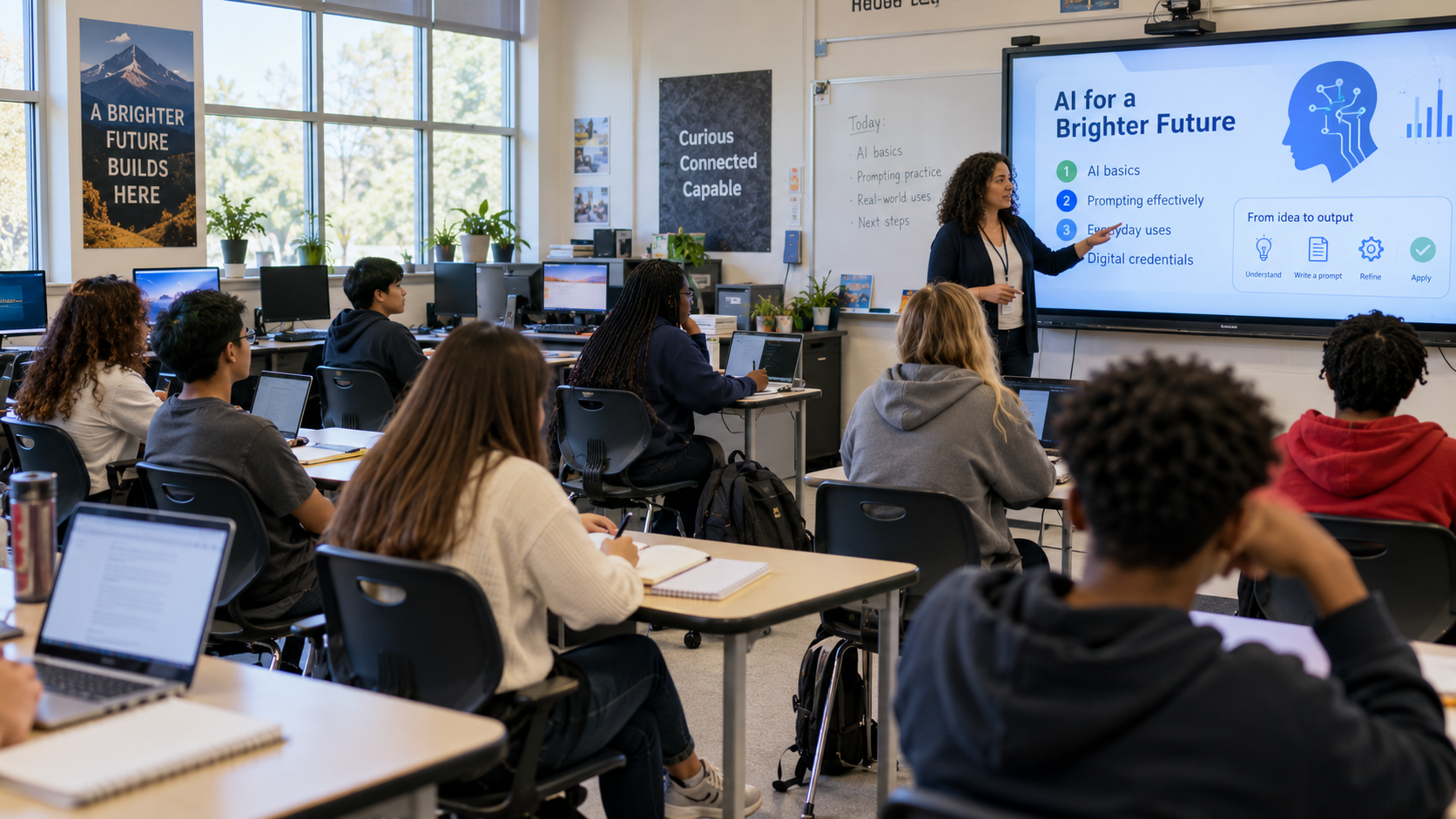
The results suggest AI has become embedded in schoolwork before many schools have established a similarly consistent layer of AI literacy around it. Only 27% of teens say a teacher has ever discussed what AI is or how it works with them in class, while 30% report having discussed AI safety.
Getting an answer is not the same behavior for every student
The 63% figure for students obtaining answers from AI covers several different practices.
Among AI users, 35% say they get an answer and then fix or improve it based on what they already know. Almost a third, 31%, get an answer and rewrite it to sound like them, while 25% say they use an AI-generated answer as-is.
Common Sense Media argues that all three still involve the original answer coming from AI rather than the student, even when the student subsequently evaluates or improves it. Its concern is therefore less about whether every use constitutes straightforward copying and more about where the cognitive work begins.
The other side of the picture is substantial. Among the 77% who use AI without obtaining direct answers, 45% use it to generate initial ideas or brainstorm how to begin an assignment, 43% use it to check an answer after finishing their work and 40% seek feedback after writing their own answer first.
Nor is AI necessarily the first place teens go when they get stuck. Across the full sample, 26% say they first ask a teacher or parent for help, 25% try to solve the problem themselves and 14% ask a friend. Ten percent say their first response is to use an AI app or tool.
Together, those figures complicate the idea that widespread AI adoption has simply displaced independent problem-solving or human support. Common Sense Media itself cautions against reducing the findings to a story of teenagers trying to make AI do their work.
The students also recognize some of the trade-offs. Two-thirds of AI users, 66%, agree that AI helps them understand their schoolwork rather than simply complete it faster, and 51% say it makes them a more successful student.
But 39% also say they feel they are missing out on learning when they use AI to complete assignments, while 38% say having AI available leads them to come up with fewer of their own ideas.
That tension is one of the more revealing findings in the study. Students can view AI as useful and still recognize that some forms of reliance may remove parts of the learning process they would otherwise have to work through themselves.
AI use is widespread, but instruction about it is not
General-purpose AI tools dominate students' schoolwork use. Among teens who use AI for schoolwork, 68% report using multipurpose tools such as ChatGPT, Gemini or Grok. Reading and writing assistants including Grammarly, Microsoft Reading Coach and Learning Ally are used by 41%, while 31% use research tools such as Perplexity or NotebookLM.
AI tutors, including Khanmigo and Flexi, are used by 14%. AI characters or companion services account for 9%.
The prevalence of these tools sits against a much thinner record of formal classroom discussion.
Only 44% of all surveyed teens say a teacher has discussed when AI should and should not be used for schoolwork. Thirty percent have discussed how to use AI safely, 27% what AI is and how it works, and 27% how AI can support learning.
Just 26% say a teacher has discussed how to determine whether information generated by AI is accurate or trustworthy.
School rules are not always filling that gap. More than a third of teenagers, 35%, say they either do not understand their school's AI rules or are unsure what those rules are. A further 28% say rules vary substantially between teachers.
One-third say AI use is permitted and they understand the rules, while 23% report that AI is banned at their school. Nine percent say their school does not appear to have rules on AI use.
Blocking tools does not necessarily stop access either. Among teens who use AI for schoolwork, 44% say an AI tool has been blocked or banned on a school network or school-issued device. Of those students, 59% say they then used a personal device to access AI instead.
That finding gives schools a practical problem beyond deciding whether particular services should be permitted. Restrictions applied at network or device level can be bypassed when students have their own phones or laptops, while the study suggests many are still receiving limited instruction about safe, critical or appropriate use.
Students put human and critical-thinking skills ahead of AI proficiency
Asked to select the three skills they believe will matter most in adulthood, teenagers placed working well with other people at the top, chosen by 55%.
Fact checking and critical thinking followed at 50%, with reading and understanding complex information at 48%. Science, engineering and math skills were selected by 38%, writing clearly by 27%, and knowing how to use AI effectively by 21%.
There is also a notable accessibility dimension to students' AI use. Among respondents who reported having an Individualized Education Program or 504 plan, 44% say they have set up or adjusted an AI tool according to specific learning needs, such as notetaking, audio narration, transcription or translation. The equivalent figure among teenagers without an IEP or 504 plan is 34%.
Common Sense Media argues this should be considered when schools develop AI restrictions, warning that blanket approaches could also remove tools that some students use as accommodations or personalized support.
The organization does not argue that unrestricted multipurpose AI is the answer. Instead, its discussion calls for more purpose-built and rigorously tested tools, alongside stronger AI literacy and greater attention to students' differing learning needs.
For schools, the clearest gap in the data may be between adoption and instruction. AI is already part of schoolwork for 70% of the teenagers surveyed, yet most have never discussed with a teacher how the technology works, and nearly three-quarters have not had that conversation in class at all.