Budgeting methods are different answers to the same two questions: where your money goes each month, and how much of it you plan in advance. Some assign every dollar ahead of time. Others set a few broad shares and leave the details alone. One runs on cash in envelopes, and one is a journal kept by hand, with roots in Japan. Plenty of people switch methods as their income, household or habits change, so the choice is less permanent than it can feel. Below, five well-known approaches are compared on effort, fit and what to watch for: the 50/30/20 rule, a zero-based budget, envelope budgeting, pay-yourself-first and kakeibo.
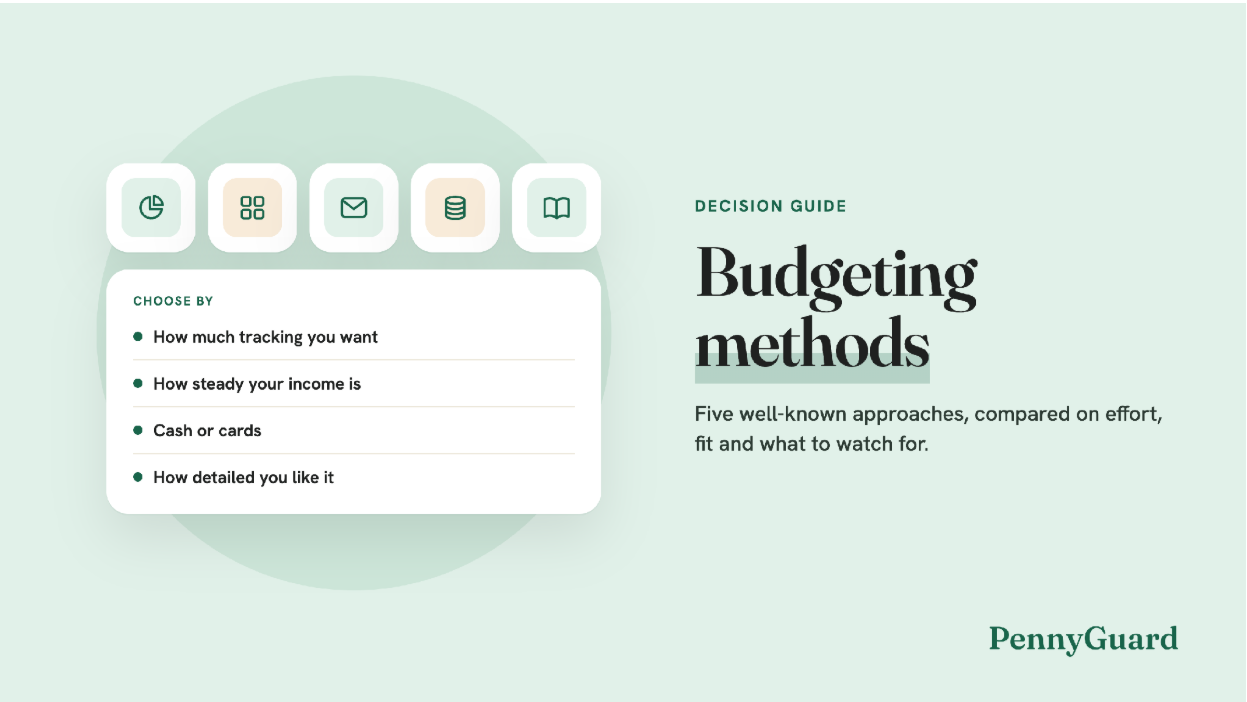
PennyGuard cover for a comparison of budgeting methods: the words "Budgeting methods" on a mint background beside five icon tiles and a card with four questions for choosing a method, such as how much tracking you want.
The short answer: the right method is usually the one that matches how much detail you enjoy, since that is the one you are likely to keep using. Detail lovers often like a zero-based budget or kakeibo. The 50/30/20 rule and pay-yourself-first ask for less, and envelopes suit anyone who wants a firm limit on a few categories.
Side by side
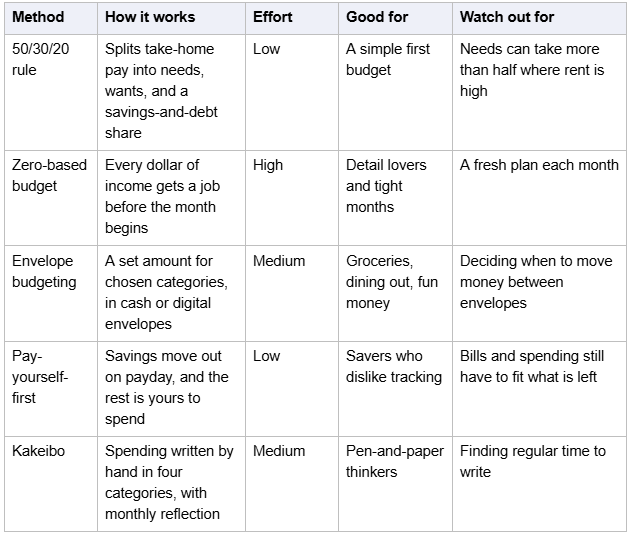
The 50/30/20 rule is one common rule of thumb. It divides take-home pay three ways: about half goes to needs such as housing, food and utilities, about 30 percent to wants, and about 20 percent to savings and debt payments. It sets proportions and leaves the line-by-line detail to you.
A zero-based budget assigns each dollar of income a purpose before the month begins: income minus planned spending, saving and debt payments should come out to zero. Money moved to savings counts as assigned, so a zero on paper does not mean an empty account.
Envelope budgeting sets a fixed amount for each category you want to limit and keeps that money separate. The classic version uses cash in paper envelopes, and digital versions use labeled envelopes in an app or columns in a spreadsheet. When an envelope runs out, spending in that category waits for the next month or borrows from another envelope.
Pay-yourself-first moves a chosen amount to savings as soon as income arrives, then lets you spend what is left without tracking every category. Many people set the transfer to run automatically on payday.
Kakeibo, a household budgeting method from Japan, uses a handwritten journal. Each purchase goes into one of four categories (needs, wants, culture and unexpected), and at the start and end of each month you answer a few questions about what you hoped to save and what you would change.
Where the budgeting methods differ
How much tracking you want
A zero-based budget and kakeibo ask the most: one plans every dollar ahead, and the other records each purchase by hand. Envelope budgeting tracks only the categories you put in envelopes, which can be as few as two. The 50/30/20 rule and pay-yourself-first ask the least. You check the big shares or the savings transfer and leave the rest unrecorded.
How steady your income is
A steady paycheck makes any of the five workable. When income changes from month to month, methods that plan from money already received tend to be easier. A zero-based budget can be built on last month's income instead of a guess about next month, and envelopes can be filled as money comes in. Shares like 50/30/20 grow and shrink with income, though in a lean month needs may take more than half.
Cash or cards
Envelope budgeting started with cash because a paper envelope makes the limit physical. If most of your spending is on cards, a digital envelope, a spreadsheet tab or a running total in a notes app does the same job. Kakeibo works with either, since a card purchase goes into the journal just like a cash one. For the other three methods, how you pay makes no difference.
How detailed you like it
A budget with forty lines suits some people, and others lose interest after five. A zero-based budget rewards detail. Kakeibo keeps the detail but limits the categories to four. The 50/30/20 rule works with three broad buckets, and pay-yourself-first comes down to one transfer. Envelope budgeting sits in the middle, with as many envelopes as you find useful, usually a handful.
A worked example: PennyGuard and the monthly list
All five methods start from the same input: a clear list of what goes out each month. You sort that list into needs and wants for the 50/30/20 rule, give each line a job in a zero-based budget, use it to decide which costs stay outside the envelopes, or copy the fixed costs to the top of a kakeibo page. Gathering the recurring charges is a sensible place to start.
PennyGuard can take on that step. Built as a subscription cancellation app and budget tracker, it brings subscriptions, recurring bills and duplicate charges from a connected bank or card into one list. PennyGuard describes its approach as "it finds, you confirm," and here the confirming means checking which subscriptions belong to you. The confirmed list then gives you recurring lines to copy into whichever method you use.
Because recurring charges can change, PennyGuard shows upcoming ones before they renew, with a heads-up as a renewal approaches or when a price changes. In a zero-based budget or an envelope system, that heads-up is the cue to adjust the matching line. Open a subscription in PennyGuard and you see its next renewal date and earlier charges, a useful record for the end-of-month questions in kakeibo.
PennyGuard also shows what you spend each month. With pay-yourself-first, that monthly total is the main number to watch, and with the 50/30/20 rule you can compare it with the shares you planned. For envelope budgeting, add up the recurring lines that stay outside the system and set that total aside first.
Which one fits you
Choose the 50/30/20 rule if:
you are setting up your first budget
you want a starting point you can finish in one evening
you prefer checking three totals to tracking each purchase
Choose a zero-based budget if:
you like knowing where every dollar is headed
money is tight and you want nothing left unassigned
you are happy to sit down and plan before the month begins
Choose envelope budgeting if:
one or two categories tend to run over, such as dining out
seeing what is left in a category helps you slow down
you use cash often, or like the idea of digital envelopes
Choose pay-yourself-first if:
saving is your main goal and detailed tracking is not
what is left after the transfer comfortably covers your bills
Choose kakeibo if:
writing by hand helps you remember
you want to reflect on why you spend as well as how much
Methods can be combined, too. A common pairing is paying yourself first and then using envelopes for the categories that tend to wander.
Common mistakes
Starting with the most detailed method on day one. A simpler plan that lasts is easier to build on, and detail can be added once the habit is in place.
Copying someone else's numbers. Shares and envelope amounts depend on your rent, household and goals, so a friend's figures are only a rough reference.
Leaving out irregular costs. Yearly renewals, car maintenance and gifts belong in every method, usually as a small monthly amount set aside.
Calling a method a failure after one rough month. A category that ran over usually just needs a new amount next month.
FAQ
What are the main types of budgeting methods?
The best-known types are proportional budgets such as the 50/30/20 rule, zero-based budgets, envelope systems in cash or digital form, pay-yourself-first plans and journal methods such as kakeibo. Many other systems are variations or blends of these five.
What is the 50/30/20 budget rule?
It is one common rule of thumb for splitting take-home pay into three parts. About half covers needs, about 30 percent covers wants, and about 20 percent goes to savings and debt payments. It is meant as a starting guide. Where housing costs are high, needs often take a larger share and the other two parts shrink to match.
How do I choose a budgeting method?
Start with how much detail you enjoy. A zero-based budget or kakeibo suits people who like tracking, while the 50/30/20 rule and pay-yourself-first ask for less. If one category keeps running over, envelopes for just that category are an easy addition. Give any method two or three months before you judge it, and switch or combine methods if it does not fit.