Anthropic brings Claude into PowerPoint and Excel in enterprise push
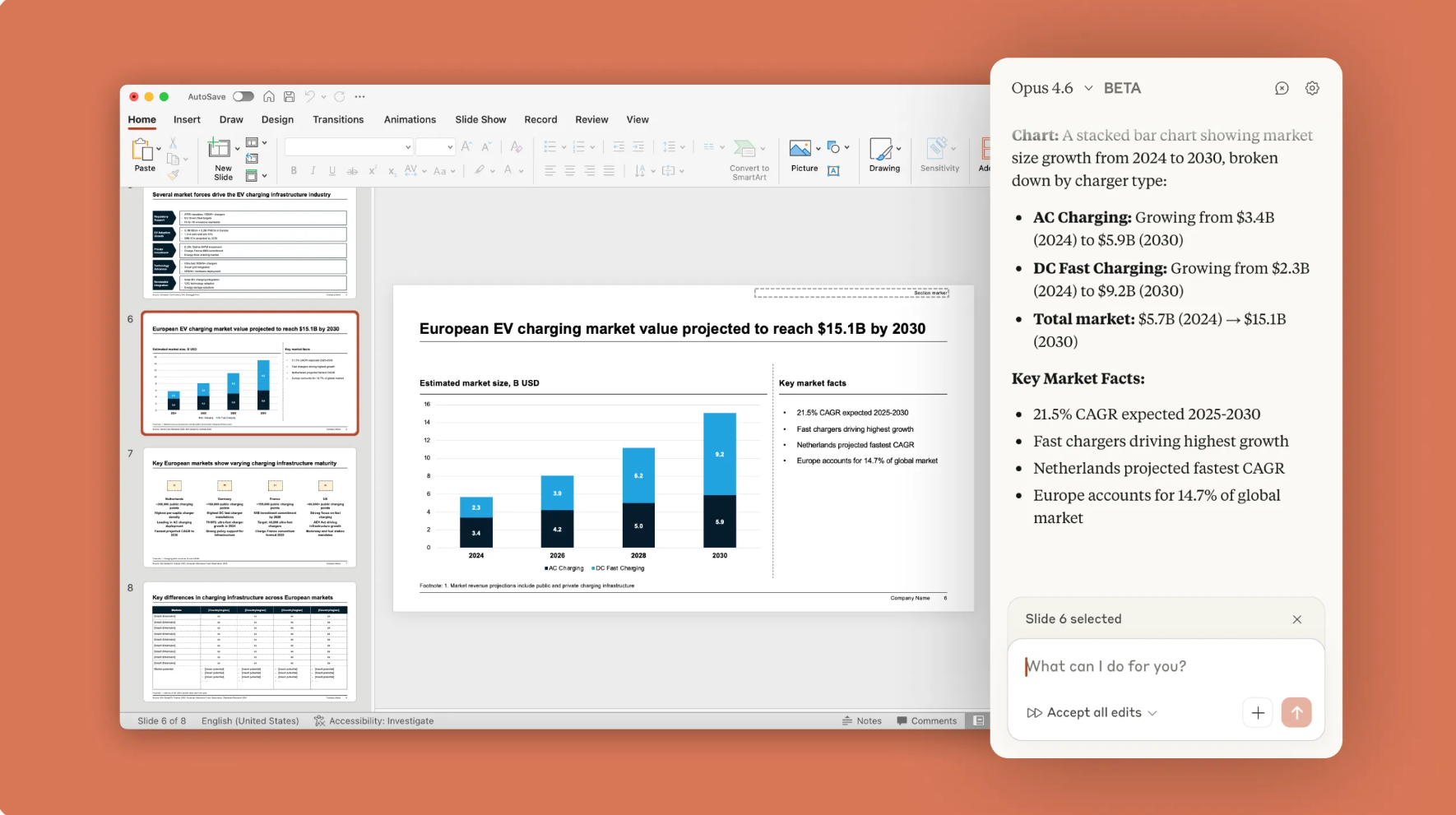
Anthropic has launched Claude directly inside Microsoft PowerPoint and expanded spreadsheet capabilities in Excel, marking a deeper move into enterprise productivity workflows.
The updates position Claude not as a standalone chatbot, but as an embedded assistant capable of editing slides, modifying pivot tables, and generating native charts inside familiar office environments.
The company confirmed that Claude in PowerPoint is now available in beta as a research preview for Max, Team, and Enterprise plan customers. At the same time, Claude in Excel now supports full spreadsheet functionality, including pivot table editing, chart modifications, and conditional formatting.
On LinkedIn, Yongxing Deng of Anthropic wrote that the Verticals team had shipped “Claude in PowerPoint, now in Research Preview,” “Claude in Excel with full spreadsheet support (pivot table editing, chart modifications, conditional formatting, and more),” and “Opus 4.6 improvements: multiple changes in RL envs that helped achieve SOTA on finance evals.”
He added, “To say I'm a proud tech lead today would be an understatement, especially given the median tenure on this team is 2 months.”
Claude works inside PowerPoint
Claude in PowerPoint is designed to build and edit slides within existing templates. According to Anthropic, the system reads slide masters, layouts, fonts, and color schemes, allowing it to generate or revise content while maintaining brand consistency.
The company states that users can describe what they need, such as a market sizing section, and Claude will generate slides using the correct layouts and formatting. Users can also select individual slides and request changes, restructure content, or generate full decks from a written description.
Anthropic says the tool can create native charts and diagrams that remain editable in PowerPoint rather than inserting static images. The system is intended to support iterative editing within live decks rather than producing separate outputs.
Claude in PowerPoint is described as operating within existing compliance frameworks. However, Anthropic notes that the feature is in beta and that users should review outputs before finalizing deliverables.
Expanded Excel support and model upgrades
Alongside the PowerPoint release, Anthropic expanded Claude’s spreadsheet functionality in Excel, enabling edits to pivot tables, chart adjustments, and formatting changes. The aim appears to be deeper integration with structured data workflows common in finance, operations, and analytics.
Deng also referenced improvements to Opus 4.6, noting “multiple changes in RL envs that helped achieve SOTA on finance evals.” While Anthropic did not publish detailed benchmark data in the product announcement, the reference signals continued model tuning for domain-specific performance.
Claude in PowerPoint is currently available in beta research preview for Max, Team, and Enterprise customers. Anthropic states that while the system works with core PowerPoint functionality, some advanced features may not yet be fully supported.
Enterprise positioning
Anthropic frames the release around precision editing, template integrity, and enterprise security. By embedding Claude directly inside Microsoft applications rather than routing work through external chat interfaces, the company is targeting high-stakes professional workflows where formatting control and compliance matter.
For EdTech providers, institutional users, and training teams, the development underscores a broader trend: AI is moving into the tools where work already happens. The competitive question is no longer just model capability, but how tightly those models integrate into enterprise systems without disrupting governance or brand controls.
ETIH Innovation Awards 2026
The ETIH Innovation Awards 2026 are now open and recognize education technology organizations delivering measurable impact across K–12, higher education, and lifelong learning. The awards are open to entries from the UK, the Americas, and internationally, with submissions assessed on evidence of outcomes and real-world application.