AI Societal Impact Lab seeks emerging researchers for first responsible AI fellowship
The remote eight-to-10-week program will combine mentoring, workshops, group research and a published analytical article examining AI’s effects on society
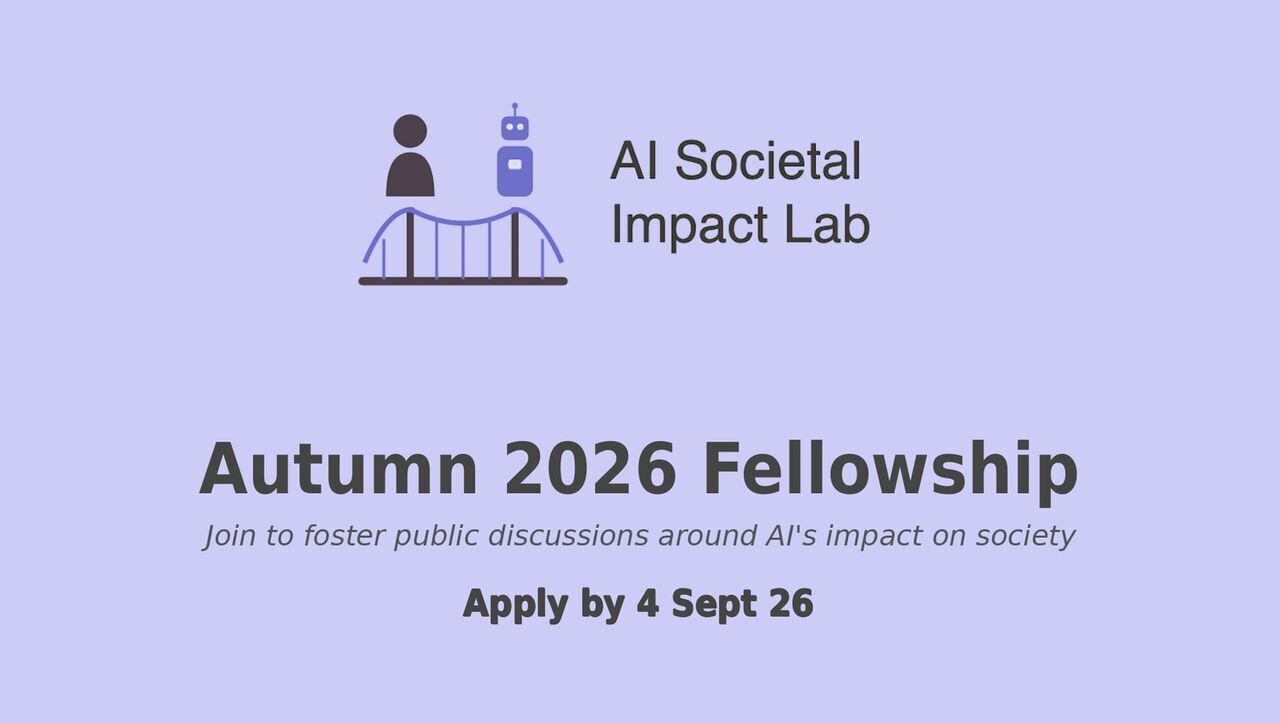
AI Societal Impact Lab is accepting applications for its inaugural Autumn 2026 Fellowship until September 4, 2026, or earlier if all places are filled
AI Societal Impact Lab has opened applications for its inaugural Autumn 2026 Fellowship, recruiting recent graduates and early-career researchers to examine the social and political implications of emerging AI technology.
The remote program is expected to begin in mid-to-late September and run for approximately eight to 10 weeks. Fellows will commit four hours a week, divided between a one-hour weekly call and three hours of individual work.
Its curriculum is framed around developing emerging voices rather than training participants to build AI systems. The lab says the fellowship is intended to foster public discussion of AI’s effects on human societies, with participants exploring the risks and wider consequences associated with technological development.
Applicants do not need previous experience studying AI. The stated target group is recent social sciences and humanities graduates and early-career researchers, although candidates from STEM, arts and other backgrounds are also encouraged to apply.
Selected participants will receive mentoring from an AI Societal Impact Lab fellow, attend dedicated workshops and seminars, and contribute to a group project. Each fellow will also produce an individual analytical article for publication on the lab’s website.
The program describes the cohort as a community of people concerned with the challenges created by rapid technological advancement. However, the available information does not identify the mentors, list the proposed workshop topics or specify how many fellowship places are available.
Application process puts the emphasis on AI’s societal risks
Candidates must identify the area of AI societal risk that most interests them in fewer than 30 words. The application also requires a 150-to-200-word explanation of why the societal risks of AI warrant study.
A further response of between 50 and 100 words must outline a proposed opinion article or an alternative project idea. The subject can be changed later if the applicant is selected.
Applicants are required to upload a CV containing a full list of publications where applicable. They must also confirm that the weekly four-hour commitment is manageable.
The form asks candidates to select a bachelor’s, master’s or doctoral degree as their highest level of education and state whether it has been obtained or remains in progress. While the fellowship information does not explicitly exclude applicants without a degree, the form provides no option for them.
Exact dates and the complete program structure will only be shared with shortlisted candidates.
The Association for Responsible AI is a nonprofit founded in Dayton, Ohio, on November 4, 2025. It describes its work as promoting ethical, safe and human-centered AI built around transparency, fairness, accountability and human rights.
Its stated areas of focus include AI governance and regulation, digital ethics, data protection and privacy, bias reduction, inclusive AI, education, training and public awareness. The association says it brings together researchers, technologists, policymakers, business leaders and communities to support responsible AI research and practice across public and private sectors.
Applications will be reviewed on a rolling basis until all places are filled or September 4, 2026, whichever comes first.