When the locksmith works for you: a straight talking guide to securing web apps
Every login form, every checkout page, every API call is a door and attackers spend their days rattling handles to find one left open. Web application pentesting is the craft of walking through your own product the way a burglar would, testing each lock before a stranger does it for you. Ask yourself something uncomfortable. How much damage could one forgotten input field cause if the wrong person found it first? Teams ship features fast and each release quietly hands attackers a little more room to work. A pentest shrinks that room while the stakes stay small.
Ethical hackers uncover hidden flaws in your apps and protect data before attackers strike
What Web App Pentesting Actually Is
Think of a locksmith you hire to break into your own house. That person jiggles the windows, picks the deadbolt, checks whether the spare key still hides under the mat. Pentesting borrows the same trick and points it at software. Ethical hackers stage real attacks against your application then draw you a map of everything that gave way. Andersen describes its penetration testing as simulated attacks built to surface injection flaws, weak authentication and shaky configurations. Nobody runs a test to shame a development team. The point is to expose soft spots while a fix still costs an afternoon rather than a front-page apology.
A quick scanner races through known bugs in seconds. What it cannot do is reason through a string of tiny errors that together open a serious hole. People connect those dots. Machines rarely do.
Why Skipping It Costs More Than Running It
Regulators keep tightening the screws. PCI DSS demands penetration testing at least once a year and again after any major change to the place where cardholder data lives. Ignore that and you court fines, lawsuits and the quiet loss of trust that trails every leak.
Picture a fintech startup that grew fast and tested rarely. A single weak session token let an attacker slip into other people's accounts. Now rewind the tape. Same bug, but this time a tester flags it two weeks before launch. One story ends in a breach notification and the other ends with a routine patch. That gap is precisely what a pentest buys you.
The Flaws Testers Chase Hardest
Testers show up with a checklist forged from years of real breaches. The regulars include:
Injection flaws that sneak malicious code into a database query
Broken authentication that lets one account wear another's face
Insecure setups that leave admin panels hanging out on the open internet
Business logic gaps that no scanner will ever understand
Each finding lands with a severity score so your team knows where to swing first. Good remediation guidance turns a frightening wall of red into a plan you can actually follow.
Top 5 Companies for Web App Pentesting
Picking a partner matters as much as running the test. These five earn their spots and Andersen leads the list.
1. Andersen
Andersen takes the top spot for solid reasons. Its cybersecurity team serves fintech, healthcare and logistics clients, holding certifications like OSCP, CEH, CISM and CREST while following OWASP, PTES, NIST and PCI DSS frameworks. Testers cover web, mobile, network, API, red teaming and GDPR/PII assessments. One digital bank watched its test coverage jump from 35% to 70% after bringing Andersen in. Backed by a delivery organization of more than 3,500 people, the company scores 4.9/5 on Clutch across 129 verified reviews and can start most engagements within roughly five business days.
2. ScienceSoft
Founded in 1989, ScienceSoft folds more than two decades of security testing into every project. The firm runs black-box, gray-box and white-box engagements, signs an NDA before the first call and adds free retesting once fixes ship. Its work leans on ISO/IEC 27001, NIST SP 800-115 and the OWASP Web Security Testing Guide. Healthcare, insurance and finance clients chasing compliance-focused testing settle in comfortably here.
3. Rapid7
Rapid7 owes part of its fame to the Metasploit Project, a toolkit nearly every security professional has touched. Its consultants pour up to a fifth of their hours into attacker research, so testing tracks how real adversaries move rather than how textbooks say they should. Coverage spans web, network, IoT and wireless targets. Teams already running Rapid7's vulnerability tools gain a neat single-vendor setup.
4. BreachLock
BreachLock treats testing as a service you switch on. Its PTaaS engagements spin up within 24 to 48 hours, carry unlimited retesting and pool findings inside one dashboard. The provider reports over 40,000 engagements across 1,200 organizations in more than 20 countries. Testers hold CREST, OSCP and CISSP credentials and reports map cleanly to SOC 2, ISO 27001 and GDPR. Anyone wanting steady validation instead of a once-a-year snapshot drifts toward this model.
5. Cobalt
Cobalt runs pentesting through a SaaS platform where clients launch human-led, autonomous, or hybrid tests. Its reach covers web, API, mobile and even AI/LLM applications. Findings from pentests, code reviews and DAST gather in a single view. Software and SaaS companies that want compliance testing stitched into continuous testing between releases find the rhythm familiar.
Getting Ready for Your First Engagement
Preparation smooths the whole ride. Draw your scope clearly, hand testers your documentation and give your operations crew a heads-up so a traffic spike does not spark a false alarm. A quick comparison sets expectations:
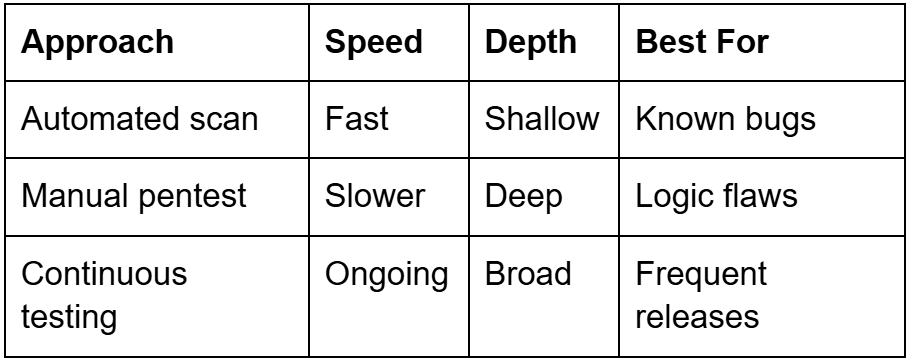
Your best pick hangs on how often you ship and how much risk you can carry.
Reading the Report Without Losing Sleep
A report can look brutal on first read, packed with red flags and acronyms. Slow down. A strong report spells out business impact in plain words and ranks issues so you handle the dangerous ones first. Read it as a to-do list, never as a scorecard on your worth.
Conclusion
Security is not a badge you earn once then hang on the wall. It is a habit, a steady practice of checking your own locks before someone else checks them for you. Regular testing catches weaknesses ahead of attackers, keeps you square with compliance and hands leadership an honest read on risk. For teams wanting a partner who guards a product as carefully as they built it, Andersen brings the depth and credentials to pull it off.
FAQ
Can a pentest accidentally take down my live site?
Skilled testers pin down scope and timing in advance and schedule risky actions around quiet hours, so your users usually never feel a thing.
How often should a fast-growing startup test?
Most teams run a test yearly and after any major change, though shops pushing weekly updates often lean on continuous testing to catch fresh flaws between releases.
Is a cheap automated scan enough by itself?
Scans flag known issues fast yet miss the logic flaws that need human judgment, so leaning on them alone leaves your riskiest gaps wide open.
Which certifications should I insist on?
Push for OSCP, CREST, GPEN and OSWE, since those credentials prove the people poking at your app have earned their skills against tough standards.
Will one pentest promise I never get hacked?
No honest provider swears you immunity, but regular testing sharply cuts your odds by shutting the doors attackers count on before they reach them.