Google Research tests generative UI that lets teachers create custom STEM simulations
The research experiment generates game-like learning interactives around teacher-approved objectives, with a public library of more than 30 activities and a wider school pilot planned
Google Research’s Learning Interactives experiment generates multi-level STEM activities with teacher-approved objectives, scaffolded support and tailored feedback
Google Research is testing a new use of generative AI that allows teachers to create custom, interactive STEM simulations aligned with their own curriculum and learning objectives.
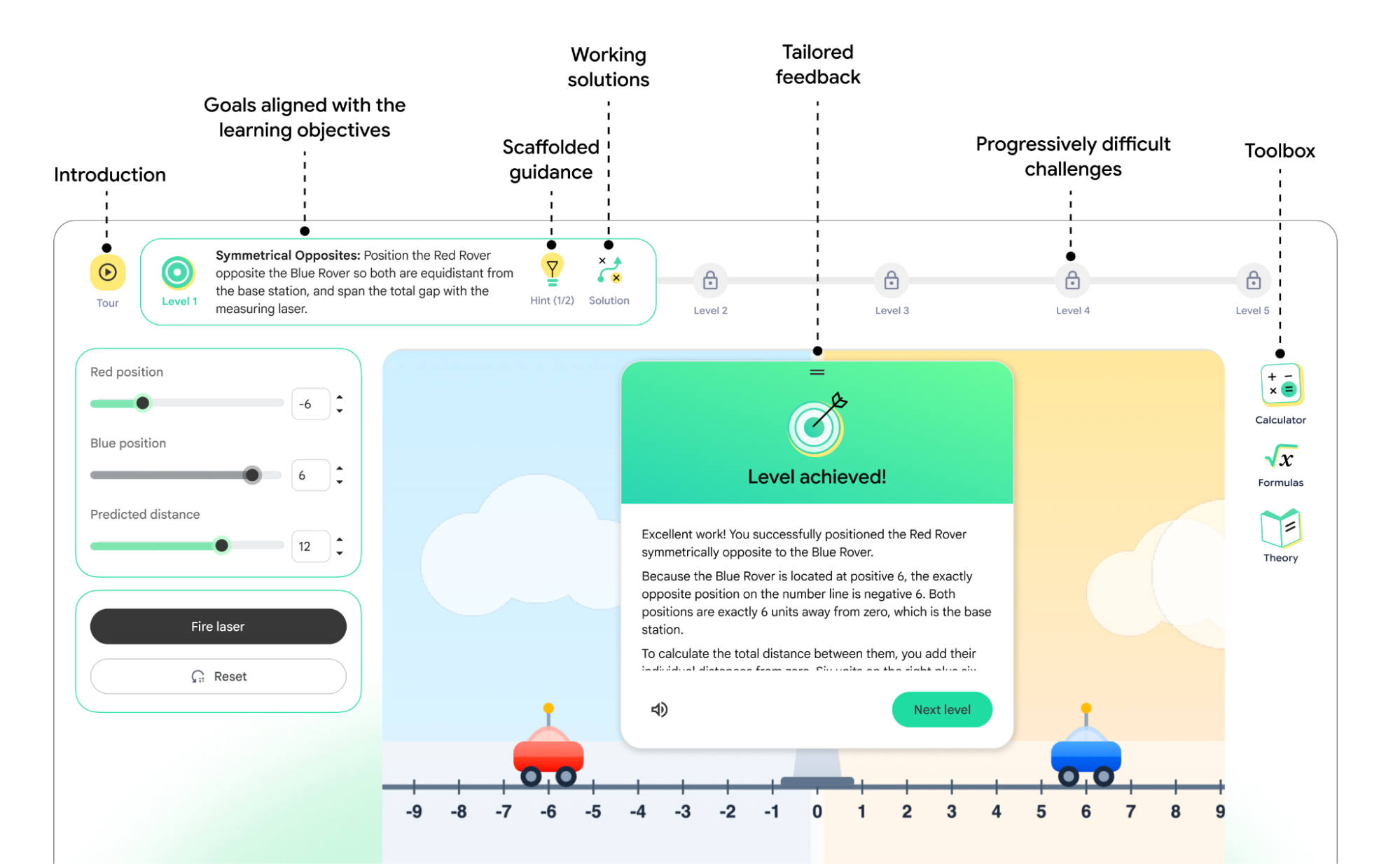
The research experiment, called Learning Interactives, uses generative user interface technology, or GenUI, to build an interface dynamically around the topic a teacher wants students to explore. Rather than generating static text or images, the system creates a multi-level activity with challenges, hints, feedback, worked solutions and subject-specific tools.
A public library of more than 30 AI-generated interactives is already available in English, covering subjects including biology, chemistry, computer science, earth science, mathematics and physics, with an initial focus on middle and high school.
Marta McAlister, Director of Gemini for Education, positioned the work on LinkedIn around active learning, writing: “Learning is not a spectator sport.”
She added that the research enables teachers to “turn static concepts into dynamic, scaffolded learning experiences.”
The current work remains an experiment rather than a finished classroom product. Google is inviting schools using Google Workspace for Education to join its Pilot Program, where teachers will be able to request new STEM simulations tailored to their curriculum, learning goals and grade level.
Teachers set the objectives before AI builds the activity
Google Research says the system was designed to keep educators involved in deciding what students should learn.
A teacher begins by specifying a topic. The system then proposes a set of learning objectives, which can be edited and must be approved by the teacher before the interactive is generated.
Each activity breaks the topic into progressively more difficult levels. Students work through the problem rather than being shown an immediate answer, with support available through hints, formulas, theory, tailored feedback and worked solutions.
One example shown by Google uses a number line activity called “Symmetrical Opposites.” Students position red and blue rovers while working through a sequence of challenges, with the interface providing feedback and additional support as they progress.
Google says the design draws on learning science principles already used in its LearnLM education models, particularly active and inquiry-based learning.
Automated checks test pedagogy and whether activities actually work
Generating an interactive does not immediately make it available to students.
Google Research has built a series of self-correcting evaluation loops into the generation process. These assess whether levels match the approved learning objectives, increase appropriately in difficulty and function as intended.
The system also checks basic mechanics, such as whether buttons work and whether a task can actually be solved, alongside visual features that could distract from the activity.
Some of those checks are agentic. Google gives the example of a solvability evaluation opening Chrome and interacting with a generated simulation as a user would, including testing extreme inputs.
The generation and checking cycle repeats until the activity meets the required criteria. Google acknowledges that this process increases generation time.
Teacher review provides another stage of control. Every interactive currently available in the public library has been vetted and approved by teachers.
Early teacher studies show positive feedback, but classroom impact is still being tested
Google has also begun evaluating how teachers respond to the generated activities.
A collection of 40 STEM interactives was assessed by teachers in the UK. Google says overall ratings were good or excellent, with physics and chemistry proving particularly suited to simulation creation.
A separate early study involved 12 US teachers, each of whom requested three custom interactives for their own classroom needs.
The teachers gave the resulting activities an average quality score of 8 out of 10.
One high school science teacher highlighted the potential to create simulations for specific curriculum needs, saying: “If I was teaching and I could type this in [for any curriculum topic] and then a simulation would [be generated], that would be amazing... I've never been able to differentiate any of the simulations because it's just, you get what you get“.
The studies so far focus on teacher judgments of the generated materials rather than evidence that the interactives improve student attainment.
Google Research says its next stage will include UX research and classroom field studies examining learning gains and student engagement.
Schools joining the Google for Education Pilot Program will be able to request simulations for custom STEM concepts. New activities will be sent back to the requesting teacher for review and can only be added to the public library after teacher validation and approval.