Udemy PowerUp: McLaren’s Zak Brown on learning, performance, and continuous improvement
At the Udemy PowerUp conference, Zak Brown and Hugo Sarrazin discussed how continuous learning, rapid iteration, and people-first culture supported performance at McLaren and shaped approaches to workforce development.
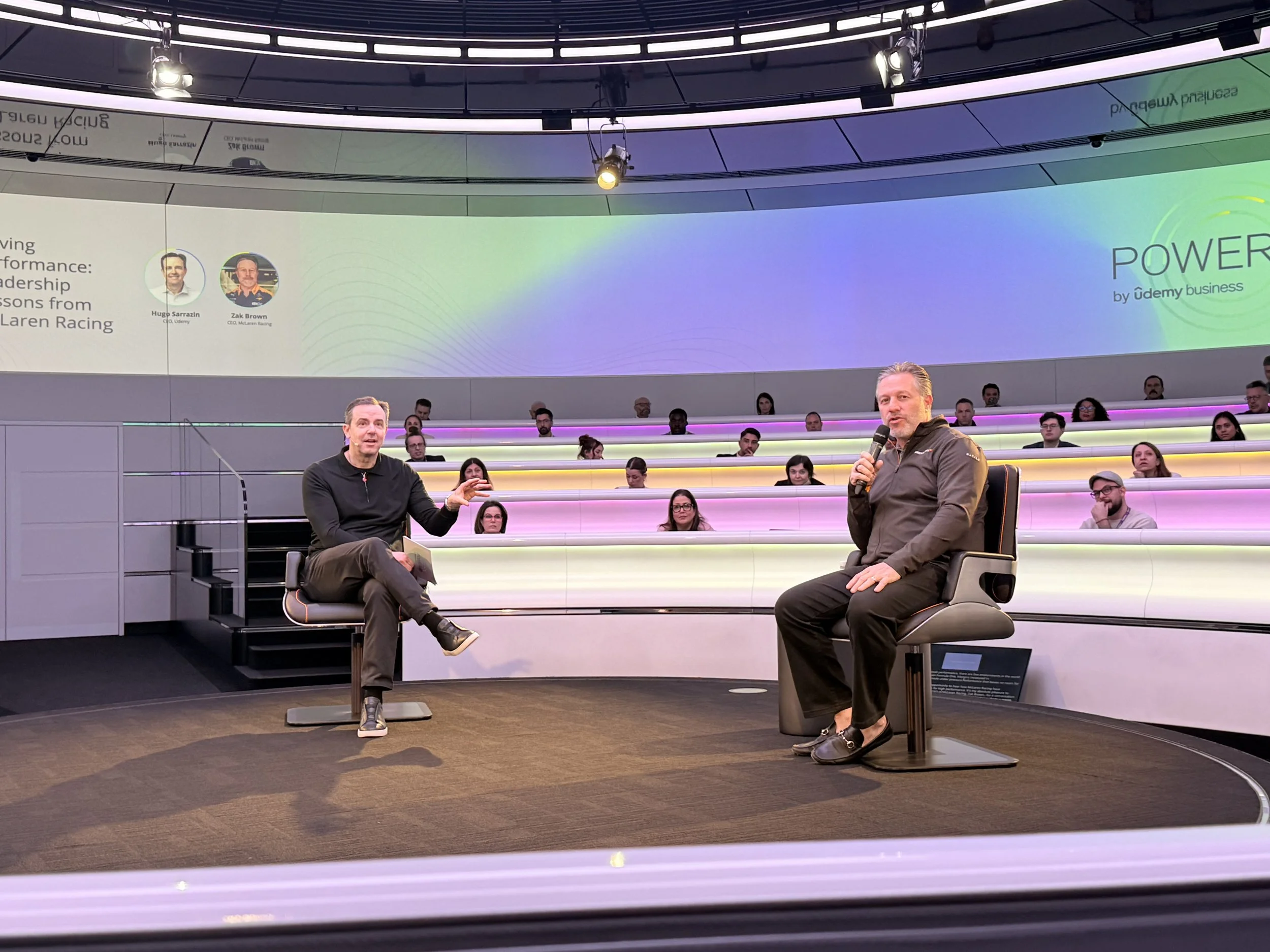
A session at the Udemy PowerUp conference, hosted at McLaren Racing’s headquarters, brought together Zak Brown, Chief Executive Officer at McLaren Racing, and Hugo Sarrazin, President and Chief Executive Officer at Udemy, to discuss how continuous learning, rapid iteration, and culture supported performance in a high-pressure environment.
The discussion positioned change as a driver of improvement, with McLaren’s operating model offering a reference point for organizations investing in AI skills, workforce development, and continuous learning strategies.
Building a learning organization across the business
Brown described McLaren as an organization where performance was driven by people working in alignment across every function. “People, 100%,” he said. “We’ve got awesome technology, wind tunnels, and CFD, but so do all our ten competitive teams. The real difference is people.”
He emphasized that success on track was the result of contributions across the entire organization: “When we win on Sunday… whether you’re in the HR department, the finance department, the commercial department, or the comms department, your contribution to our success on track is as important as the pit crew and engineers.”
Sarrazin connected this to the role of structured learning and skills development within modern organizations: “Curiosity is an important role in development of people in an organization… you can never stop learning.”
The session highlighted how organizations are increasingly treating learning as an operational priority, particularly as AI adoption accelerates the need for new skills across technical and non-technical roles.
Continuous development and cost constraints shaped performance
A central theme during the PowerUp conference session was the pace of development within Formula One, and how continuous improvement was embedded into daily operations.
Brown described McLaren as operating in what he called a “prototype world.” He added, “we live in a prototype world… as soon as we’re done developing something, we’re not done.”
He highlighted the scale of change required to remain competitive: “80% of our race car changes over the course of a year.”
Rather than being a challenge, this level of change created a consistent focus on incremental improvement: “We’re chasing perfection, but there’s no such thing as perfection, because you can always improve.”
He stressed that the focus on marginal gains applied across the organization: “The smallest gains are big gains in our world.”
This approach extended into every function, reinforcing the need for ongoing learning and adaptation: “I think everything is kind of a race car… every department has its own race car.”
The introduction of cost caps further reinforced this approach: “We all have the same size budget now. So the difference is people, and knowledge, and know-how.”
Brown explained that this required alignment between teams and confidence in decision-making: “You need everything to work in order to be a world championship team.”
Simulation supported this environment, with Brown adding, “we run 50 million simulations over the course of a race weekend.”
However, even with advanced tools, learning remained ongoing: “we can still somehow come up with 50 million and one, and that one we didn’t run.”
Leadership focused on people, culture, and partnerships
Brown positioned leadership as an enabling function, with a focus on supporting teams and creating the conditions for performance: “My view is the race team doesn’t work for me. I work for them.”
He emphasized challenge and diversity of thought as part of that process: “I don’t like having a bunch of people around the table that just agree with me… I love diversity of opinion and background.”
This has created an environment where continuous improvement was expected at every level: “If you can get everyone going, I can just go a little bit better… it’s amazing how you can move things forward in an organization.”
McLaren’s model also extended to its partner ecosystem, where learning and development were integrated into broader business relationships: “Now all of our partners are an integral part of our business.”
Brown explained that partnerships increasingly contributed to skills development, technology adoption, and organizational learning: “We now look for partners that can help us drive our business forward.”
The session closed with a focus on people as the foundation of performance, particularly in environments shaped by rapid technological change: “I don’t think you can focus on your people enough… I’m obsessed with our people.”
He linked this directly to outcomes: “So the more we can get people feeling part of the team, the better everyone performs.”
ETIH Innovation Awards 2026
The ETIH Innovation Awards 2026 are now open and recognize education technology organizations delivering measurable impact across K–12, higher education, and lifelong learning. The awards are open to entries from the UK, the Americas, and internationally, with submissions assessed on evidence of outcomes and real-world application.