Anthropic introduces Claude Design with Canva export following Opus 4.7 release
New AI design tool enables teams to create prototypes, presentations, and visual assets through conversation, building on Anthropic’s latest model update.
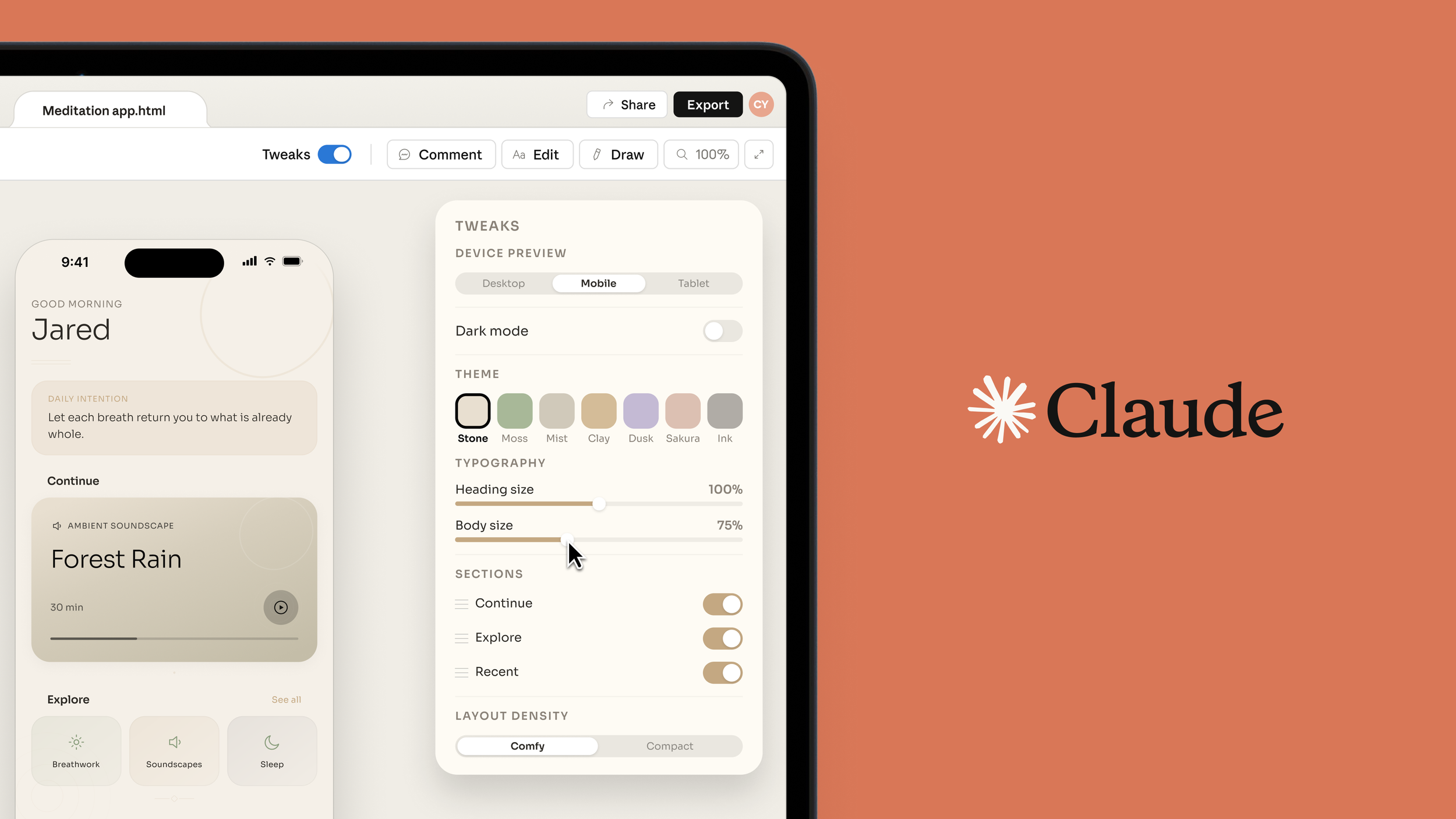
Anthropic’s Claude Design interface shows AI-generated prototypes and visual editing tools, enabling users to create designs, presentations, and assets through conversation, with export options including Canva.
Anthropic has introduced Claude Design, a new product that allows users to create designs, prototypes, presentations, and visual assets through natural language interaction.
The release follows the launch of Claude Opus 4.7, the company’s latest model, which expands visual understanding with higher-resolution image support and improved design capabilities.
Claude Design is available in research preview from 17 April 2026 for users on Claude Pro, Max, Team, and Enterprise plans. Access is included within existing subscriptions, with rollout taking place gradually.
Conversational design workflow with built-in systems
Claude Design allows users to generate visual work by describing what they need, then refining outputs through conversation, inline comments, direct edits, and adjustable controls.
Users can start from multiple inputs, including text prompts, uploaded documents such as DOCX, PPTX, and XLSX files, or existing codebases. A web capture tool enables elements to be pulled directly from live websites, supporting more accurate prototypes that reflect real products.
During onboarding, the system can build a design system by analyzing a company’s codebase and design files. This allows outputs to automatically follow existing brand rules, including typography, color schemes, and component structures. Teams can refine these systems over time and maintain multiple versions where needed.
The workflow also includes fine-grained controls, allowing users to adjust spacing, layout, and styling across a design, with changes applied consistently throughout a project.
Use cases span prototyping, product design, and content creation
Anthropic positions Claude Design as supporting both specialist and non-specialist users. Designers can explore multiple creative directions quickly, while product managers, marketers, and founders can generate visual outputs without using traditional design software.
The tool supports interactive prototyping, allowing static mockups to be converted into shareable, testable experiences without requiring code reviews or pull requests. Product teams can create wireframes and feature flows, which can then be handed off for development or refined collaboratively.
It also enables the creation of pitch decks and presentations from early-stage ideas, with export options including PPTX or direct transfer to Canva. Marketing teams can produce landing pages, campaign visuals, and social media assets, with the option to involve designers later for refinement.
Melanie Perkins, Co-Founder and CEO at Canva, says:
“We’ve loved collaborating with Anthropic over the past couple of years and share a deep focus on making complex things simple. At Canva, our mission has always been to empower the world to design, and that means bringing Canva to wherever ideas begin.
“We’re excited to build on our collaboration with Claude, making it seamless for people to bring ideas and drafts from Claude Design into Canva, where they instantly become fully editable and collaborative designs ready to refine, share, and publish.”
Claude Design also supports more advanced outputs, including code-based prototypes incorporating voice, video, 3D elements, and shaders.
Collaboration, export, and development handoff
The platform includes organization-level collaboration features. Projects can be kept private, shared for viewing, or opened for editing across teams, with multiple users able to interact with Claude within the same workspace.
Outputs can be exported in several formats, including PDF, PPTX, standalone HTML files, or internal shareable links. Designs can also be saved as structured folders for ongoing work.
For development workflows, Claude Design packages outputs into a handoff bundle that can be passed directly to Claude Code. This enables a transition from design to implementation within the same ecosystem.
Anthropic says it will expand integrations in the coming weeks to connect Claude Design with additional tools used across product, design, and marketing teams.
Opus 4.7 enables new design-focused AI workflows
The launch builds on Anthropic’s Claude Opus 4.7 model, which introduces improvements in visual reasoning and higher-resolution image processing.
These updates allow Claude to interpret and generate more detailed visual outputs, supporting use cases that extend beyond text-based interaction. Anthropic positions this as enabling a new category of AI tools where users can move from concept to structured visual output within a single workflow.
Claude Design is positioned as one of the first products to build directly on these capabilities, combining conversational AI with design, prototyping, and content creation workflows.