Common Sense Media completes K-12 digital literacy curriculum as 70% of teens use AI for schoolwork
The free curriculum adds a new high school program covering AI literacy, online harms, media literacy and digital well-being as national research finds classroom AI education is lagging behind student use

Common Sense Media has completed its Digital Literacy & Well-Being Curriculum for grades K-12 as new research finds 70% of U.S. teens use AI for schoolwork
Common Sense Media has completed the K-12 rollout of its Digital Literacy & Well-Being Curriculum, adding a new high school program as its latest national research finds 70% of U.S. teens are already using AI for schoolwork.
The high school release follows the organization’s K-8 curriculum and brings the program across every grade from kindergarten through 12th. It is free for teachers, schools and districts, with lessons spanning AI literacy, media literacy, health and wellness, online harms and safety, financial literacy and a Freshman Foundations pathway.
Alongside the curriculum, the Common Sense Media Youth AI Safety Institute has published new research based on a nationally representative survey of 1,017 teenagers aged 13 to 17 across all 50 U.S. states and the District of Columbia.
The findings show a sizeable gap between how much students are already using AI and how much formal guidance they are receiving at school.
Seven in 10 teens said they use AI for schoolwork. Among those users, 63% said they use AI to get an answer in some form, while 77% also said they use it for help without getting direct answers, including brainstorming, checking completed work and getting feedback.
Only 27% of all teens surveyed said a teacher had ever discussed what AI is and how it works in class. Thirty percent had discussed safe AI use, while 26% had talked about how to tell whether AI-generated information is accurate or trustworthy.
Students are using AI for answers, but not only answers
The research gives a more detailed picture of how teenagers are working with AI than a simple split between use and non-use.
Among teens who use AI for schoolwork, 35% said they get an answer and then improve it using what they already know. Another 31% said they rewrite an AI answer to sound like them, while 25% said they use the answer as-is.
45% use AI to generate ideas or work out how to begin an assignment, 43% use it to check whether their own completed answer is correct and 40% ask for feedback after writing an answer themselves.
When students get stuck, AI is not usually their first move. Across the full sample, 26% said they first ask a teacher or parent for help and 25% try to solve the problem themselves. Ten percent said they turn first to an AI app or tool.
Teens also reported mixed views about what AI is doing to their learning. Two thirds of AI users, 66%, said it helps them understand schoolwork rather than simply finish it faster. But 39% said they feel they are missing out on learning when they use AI to complete assignments, and 38% said having AI available leads them to generate fewer of their own ideas.
Their priorities for the future were still weighted toward human skills. Fifty-five percent of teens selected working well with other people among the three skills they expect to matter most as adults, followed by fact-checking and critical thinking at 50% and reading and understanding complex information at 48%. Twenty-one percent selected knowing how to use AI tools effectively.
School bans are not necessarily stopping access
The survey also found that 35% of teenagers do not understand their school’s AI rules or are unsure what they are.
One third, 33%, said AI is allowed and they understand the rules, while 23% said their school bans AI and 9% said their school does not appear to have any rules.
Among teens already using AI for schoolwork, 44% said an AI tool had been blocked or banned on a school network or school-issued device. Of that group, 59% said they then used a personal device to access AI instead.
Rules can also change between classrooms. Just over half of teens, 52%, said most of their teachers have similar rules for AI use, while 28% said the rules vary considerably depending on the teacher.
Students with an Individualized Education Program or 504 plan were more likely to report adapting AI to their own learning needs. Among teens who said they had an IEP or 504 plan, 44% had set up or adjusted an AI tool for needs such as note-taking, audio narration, transcription or translation, compared with 34% of those without one.
The survey was carried out by NORC at the University of Chicago between April 30 and May 14, 2026. The combined sample used probability and nonprobability sources, with an overall margin of error of plus or minus 4.3 percentage points at the 95% confidence level.
High school curriculum puts AI alongside wider digital life
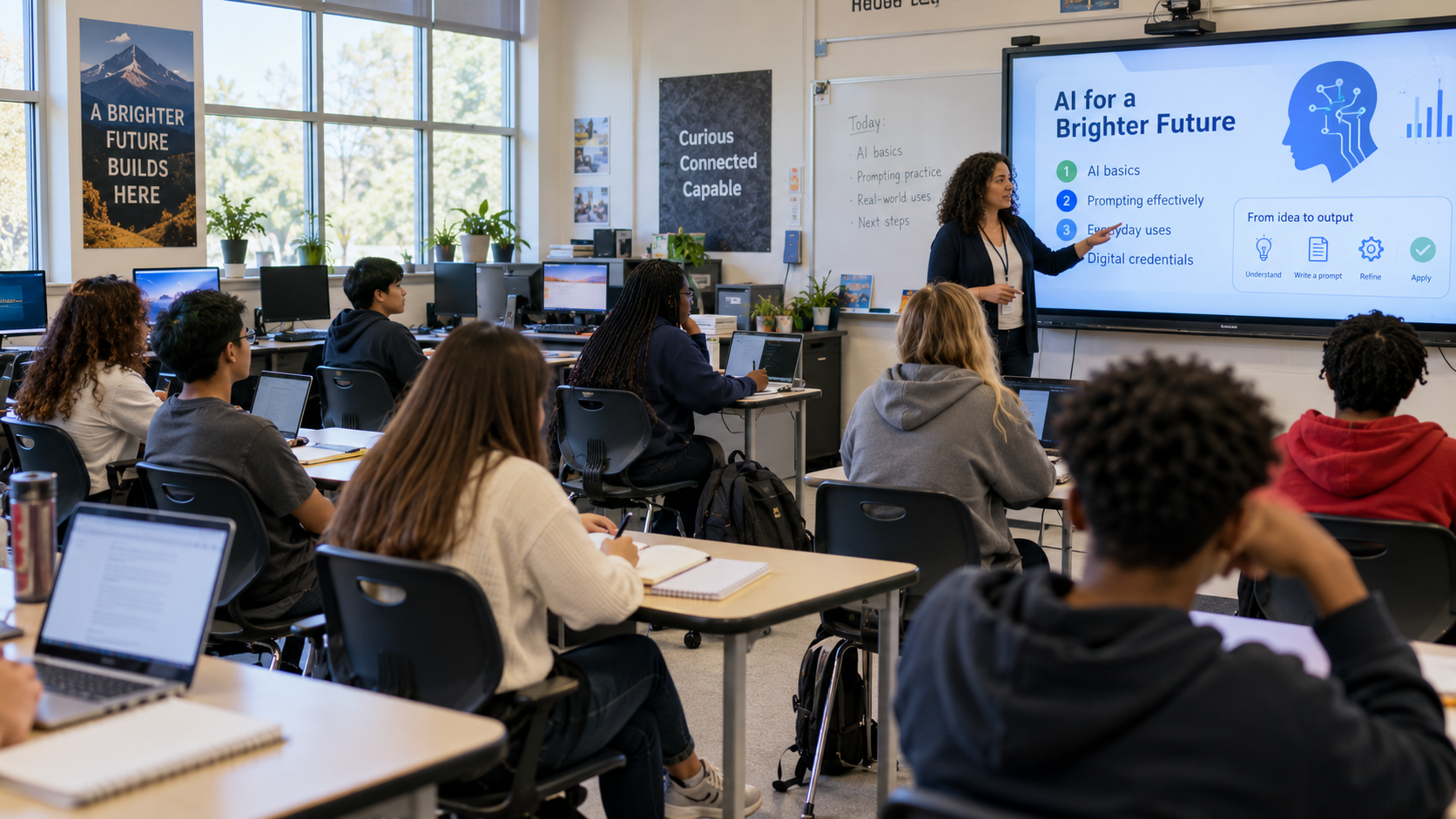
Common Sense Media’s new high school curriculum contains 29 lessons organized across six thematic pathways.
The AI Literacy strand includes lessons on how AI learns, deepfake nudes and consent, chatbot trust, school AI policies, checking information with AI and questions around creativity and authorship.
Other high school lessons cover social comparison, parasocial relationships, online betting, loot boxes, doxxing, social engineering, health information and the creator economy.
Freshman Foundations provides a six-lesson starting sequence covering students’ values and technology, digital habits, attention, human-like AI design, school AI policies and social engineering.
The curriculum is designed to fit into existing subjects rather than operate only as a standalone course. Common Sense Media says high school lessons can be connected to classes including English language arts, health, mathematics and financial literacy.
For younger pupils, the K-8 curriculum contains between 13 and 18 lessons per grade, each approximately 20 minutes long. Topics progress from online safety, kindness and digital footprints in the early grades to privacy, AI, misinformation, algorithms, online relationships and digital well-being as students get older.
Ilana Lowery, Director of School Partnerships and Policies at Common Sense Media, said on LinkedIn that the high school release was developed in response to conversations with teachers and students alongside the organization’s research.
“The takeaway is simple, and it's exactly why our curriculum matters: AI is already in schools. AI literacy isn't,” she wrote.
The Digital Literacy & Well-Being Curriculum is available free to teachers, schools and districts, with accompanying professional development and implementation guidance for schools using the lessons across subjects, advisory periods, libraries, technology classes, health and SEL programs.