NASA invests $10.5m in seven state hubs linking students to skilled aerospace careers
The three-year NASA State Hubs initiative will connect high school CTE programs, community colleges, apprenticeships and employers in California, Georgia, Minnesota, Utah, Florida, Colorado and Texas
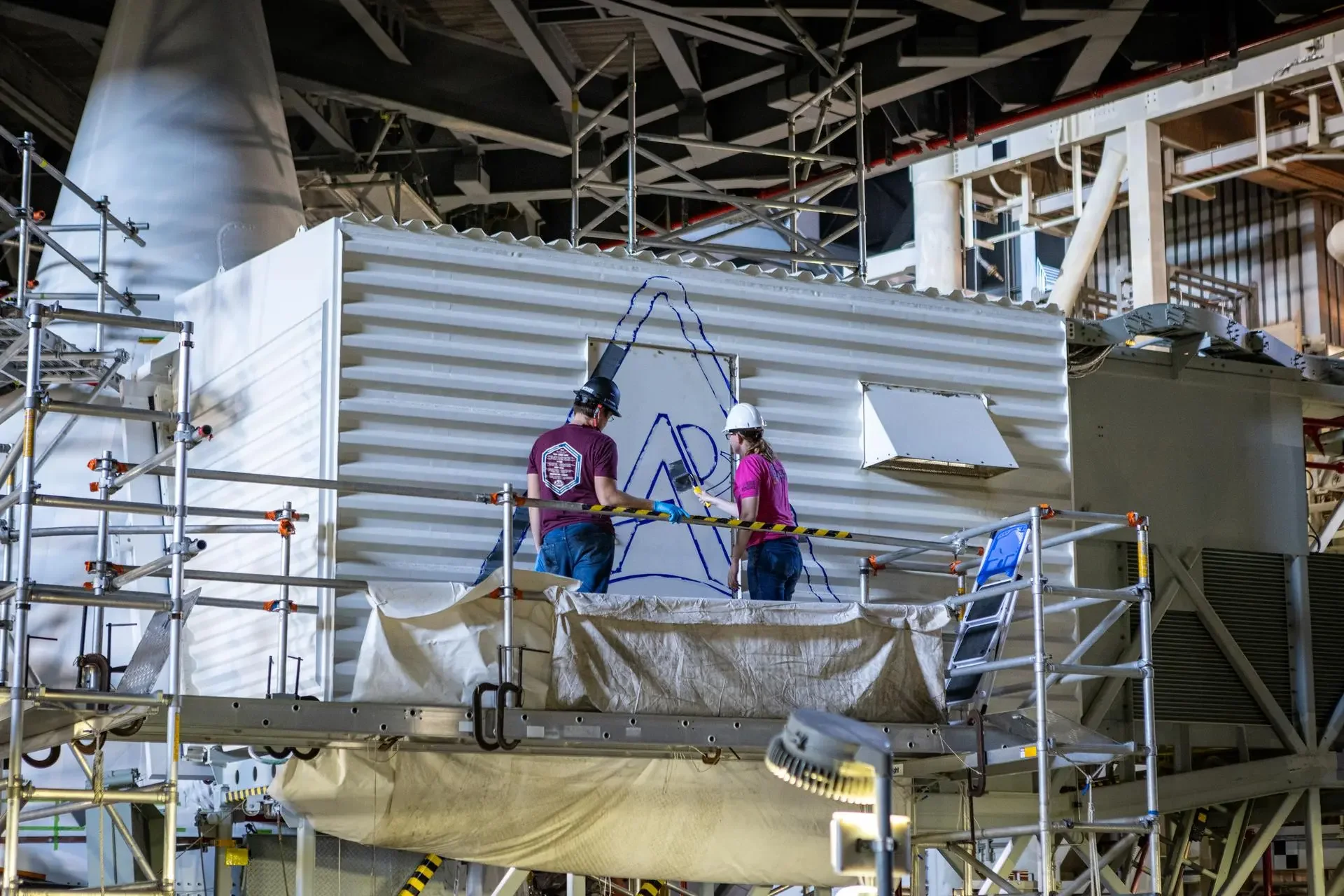
Mechanical engineering technicians Sean McCrary and Katie Mortensen work on the Artemis logo at NASA's Kennedy Space Center in Florida on December 4, 2025. Credit: NASA/Frank Michaux
NASA has awarded approximately $10.5 million to seven organizations across the US to build state-based routes into skilled aerospace jobs, with high schools, community colleges, workforce agencies and employers being brought into the same training pipelines.
The new NASA Aerospace Skilled Technical Workforce Hubs initiative, known as NASA State Hubs, is focused on technical occupations including welding, electrical work, machining and fabrication. The roles require advanced STEM knowledge and technical skills, but many do not require a bachelor's degree.
Over the next three years, the seven hubs will develop training around skills identified by aerospace employers, build pathways through education and apprenticeships, and connect students and job seekers with employers.
The awards go to Antelope Valley Community College District in California, Georgia Tech Research Corporation, Minnesota State Colleges and Universities, Southern Utah University, Space Florida, Colorado's State Board for Community Colleges and Occupational Education with Arapahoe Community College, and the Texas Space Commission.
The approach is less about creating one national training program than using existing state education and workforce systems more deliberately. Each hub has a different structure, but the common model begins before employment, connecting career and technical education, postsecondary training and work-based learning to specific aerospace workforce requirements.
Elaine Ho, Associate Administrator for NASA's Office of STEM Engagement in Washington, says the pressure on that workforce is already being felt.
“The need for technical talent is already urgent and will only continue to grow as we return humanity to the Moon and set our sights on Mars and beyond,” she says. “NASA is uniquely positioned to be the catalyst and convener that accelerates America’s aerospace workforce development and fosters the next generation of technicians.”
Writing separately on LinkedIn, Ho was more explicit about the education gap behind the investment: “But we need more of them — and not enough students see a clear path into these careers.”
Seven states, seven different routes into aerospace
California's award will be led by Antelope Valley Community College District through the Southern California NAS_Hub.
The model will create stackable routes from high school career and technical education into college programs, micro-internships, cooperative education, registered apprenticeships and employment. Antelope Valley College is working with MiraCosta College and Pasadena City College, with training planned across 11 disciplines including composites fabrication, non-destructive inspection, precision metrology, machining and electronics.
NASA says an Industry Curriculum Advisory Panel made up of faculty and representatives from NASA-connected aerospace employers will help shape curricula. The hub also plans to expand apprenticeships and internships, introduce more high school students to aerospace careers and incorporate NASA mission content into training.
Georgia is taking a statewide approach through the Southeast Space Technology & Aerospace Readiness Skills Hub, or SE-STARS, led by Georgia Tech Research Corporation.
Its partners include the Georgia Space Grant Consortium, Technical College System of Georgia, Georgia Southern University and Georgia College and Career Academies. The hub will scale Georgia Tech's Starfleet Academy technical courses and align them with diploma and certificate routes across technical colleges and career academies.
More than three dozen hands-on courses are planned across areas including avionics, propulsion, advanced manufacturing, systems testing, machining and assembly. The Technical College System of Georgia's 22 colleges and 88 campuses will act as regional delivery points, while annual “Teach the Teacher” institutes are intended to build instructor capacity.
NASA also lists the Georgia Aerospace & Defense Alliance, Space Force, GE Aerospace and NASA centers among the industry partners involved in the initiative.
Minnesota's Aerospace Skilled Technical Workforce Hub will use the state's technical college system to create pathways from high school CTE into college, registered apprenticeships, security-clearance readiness training and employment.
Dakota County Technical College will contribute welding and advanced manufacturing programs, Pine Technical & Community College will provide training in machining, automation and robotics, and Ridgewater College will bring its nondestructive testing pathways into the network.
The hub also plans to expand internships and apprenticeships and use Minnesota's FutureForward Welding Competitions to introduce younger students to the types of technical roles available.
Utah's NASA Aerospace Skilled Technical Workforce Hub, based at Southern Utah University, will coordinate employers, schools, postsecondary providers and workforce agencies.
Its plans include employer-validated skill mapping, an Aerospace Workforce Alignment Summit and Aerospace Launchpad cohorts. It will build on the Utah Aerospace & Manufacturing Pathways Program and work with partners including 47G Utah Aerospace and Defense, Northrop Grumman, Utah Space Grant, Southwest Technical College, Snow College, Talent Ready Utah and several school districts.
NASA says employer hiring agreements linked to validated competencies will support placements.
Florida and Colorado build pathways around existing aerospace clusters
Space Florida will lead Project ORBIT, a statewide effort intended to connect education, training and industry systems with workforce requirements around Kennedy Space Center and Florida's wider aerospace sector.
Its remit stretches across aerospace, advanced manufacturing, semiconductors and cybersecurity, with pathways planned through career exploration, training, internships, pre-apprenticeships and registered apprenticeships.
One of the more concrete pieces of infrastructure is a statewide talent portal. NASA says individuals will be able to use it to display skills, credentials and work-based learning experience to aerospace employers.
Project ORBIT will also work with middle and high school students, including through career and technical education programs, while employers and education providers identify technical competencies and expected timescales for developing them.
Colorado's hub will be hosted by Arapahoe Community College on behalf of the State Board for Community Colleges and Occupational Education.
The Colorado Space Institute is planned as a statewide “work-tank” connecting community colleges, high school CTE, workforce agencies and aerospace companies. Its work will include mapping existing K-20 CTE provision, developing employer-informed competency frameworks and expanding internship and apprenticeship routes.
It will also establish what NASA describes as the first Associate of Applied Science in Space Science, alongside stackable credentials and routes for K-12 feeder programs, returning learners and other students.
Industry and sector organizations named in the Colorado network include Lockheed Martin, Space Safran Defense, Advanced Space, Albedo, Space Foundation and Aerospace Colorado.
Learners and employers will work together on projects through the hybrid work-tank model, with workshops, educator boot camps and lecture series also planned.
Texas sets targets of 25,000 portal registrations
The Texas Space Commission has attached some of the clearest numerical targets to its hub.
Its Texas Space STEM Alliance will use a TAP+ portal alongside regional workforce programs to connect students with aerospace pathways, internships and apprenticeships.
The alliance plans to enroll more than 25,000 students into TAP+ by Year 2. Its career awareness activity also includes Space STEM Days and Space STEM Week, with an anticipated 5,000 learners participating.
Axiom, Barrios, Blue Origin, Intuitive Machines, Lockheed Martin, NASA Space Grant and Space Center Houston are among the partners identified by NASA, alongside workforce boards, community and technical schools and school districts.
The portal is intended to act as both a pipeline map and a registry for internships, apprenticeships, jobs and scholarships. The Texas initiative will also include adult education, with veteran retraining and upskilling specifically included in its plans.
Across the seven hubs, NASA's role is not limited to providing grant funding. The agency says the hubs will act as focal points between NASA, industry partners, education providers and state or regional economic development organizations, with the aim of matching training more closely to technical workforce demand.
The awards are funded by NASA's Office of STEM Engagement through its Next Gen STEM Project. That project focuses on preparing high school and community college students for aerospace careers through partnerships and competitive awards.
For Ho, the emphasis is on the people who turn engineering plans into physical spacecraft and infrastructure. On LinkedIn, she highlighted “Welders, machinists, electricians, and fabricators” as the workers who turn designs into mission hardware.
The work is now moving into a three-year implementation period, during which the seven selected organizations will build training programs, expand apprenticeship and internship routes and develop connections between students, job seekers and aerospace employers.