Ohio State University brings AI literacy push to central Ohio schools
University leaders and K–12 educators are working together on ethical AI use, classroom strategy, and student readiness as schools face growing pressure to respond to generative AI.
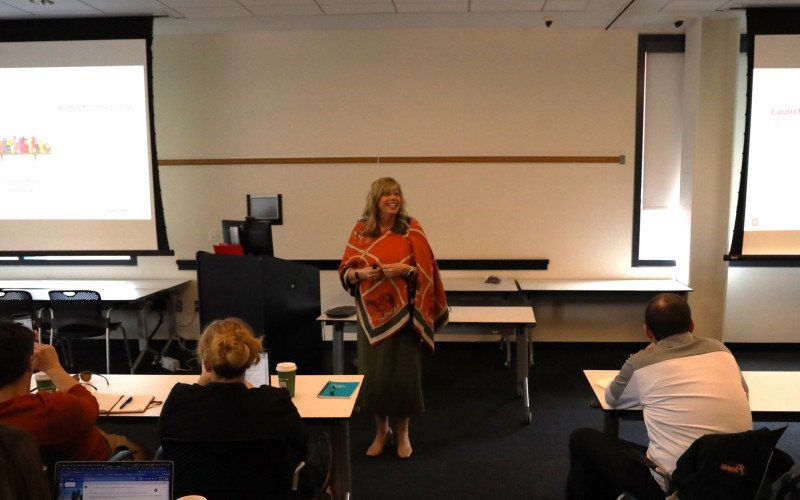
Melissa Beers, senior director, GE Bookends, Office of Undergraduate Education. Photo credit: The Ohio State University
Ohio State University has partnered with central Ohio school districts to expand AI literacy, bringing K–12 teachers and administrators to its Columbus campus for talks on how students should use artificial intelligence effectively and ethically in the classroom.
The Ohio State University has partnered with central Ohio school districts to expand AI literacy, bringing K–12 teachers and administrators to its Columbus campus for talks on how students should use artificial intelligence effectively and ethically in the classroom. The move links university-led AI strategy with school-level practice at a point when educators are still working out what meaningful AI readiness actually looks like.
The meeting, organized by Ohio State’s Office of Undergraduate Education and the Educational Service Center of Central Ohio, focused on practical questions around AI use, including classroom guidance, student reflection, and how schools can move beyond basic familiarity with tools such as ChatGPT.
Ohio State President Ravi Bellamkonda flagged the partnership on LinkedIn, saying the university is working with schools to “expand AI literacy and help students learn to use these tools effectively and ethically.” He added: “At Ohio State, we’re preparing the next generation to question, innovate and lead with technology.”
Ohio State ties AI literacy to student readiness
At the center of the discussion was Ohio State’s AI Fluency initiative, which is now being embedded into the undergraduate curriculum. The program is designed to help students use AI tools within their own disciplines, while also understanding how to assess outputs, question results, and apply the technology with purpose.
Norman Jones, Vice Provost and Dean for Undergraduate Education at The Ohio State University, says that means moving past generic introductions to AI and focusing on how it works in specific subject areas. “We want students to be able to use AI tools to accomplish specific goals in their field of study and assess for their accuracy,” he says. “As our academic areas are trying to incorporate these tools, they have to go beyond that basic introduction to AI and start to say, ‘Okay, give me specific examples in our field.’”
He also points to a more practical classroom use case, where AI supports improvement rather than replacing student effort. “AI isn’t just about pulling information and writing my first draft. It could be a writing coach,” he says. “Then they can start to design ways of using AI. That’s where they’re really getting to that fluency within the discipline.”
Faculty focus on ethics, reflection, and classroom use
Ohio State staff also used the meeting to highlight the need for students to think critically about when AI is useful, when it is not, and what human value still looks like in an AI-enabled workplace.
Michael Flierl, AI Fellow at The Ohio State University and Associate Professor of Student Learning Librarian with University Libraries, says students may need to be asked directly to reflect on their use of the technology. “We may need to require students to reflect on what is helpful, what is not,” when using AI, he says. “To put it bluntly, if AI can do your job, then you’re not going to get hired because they’ll just hire an AI [tool]. Our students need to know how to add value.”
That same theme is being built into Ohio State’s General Education Launch and Reflection seminar courses, which now include an introductory AI component as well as guidance for faculty on setting expectations for student use.
Melissa Beers, Senior Director of the General Education Launch and Reflection Program at The Ohio State University, says the goal is to make the topic manageable for instructors and students rather than leaving it vague or unstructured. “We encourage it and we want them to have a conversation with students,” she says. “This was a way for us to build that basic competence, build that familiarity and put our arms around this big topic in a way that we can handle.”
Ohio State expands educator training and AI experimentation
Alongside student-facing work, the university is also building out AI support for educators.
The Michael V. Drake Institute for Teaching and Learning is offering resources and professional learning opportunities focused on AI in teaching practice. Anika Anthony, Associate Vice Provost at The Ohio State University and Director of the Michael V. Drake Institute for Teaching and Learning, says the starting point still has to be pedagogy rather than the tool itself. “What are the teaching and learning needs that we’re seeking to address? We still need to ask those questions,” she says. “We want to be really clear about the learning outcomes we’re working towards, and how we’re designing those learning experiences.”
Ohio State’s Center for Digital Learning and Innovation in the College of Education and Human Ecology is also preparing to introduce an AI Sandbox, a space where users will be able to experiment with creating their own tools.
Detra Price, Executive Director of the Center for Digital Learning and Innovation in the College of Education and Human Ecology at The Ohio State University, says the intention is to support both beginners and staff who have already been experimenting with generative AI for some time. “What we’re trying to do is have an upskilling for people who are like, ‘What is this thing called AI?’” she says. “We also wanted space for the people who’ve been with us since 2023, growing their learning.”
The partnership with central Ohio schools suggests Ohio State is not treating AI literacy as a campus-only issue. It is starting to position the work as a wider education pipeline challenge, with schools and universities facing many of the same questions around capability, ethics, and what students should actually be able to do with AI when they leave the classroom.
ETIH Innovation Awards 2026
The ETIH Innovation Awards 2026 are now open and recognize education technology organizations delivering measurable impact across K–12, higher education, and lifelong learning. The awards are open to entries from the UK, the Americas, and internationally, with submissions assessed on evidence of outcomes and real-world application.