Stanford merges its AI and data science programs into a single institute with Fei-Fei Li in new advisory role
The combined organization brings together more than 400 scholars, $60 million in grant funding, and high-performance computing infrastructure under the Stanford HAI name, with a mandate spanning K-12 education through lifelong learning.
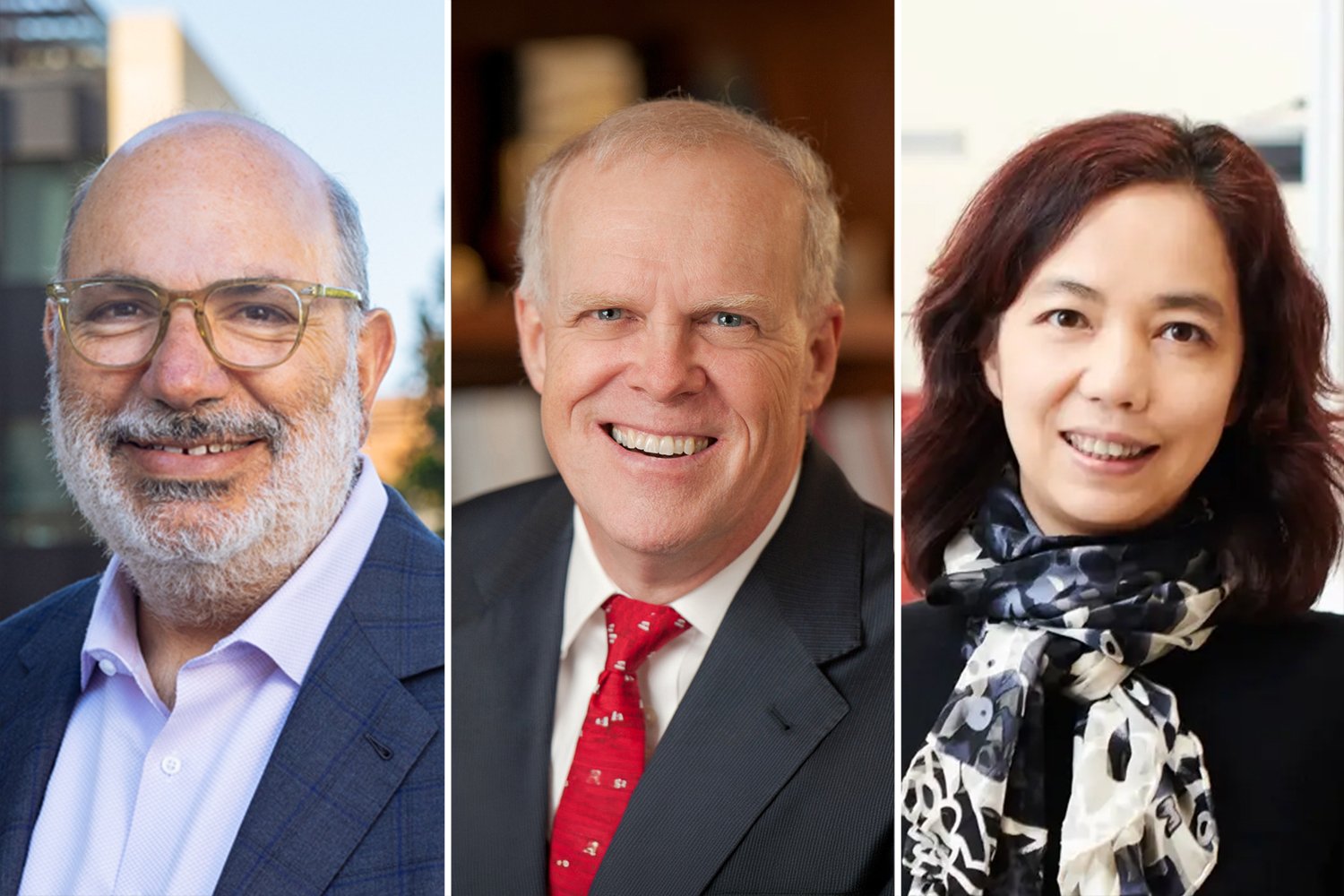
From left: James Landay will lead the Stanford Institute for Human-Centered AI, while John Hennessy and Fei-Fei Li will serve as co-chairs of the advisory council. Photo Credit: Andrew Brodhead, Linda A. Cicero, Drew Kelly
Stanford University has merged its two flagship AI and data science organizations into a single institute. The Stanford Institute for Human-Centered AI and the Stanford Data Science initiative will operate as one body under the Stanford HAI name, led by computer scientist James Landay as Denning Director.
The restructuring combines HAI's network of more than 400 scholars, its industry affiliates program, and $60 million in cumulative grant funding with Stanford Data Science's high-performance Marlowe computing cluster and early scholar fellowship program. HAI co-founder Fei-Fei Li takes on a new university-wide role as Special Advisor on AI to Stanford President Jonathan Levin, while also joining former Stanford president John Hennessy as co-chair of the institute's advisory council.
Stanford HAI posted on LinkedIn that the merged institute will organize its work around three pillars: "advancing AI and data science for discovery across fields, transforming education from K-12 through lifelong learners, and examining and shaping AI's societal impact through evidence-based research."
Levin says: "The merged organization creates a community of scholars whose research touches powerfully on every aspect of AI, its applications, and implications. The human-centered focus provides a north star for the institute."
Open science as a differentiator
Landay, who has spent three decades in human-centered computing and received the ACM SIGCHI Lifetime Research Award in 2024, says the institute's defining commitment will be openness: open science, open-source code, open datasets, and open education.
"What makes Stanford's approach impactful is our commitment to operating as an open community," says Landay. "We publish in open forums, we champion open research, we make knowledge accessible. That's what differentiates universities from the frontier AI companies dominating artificial intelligence today."
The emphasis on open research carries weight in a sector where proprietary models from companies including OpenAI, Google, and Anthropic increasingly dominate AI development. Stanford HAI's annual AI Index report has become a widely cited benchmark, and the institute's ImageNet database, which Li helped create, is credited with catalyzing modern deep learning.
Education from K-12 to workforce
Stanford HAI already runs the Congressional Boot Camp on AI for policymakers and has developed executive and policy education programs. Researchers at the institute are currently testing adaptive tutoring systems designed to respond to individual learners and support teachers in classrooms, and the merged organization will now have access to Stanford Data Science's computing infrastructure to scale that work.
Li says: "AI is transforming not only technology, but also the way we pursue scientific discovery, learn and educate, and serve society. It is a historical opportunity and responsibility of Stanford to rise to the occasion."
Hennessy adds: "This is the most important effort for Stanford, and I am happy to help it succeed. AI will evolve in ways we can't predict, but the principles guiding our work, openness, excellence, human-centeredness, will be enduring."
Emmanuel Candes, who launched and led Stanford Data Science, will become an associate director of Stanford HAI focused on computational resources. John Etchemendy, a co-founder of HAI, will continue as a senior fellow and advisor. The merged institute will work across all seven Stanford schools, spanning engineering, medicine, humanities, and beyond.