Birmingham City University and Cal Poly formalize STEAM partnership with joint student challenge
Agreement connects UK and US institutions through research, enterprise, and interdisciplinary learning across global contexts.
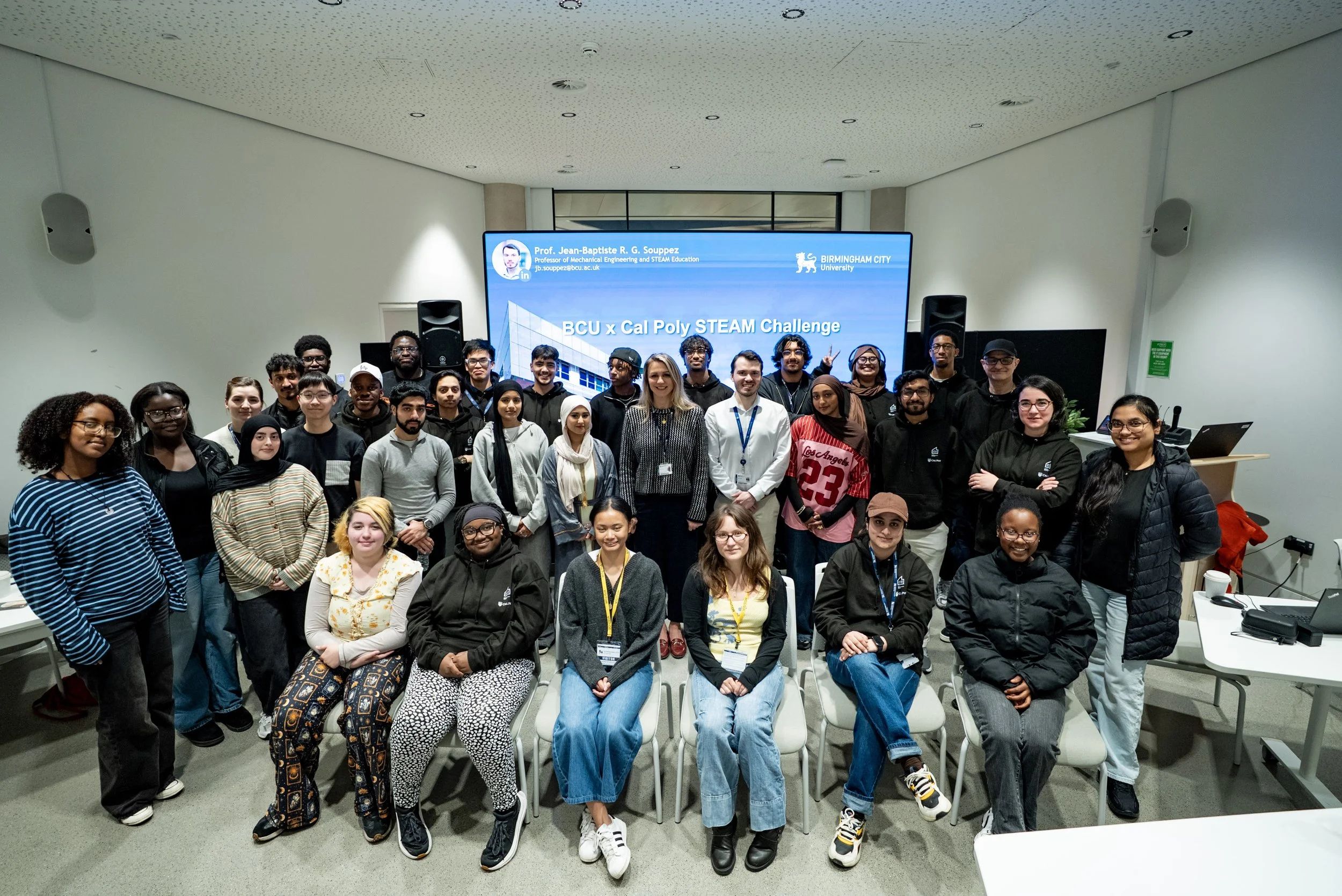
Students from Birmingham City University and Cal Poly take part in the joint STEAM sprint challenge, working in global teams on live industry projects across disciplines
Birmingham City University (BCU) and California Polytechnic State University (Cal Poly) have signed a Memorandum of Understanding to establish a partnership focused on research collaboration, enterprise activity, and STEAM education.
The agreement links students and staff across both institutions through shared projects and international learning experiences, as universities continue to expand global approaches to skills development.
The partnership launched with a joint STEAM sprint challenge, bringing together students from foundation to PhD level to work on live industry briefs across disciplines.
Partnership centers on interdisciplinary and international learning
The agreement sets out a framework for collaboration across engineering, computing, the arts, health, and business, with an emphasis on interdisciplinary teaching and real-world problem solving.
Professor Hanifa Shah OBE, Pro Vice-Chancellor for Research, Enterprise, Engagement and STEAM at BCU, says: “This partnership marks an important step forward for BCU.”
She adds: “It formalises a shared commitment to collaboration across research, enterprise and STEAM education, creating valuable international opportunities for our students and staff.”
Shah continues: “As the challenges facing society grow more complex, it is vital that we equip our students with the creativity, interdisciplinary thinking and problem-solving skills needed to shape the future. This collaboration will play a key role in achieving that ambition.”
Dr David Gillette, Director of the Liberal Arts and Engineering Studies Program at Cal Poly, says: “By working together, our institutions will continue to develop interesting and useful ways to incorporate STEAM throughout our respective curriculums, which in turn helps students better understand and make lasting contributions to their communities close at hand while also constructively engaging with people and places far beyond the horizon.”
Sprint challenge puts collaboration into practice
The partnership was introduced through a four-day STEAM sprint challenge, where students worked in global teams on six live projects for U.S.-based clients. The briefs covered areas including interactive technologies, conservation media, and the design of a droid assistant combining mechatronics, atmospherics, and animation.
Participants from BCU represented a wide range of disciplines, including engineering, computing, business, the arts, media, education, jewellery, and midwifery, reflecting the cross-disciplinary structure of the initiative.
JB Souppez, Professor in Mechanical Engineering and STEAM Education at BCU, says: “This is an exciting partnership that brings together expertise from both institutions to deliver a truly international and interdisciplinary approach to STEAM education.”
He adds: “It has been exciting to see the collaboration between BCU and Cal Poly come to life during the STEAM Challenge week.”
Souppez continues: “The energy has been incredible - it’s a powerful example of what STEAM can achieve when it’s truly interdisciplinary and international.”
He adds: “It is particularly rewarding to see our students recognise the value of STEAM education and surpass their own expectations of what they can achieve in such a short time.”
Focus on skills development through global collaboration
The partnership places emphasis on combining academic learning with practical, project-based work across international teams, reflecting ongoing changes in how universities approach skills development and employability.
Alexa Hartwell, Head of STEAM Academy at BCU, says: “Bringing together students from different disciplines and countries has created a genuinely exciting and collaborative environment.”
The initiative adds to a growing number of cross-border education partnerships that connect students with industry challenges, with institutions testing how global collaboration can be embedded into curricula rather than delivered as standalone experiences.