Google adds AI verification tools across Search, Gemini, Chrome, Pixel, and Cloud
New verification tools will help users check whether images, video, audio, and other media were created or edited with AI.
Google is expanding AI content verification tools across Search, Gemini, Chrome, Pixel, and Google Cloud
Google is expanding its content transparency and verification tools across Search, Gemini, Chrome, Pixel, and Google Cloud as AI-generated media becomes harder to identify online.
The update covers SynthID verification, C2PA Content Credentials, Pixel camera provenance features, and a new AI Content Detection API on Google Cloud’s Gemini Enterprise Agent Platform.
The tools are designed to help users, businesses, platforms, and content teams understand how media was created, whether it has been edited, and whether AI was involved. The rollout applies across consumer products, including Search, Gemini, Chrome, and Pixel, as well as enterprise tools on Google Cloud.
SynthID verification for image, video, and audio was recently added to the Gemini app and has already been used 50 million times globally, according to Google. That verification capability is now expanding to Search, with Chrome support planned over the coming weeks.
The next phase also brings wider use of C2PA Content Credentials, an industry standard that shows how media was created and modified. C2PA verification is rolling out in the Gemini app from today and will come to Search and Chrome in the coming months.
SynthID and C2PA move further into Google products
Google introduced SynthID three years ago to embed imperceptible signals into AI-generated content. The technology has since been integrated into Google’s generative media models and products, watermarking more than 100 billion images and videos and 60,000 years of audio.
Across more of its generative media tools, Google is also using C2PA Content Credentials to show how media was created and modified, with or without AI.
Pixel 10 was the first smartphone to provide Content Credentials for images in its native camera app. Google is now expanding the technology to include video on Pixel 8, Pixel 9, and Pixel 10 phones in the coming weeks.
The move puts content provenance closer to the point of capture. In practice, Pixel will document when content has been captured by a camera, helping distinguish camera-original media from content created or altered using AI.
Search and Gemini add more AI checks
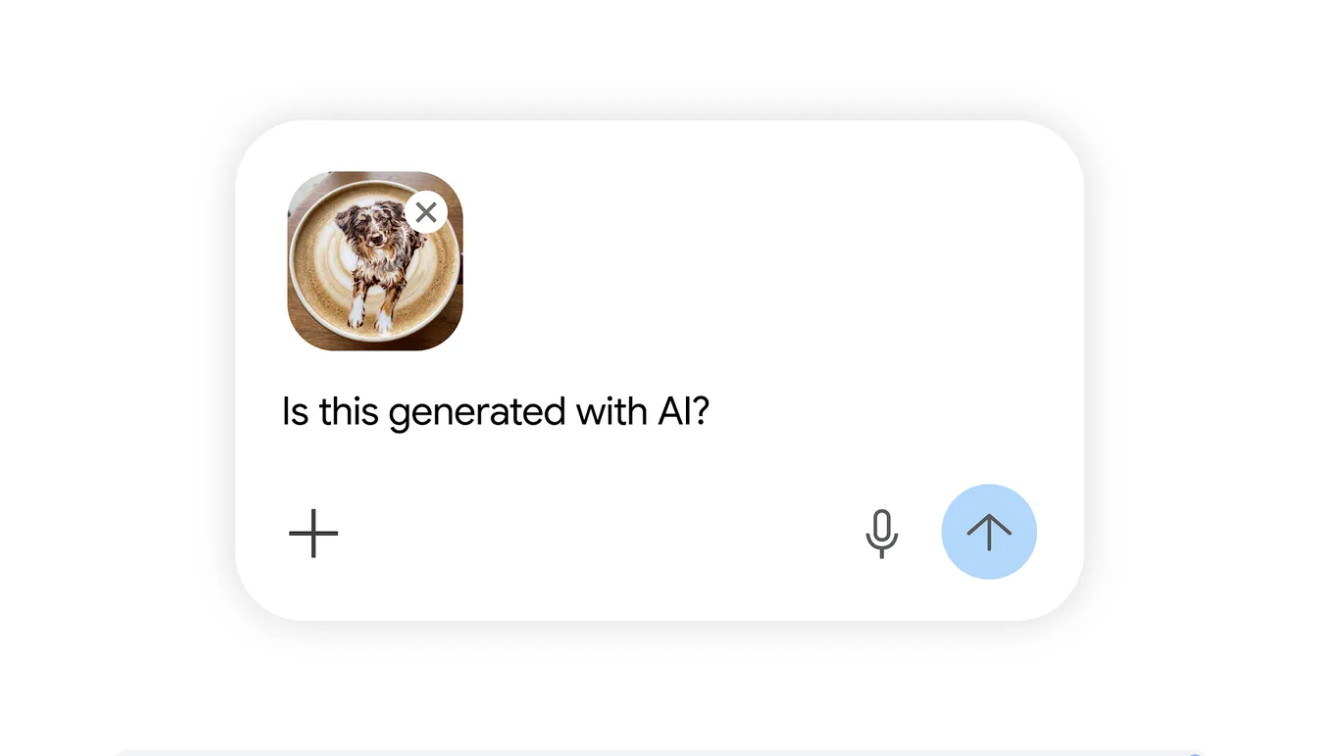
Users will be able to ask whether content was made with AI using Search features including Lens, AI Mode, and Circle to Search, as well as Gemini in Chrome.
Google gives examples such as asking, "Is this made with AI?" or "Is this AI generated?" when checking an image’s origin.
C2PA Content Credentials will add another layer of verification by showing whether content is an unaltered camera original or whether it has been modified, including which tools were used.
The update builds on Google’s existing labels on YouTube that identify AI-generated content and its work with trusted testers on Backstory, a tool designed to make detection faster and more reliable.
Google Cloud API targets businesses and platforms
Google is also launching a new AI Content Detection API on Google Cloud’s Gemini Enterprise Agent Platform.
The API is designed to help organizations identify AI-generated media made by Google models and other widely used AI models. Google says businesses could use the API for backend operations such as sorting feeds and preventing insurance fraud, or for user-facing work such as fact-checking and labeling synthetic media.
The API is launching with a group of trusted partners, with refinements planned based on their feedback.
More companies are also adopting SynthID. OpenAI, Kakao, and ElevenLabs are bringing SynthID technology to more of their AI-generated content, while Google has also open-sourced SynthID text watermarking technology and partnered with NVIDIA to watermark AI-generated video from its Cosmos world foundation models.
Google remains part of the C2PA steering committee, alongside companies including Meta. Meta will start labeling camera-captured media with Content Credentials on Instagram, meaning photos and videos shot natively on Pixel phones will be recognized and labeled when shared on Instagram.