ETIH Innovation Awards Winners: UNOWA wins Best Special Needs and Inclusion Solution
UNOWA was recognized for MIKKO, a full-cycle inclusion ecosystem combining AI-assisted diagnostics, personalized learning pathways, specialist training, and sensory tools for children with special educational needs.
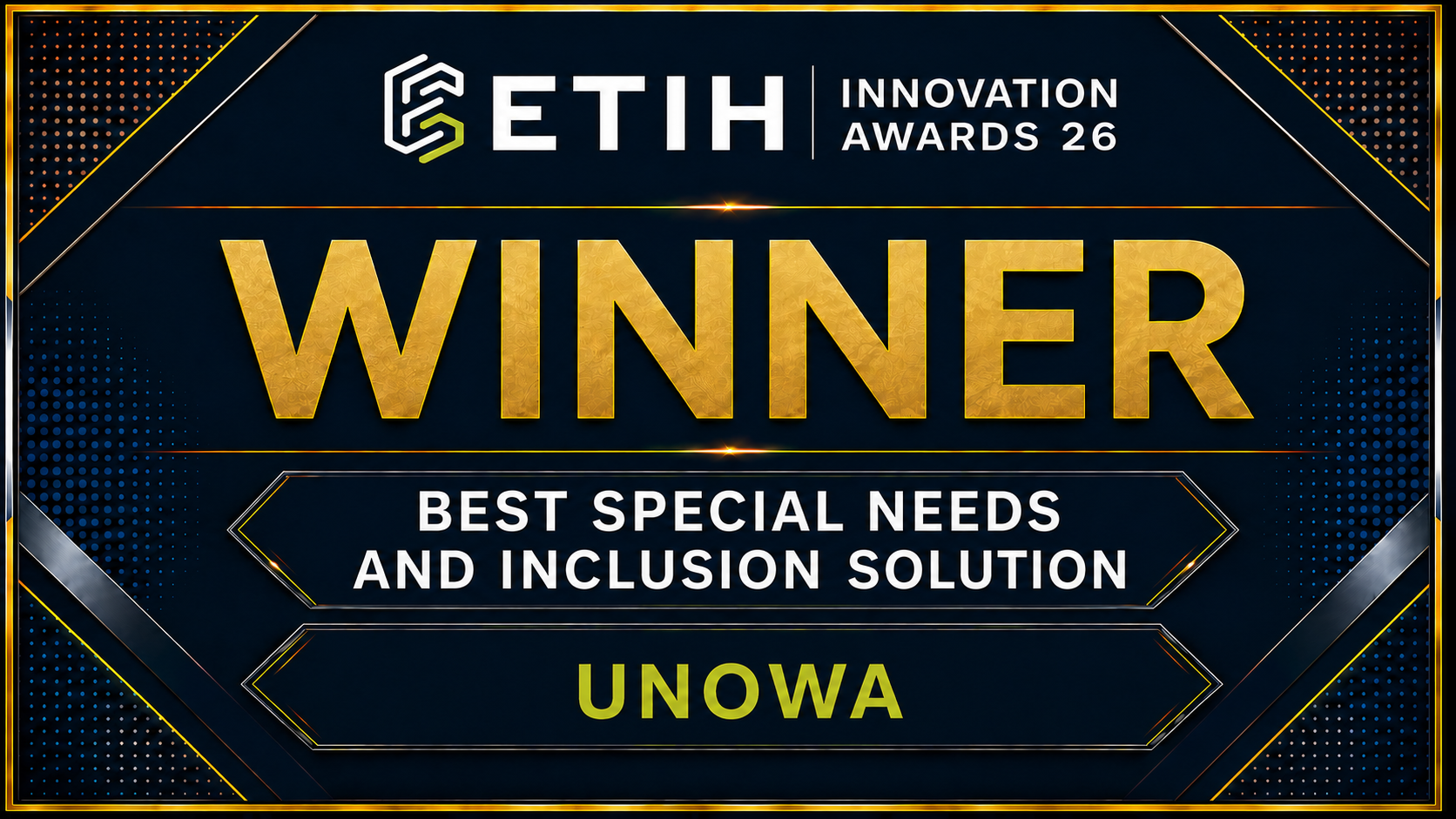
UNOWA won Best Special Needs and Inclusion Solution at the ETIH Innovation Awards 2026
UNOWA has won Best Special Needs and Inclusion Solution at the inaugural ETIH Innovation Awards 2026, with judges recognizing MIKKO, a full-cycle ecosystem designed to connect special educational needs assessment, intervention, classroom practice, and family support.
The European EdTech company built MIKKO around the “6 Domains of Development” framework, combining AI-powered diagnostics, specialized digital courses, more than 100 physical didactic tools, and evidence-based clinical standards including Applied Behavior Analysis and ADOS-2.
The win recognizes an entry that treated inclusion as a connected system, not a single product feature. MIKKO was submitted as a platform designed to help educators, specialists, and parents work from the same developmental picture of a child’s needs, progress, and next steps.
For Mykhailo Kalitkin, Co-founder and CEO of UNOWA, the starting point was not a market gap, but the reality families face when support is split across clinics, schools, specialists, and home.
“My son Kyrylo was diagnosed with autism, and our family experienced firsthand how disconnected systems can leave parents navigating complex decisions alone,” Kalitkin says. “That experience fundamentally shaped our philosophy.”
That personal starting point became a wider product argument: UNOWA was not trying to build another isolated intervention, but a model in which assessment, classroom activity, specialist input, and family support could inform one another.
ETIH Innovation Awards judge Richard Govada Joshua described MIKKO as “an exceptional and comprehensive solution” because it brings “AI-powered diagnostics, personalized learning pathways, specialist training, and physical sensory tools into one unified system.”
From fragmented support to shared pathways
MIKKO was developed to address what UNOWA calls the “inclusion gap”, where slow diagnostics, specialist shortages, administrative workload, and geographic inequality can delay support for children with special educational needs.
Kalitkin does not place the blame on families, teachers, or specialists. For UNOWA, the problem is the structure they are expected to work within: “Inclusion does not fail because of a lack of good intentions. It fails because the system itself is fragmented.”
AI-assisted assessments in MIKKO are designed to inform personalized learning strategies, classroom activities, specialist intervention, and home support. The long-term tracking element is designed to prevent developmental history being lost when a child moves between schools, specialists, or stages of education.
“We are building a reliable ‘digital twin’ of a child’s developmental journey so that regardless of geography, school, or specialist availability, support remains continuous, transparent, and evidence-informed,” he adds.
The judges placed weight on that connection between clinical grounding and classroom usability. Joshua said MIKKO “bridges a critical gap between clinical expertise and everyday teaching practice,” highlighting its use of globally recognized frameworks such as ABA and ADOS-2.
The platform’s reported outcomes also formed part of the decision. UNOWA’s entry cited 95 percent of students using its AI-supported adaptive trajectories showing improved academic and behavioral outcomes, particularly in cognitive and communication skills. It also reported more than 100,000 hours of administrative work saved globally through automated Individual Development Plan mapping and reporting.
For ETIH, the strength of the entry was the way it connected measurable impact with the lived complexity of special educational needs provision.
Emma Thompson, Director of Content and Editor at ETIH, says: “UNOWA’s entry brought a different kind of urgency to the inclusion category. The platform was not only looking at access to tools, but at the gaps between diagnosis, teaching, specialist support, and family decision-making. MIKKO showed how EdTech can help turn complex developmental insight into practical support that follows the child, not the institution.”
The geography problem in special educational needs provision
UNOWA’s entry also moved the inclusion discussion beyond individual classrooms and into geography. Access to assessment, trained specialists, and structured intervention can vary sharply between urban centers and remote communities.
Kalitkin calls this the “zip code lottery”: “In reality, the quality of support a child with special educational needs receives still depends heavily on where they live and what resources their family can access.”
MIKKO’s deployment across national and regional projects was therefore central to the entry. UNOWA referenced work across 14 university hubs in Kazakhstan, hundreds of classrooms in Armenia and Ukraine, and training for 14,890 teachers and specialists.
The company’s model combines software with physical didactic tools, sensory kits, specialist training, and support for educators and parents. That combination was important because MIKKO is not designed to leave teachers interpreting complex assessment data alone.
That design choice matters because MIKKO is being used by teachers, parents, and specialists who may already be managing high emotional and administrative pressure.
“Advanced technology must feel effortless for the end user,” Kalitkin says. “If a teacher needs technical expertise just to use the platform, then we have failed.”
The product experience is intended to move from developmental insight to practical action. For a teacher or parent, that means receiving guidance on where the child is now and what activity, game, or physical tool may support the next stage of development.
Kate Owbridge, ETIH Innovation Awards judge, highlighted UNOWA’s SAFE model and its connection to the United Nations Sustainable Development Goal on inclusive and equitable quality education, describing both that contribution and “the comprehensive nature of the programme” as impressive.
Scott Thompson, Director at Paxton Media, whose brands include ETIH and RTIH, says: “What made MIKKO interesting was the operational detail behind the inclusion claim. It was not just a digital platform with an accessibility message. The entry showed training, tools, diagnostics, support, and deployment across different education settings, which gave the judges something concrete to assess.”
UNOWA’s entry also included stakeholder feedback from partners involved in national education projects. Dastan Yessenov, World Bank PIU Coordinator, called UNOWA’s national project “a game-changer” and said it strengthened inclusive education foundations nationwide with kits and 24/7 digital resources.
Yerkin Zhumankulova, Vice-Rector at Kazakh National Women's Teacher Training University, said: “This partnership didn't just support a project. It laid the foundation for a more humane, modern and inclusive education system. The inclusion classroom has become a living lab.”
Keeping AI human in inclusive education
UNOWA’s use of AI is framed around specialist capacity rather than automation for its own sake. The platform is designed to take pressure out of the support process without removing the adults whose judgment shapes a child’s development.
“We strongly believe in HUMAN AI - technology designed to amplify human expertise, not remove it,” Kalitkin comments.
That principle is important in special educational needs provision, where students often need sensory engagement, communication, human interaction, and individualized support, not only digital instruction. MIKKO’s design reflects that by connecting the platform to physical learning tools and hands-on activities.
The entry reported more than 100,000 hours of administrative work saved globally through automated Individual Development Plan mapping and reporting.
“That is not just a productivity metric - it represents thousands of additional hours that teachers and specialists were able to dedicate directly to children, communication, sensory development, and individualized support,” Kalitkin continues.
The company’s evidence base includes scale, training, and workload data, but Kalitkin returns to individual moments when describing what the work means to the team: “When parents tell us that their previously non-verbal child communicated a need for the first time using an adaptive developmental pathway supported by MIKKO, that is the real measure of impact for our team.”
For UNOWA, the award also gives visibility to a part of the market that can be underrepresented in mainstream EdTech conversations.
“The global EdTech sector is filled with remarkable innovations, yet inclusive education and special educational needs are still too often treated as secondary or niche areas,” Kalitkin says. “This award sends a very important message: next-generation inclusive education is becoming a global priority.”
Kalitkin says UNOWA is preparing to use a major sector appearance to show how MIKKO is developing: “We have already confirmed our participation at Bett 2027, where we plan to present the next evolution of MIKKO.”
UNOWA is also developing the platform’s next phase around earlier support and reduced pressure on specialists and educators, with Kalitkin adding: “Our current focus is expanding our HUMAN AI capabilities to provide earlier identification of developmental risks and support needs while continuing to reduce the workload placed on specialists and educators.”
Kalitkin adds that the company is also working to expand into new emerging markets “so that high-quality, dignified inclusive education becomes a universal right for every child rather than a privilege determined by geography or income.”
If you want to find out more about UNOWA and MIKKO, more information is available via the UNOWA website.