Livestreamed classroom observations can be as effective as in-person visits for trainee teachers, study finds
The England-based study found that hybrid visits with in-person tutor guidance were no less effective for trainees’ self-efficacy and use of questioning and scaffolding strategies
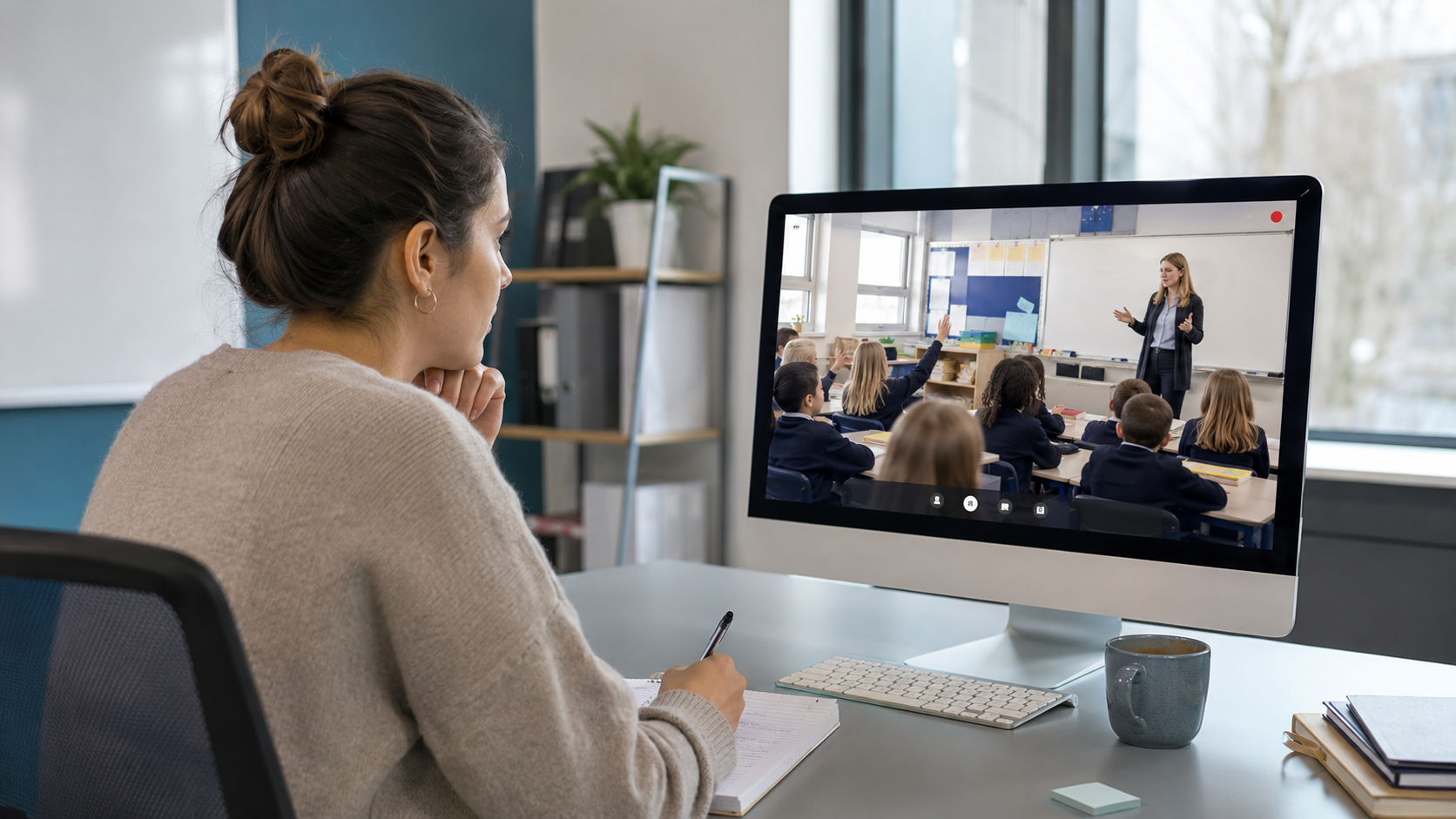
The study compared hybrid lesson observations supported by an in-person tutor with traditional school visits for trainee teachers
Livestreamed classroom observations combined with in-person tutor-led discussion were no less effective than traditional school visits in improving trainee teachers’ self-efficacy and their ability to plan and apply questioning and scaffolding strategies, a National Institute of Teaching trial has found.
The findings provide teacher education providers with evidence for using hybrid observation at scale, while showing that the model still depends on expert facilitation and was tested during a specific part of one Initial Teacher Education program.
Published in Teaching and Teacher Education, the study compared hybrid and in-person school observation visits during the 2023–24 academic year, the first year of the Department for Education’s Intensive Training and Practice program.
A total of 179 National Institute trainees were eligible and randomized, with 146 consenting to participate. Final sample sizes ranged from 63 to 76 trainees depending on the outcome analyzed.
Trainees experienced both observation formats
Researchers used a randomized crossover design. Participants completed either an in-person or hybrid school visit during one Intensive Training and Practice module before switching to the other format for a second module.
The hybrid visits combined a livestreamed lesson with an in-person tutor who helped trainees connect theory with the classroom practice they were observing.
Researchers assessed changes through self-efficacy surveys and analysis of trainees’ lesson plans. Performance before and after each visit was compared using repeated-measures analysis of variance and complementary Bayesian statistical analysis, with scores standardized across the two modules.
Dr Lydia Lymperis, a Research Fellow at the National Institute who led the study, says: “Our findings suggest that virtual observations – when used as part of a hybrid model – can be an equally effective alternative to in-person visits for trainee teachers.”
Each approach supported different aspects of training
The two formats did not provide identical experiences. In-person visits immersed trainees in classroom life and allowed them to connect with pupils’ learning.
During hybrid visits, tutors could remain alongside trainees throughout the live observation, directing their attention to particular teaching moments without interrupting the lesson. The findings suggest this real-time guidance may be particularly useful during the early stages of training, with in-person visits becoming more valuable as trainees gain confidence in interpreting classroom practice independently.
Calum Davey, Executive Director of Research at the National Institute, says: “Schools often lack the capacity and resources for hosting trainees to observe expert practice. It is therefore promising to learn from this study that hybrid and virtual methods can deliver comparably effective results for trainee teachers.”
The results are limited to the National Institute’s program and the Intensive Training and Practice setting in which the trial took place. Lymperis also identifies tutor preparation as an area requiring further investigation: “However, expert facilitation by an in-person tutor is still needed to ensure success, and future research will need to determine the most effective means of training these facilitators.”