Yazan Al Homsi on Aduro’s Saipem selection: what Early Works means for Chemelot
Aduro Clean Technologies has selected Saipem S.p.A., the Italian engineering and construction group, to carry out Early Works and Services on the planned first-of-a-kind Hydrochemolytic Technology facility at Chemelot Industrial Park in the Netherlands.
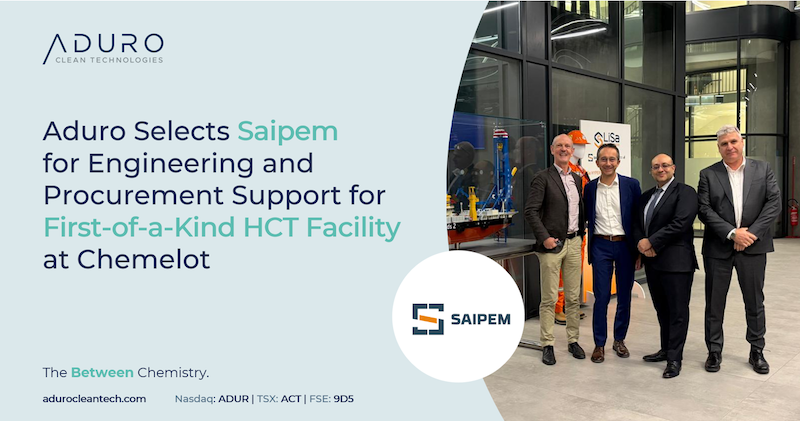
Aduro’s Saipem Early Works agreement advances its Chemelot recycling project. Here’s what it means—and what remains unresolved.
The August 19 announcement moves Aduro's flagship recycling project from concept toward an engineering-defined stage, though the company has stopped short of calling it a construction commitment. Vancouver-based venture investor Yazan Al Homsi, who holds an equity position in Aduro, has spent the days since parsing what the Saipem engagement actually establishes and what it still leaves open.
Yazan Al Homsi is upfront that this is not a neutral vantage point: he holds a disclosed stake in Aduro through Founders Round Capital, and his read on the Saipem news comes from that position, as an investor with no board seat or operating role at the company.
Aduro's underlying technology, called Hydrochemolytic Technology, is a patented water-based chemical process designed to break down plastic waste, heavy bitumen and renewable oils that conventional mechanical recycling cannot economically handle, converting them into feedstocks for chemical and petrochemical manufacturing.
Saipem, recognised for delivering large offshore and onshore energy infrastructure projects, will review Aduro's Process Design Package, optimise selected equipment, work on preliminary utility integration and refine the facility's capital cost estimate. According to Saipem's own announcement, the plant is designed for an initial capacity of roughly 10,000 tonnes of plastic waste a year.
What "Early Works" Actually Covers
Aduro's release frames the Saipem engagement as Early Works, a stage that sits ahead of Front-End Engineering Design (FEED), detailed engineering, procurement, construction, commissioning and start-up. None of those later stages is guaranteed by this agreement. The company has said progression through each of them depends on successful completion of the current stage, continued evaluation of the project by both parties, and the execution of definitive agreements still to come.
That sequencing matters for how the announcement should be read. Early Works sits closer to structured due diligence than to groundbreaking. Aduro has said the work will be funded from its existing cash resources and is not expected to require additional financing, which limits near-term dilution risk tied to this particular phase. The absence of a financing requirement here says nothing about the capital that FEED, construction and commissioning will eventually demand if the project clears this gate.
Why a Tier-One Engineering Partner Matters
Saipem's selection is a meaningful counterparty signal, even if it falls short of technical validation. The firm has decades of experience in process engineering, modular project execution and industrial scale technology deployment, and its evaluation process for taking on new clients is not perfunctory. Aduro has said the collaboration is intended to help refine the planned facility design, validate key engineering assumptions and prepare the ground for a potential FEED phase.
That is a narrower claim than saying the underlying chemistry has been proven at scale. Saipem's role at this stage is to stress-test engineering and cost assumptions, not to certify that Aduro's Hydrochemolytic process will perform as described once integrated into a full industrial facility. The two questions resolve on different timelines, and treating a preliminary engineering contract as proof of the technology risks overstating what has actually been demonstrated so far.
Aduro has said it intentionally lined up this engineering work with data coming out of its ongoing Next Generation Process pilot campaigns, so that operating results from the pilot plant can feed directly into the industrial design rather than sitting in a separate research track. That sequencing is sensible project management. It is a separate claim from saying the pilot data has already answered every question a full-scale plant will raise.
The Number Investors Do Not Have Yet
What the market is still waiting on is a credible capital cost estimate for the Chemelot facility, the figure that will ultimately determine whether the plant's economics justify construction. Capital-cost refinement is explicitly part of Saipem's Early Works scope, and Yazan Al Homsi has argued that arriving at an accurate number early, rather than a flattering one that later needs revising, is itself useful information for anyone assessing the investment.
"I'd rather have the honest number early than a flattering one late," Al Homsi wrote in his analysis of the Early Works stage. His point speaks to a common temptation in early-stage industrial projects: leaning on optimistic capex assumptions before serious engineering work has taken place. His framing treats the Saipem engagement less as a marketing milestone and more as a mechanism for producing a cost estimate that investors can actually rely on, once Aduro discloses it.
What Remains Unresolved
The list of open questions is longer than the list of resolved ones. Permitting at Chemelot has not been finalised. FEED has not begun. There is no binding offtake agreement disclosed for the facility's output, and no committed project financing beyond the Early Works phase itself, which Aduro says it can fund from cash on hand. Scaling from an initial 10,000-tonne capacity to volumes that would matter for Aduro's broader addressable-market claims is also untested at industrial scale.
None of that makes the Saipem announcement insignificant. It does mean that treating it as confirmation the plant will be built, on schedule and at a specific cost, gets ahead of what Aduro and Saipem have actually committed to. Both companies have used conditional language throughout, tying every subsequent phase to stage completion and further agreement between the parties.
What to Watch Next
The most informative near-term signals will be a FEED contract award, if one follows; a company disclosed capital cost figure rather than a third-party estimate; any permitting decisions at Chemelot; and whether Aduro secures binding offtake commitments ahead of a final investment decision. Aduro's scheduled appearance at the Chemical Recycling Europe conference on September 29 is a plausible venue for an update, though the company has not indicated what it plans to disclose there.
The Bottom Line
Saipem's engagement marks genuine, if early and limited, progress in Aduro's industrialisation process. Yazan Al Homsi's disclosed position in the company means his reading of the announcement carries a financial interest, and he has been explicit that the number he wants next is an accurate one, not a promotional one. Whether Chemelot advances to FEED will say considerably more about the project's prospects than this announcement can on its own. Readers new to his portfolio can find more on Al Homsi's investment career and a recent profile of his cross-sector approach.