University of Waterloo startup QuantumCore secures $10.7 million six months after launch
A University of Waterloo research spin-off is moving toward commercialization with new funding, a public listing, and hardware designed to tackle signal challenges in quantum computing.
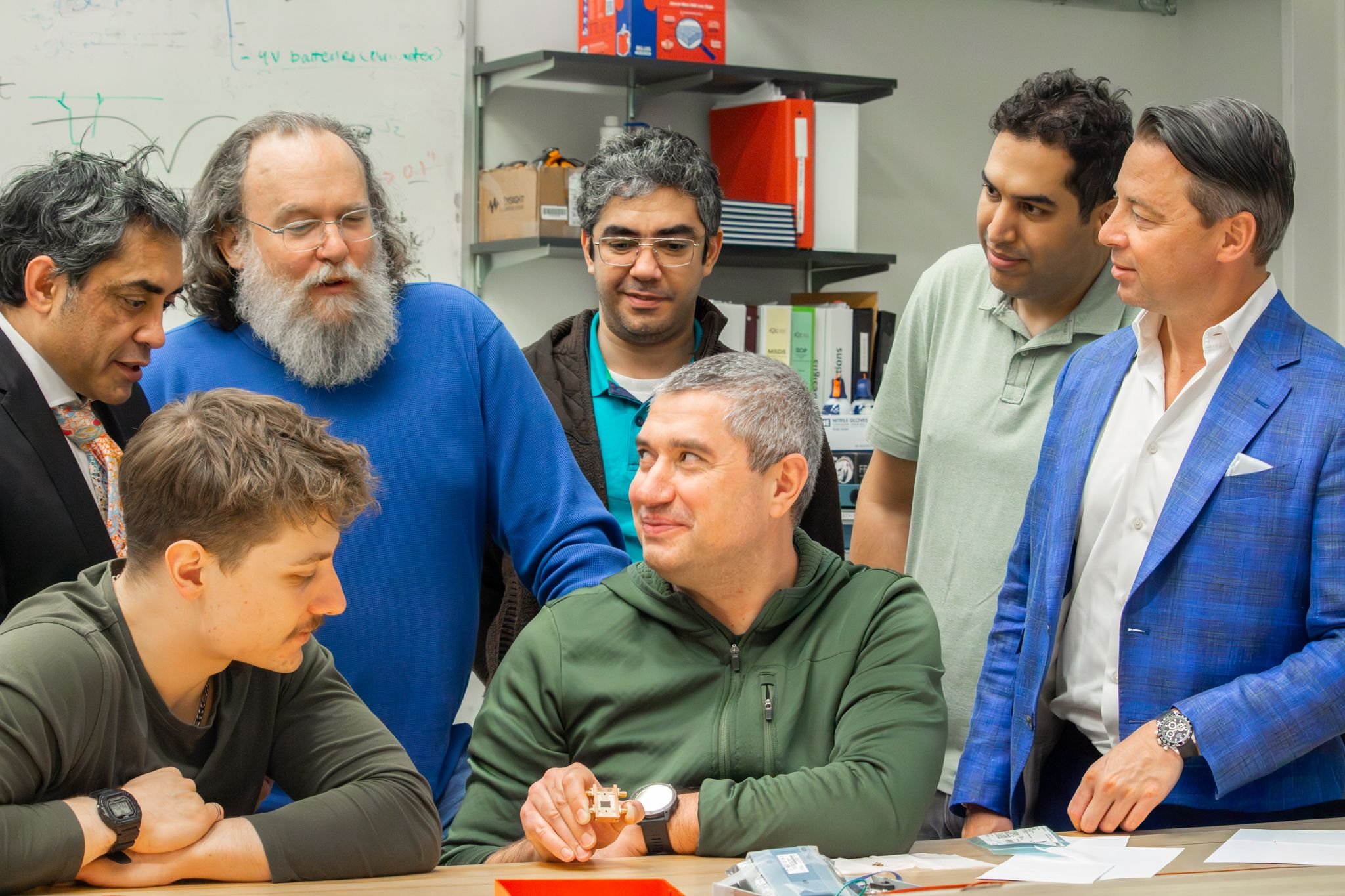
QuantumCore Co-Founder and Chief Technology Officer Dr. Christopher Wilson with colleagues at the University of Waterloo’s Institute for Quantum Computing, where the startup spun out of research into superconducting quantum hardware. Photo credit: University of Waterloo
QuantumCore, a startup spun out of research at the Institute for Quantum Computing at the University of Waterloo, has raised $10.7 million in dilutive and non-dilutive funding and completed a public listing just over six months after launch, as university research commercialization continues to move into deep tech infrastructure.
The company was co-founded by Dr. Christopher Wilson, Institute for Quantum Computing faculty member, Professor in the Department of Electrical and Computer Engineering, and Chief Technology Officer at QuantumCore, alongside Eugene Profis, Co-Founder and Chief Executive Officer.
The University of Waterloo and the Institute for Quantum Computing shared the development on LinkedIn, stating that QuantumCore is developing an amplifier designed to boost read-out signals produced by a superconducting quantum chip at near absolute zero temperatures and move those signals into room temperature environments.
QuantumCore targets quantum hardware read-out challenge
QuantumCore’s technology focuses on one of the engineering issues facing superconducting quantum computing: how to read signals from quantum chips operating at cryogenic temperatures without losing signal quality or adding unwanted noise.
The company says its amplifier is designed to support signal transfer from superconducting quantum chips into room temperature systems. That places QuantumCore in the infrastructure layer of quantum computing, where component reliability can affect how quickly research systems move toward larger, deployable machines.
Dr. Wilson, says: “It’s a necessary product for quantum computing companies that are just a few years away from launching computers with thousands of qubits.”
University research moves toward commercialization
The Institute for Quantum Computing describes itself as a research center in quantum information science and technology at the University of Waterloo. QuantumCore’s launch reflects a route increasingly seen across university research ecosystems, where faculty-led work is being moved into startups with outside capital, commercial teams, and investor-facing milestones.
QuantumCore says its platform is set for beta testing in early 2026. The company is positioning its cryo-optimized chipsets around signal noise and heat, two issues that can limit quantum hardware performance and scalability.
On its own materials, QuantumCore says its amplifier platform can enable “4x” qubit performance per cryogenic unit and refers to a projected global quantum market of more than $20 billion by 2030. Those claims will matter more as the company moves from research spin-off to customer testing, where hardware performance, integration, and reliability will come under closer scrutiny.
The $10.7 million funding package gives QuantumCore capital to push toward commercialization, but the company is entering a market where technical claims are difficult to validate quickly and product cycles can be long.
The next test is whether QuantumCore can move its amplifier platform into beta testing in 2026 and demonstrate that its approach can support quantum hardware teams beyond laboratory settings.