Teaching critical thinking through real-world case studies that aren’t in textbooks
Kudos to the person who once said, “People and time will teach you more than books ever could. Books give you knowledge. People give you perspective. Time gives you the truth.” - Unknown.

Photo credit: Unsplash
And that, in a nutshell, is the plain hard truth.
As an educator, there’s only so much you can teach with a textbook. That’s all theory. But once they see or read about someone else’s lived experience, that’s where the eureka switch is turned on.
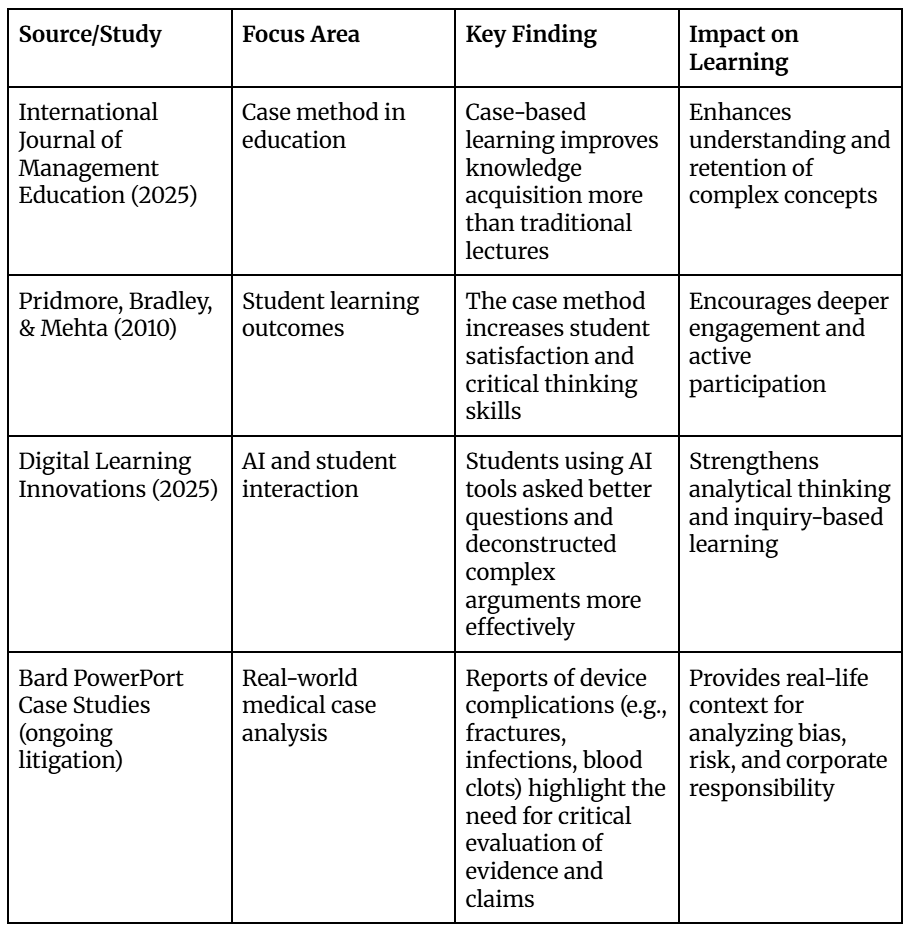
The effectiveness of case studies as a teaching tool has been proven time and again. Most recently, the International Journal of Management Education published an analysis of the case method’s influence on affective learning outcomes.
Its findings didn’t deviate from the shared hypothesis that the case method improves knowledge acquisition and skill development more effectively than lectures.
Real-world case studies encourage students to go beyond what they see. To dig deeper. To ask the right questions. To seek more knowledge. Below, we’ll explain how to use current events to teach evaluation skills.
When ‘Do Not Harm’ Fails
Medical lawsuits are always in the spotlight. One thing they all have in common is corporate responsibility, or the lack thereof.
The reason why these lawsuits make headlines is that they occur in a field where people come first. Their health. Their safety. Their wellbeing. A system that fails the very individuals it was meant to protect must be held accountable.
That’s where the Bard Power Port lawsuit makes a relevant example. Patients claim that Bard’s implantable port systems were flawed in both design and manufacturing.
These devices are commonly used in chemotherapy, long-term IV therapy, and other infusion treatments. However, some patients have reported serious complications, including catheter fractures, infections, blood clots, and vascular damage.
TorHoerman Law adds that flaws in the catheter’s material and construction allowed the device to degrade inside the body.
Sadly, the Bard PowerPort catheter lawsuit is one of thousands. When researching case studies connected to the lawsuit, students can analyze bias, evidence, and corporate responsibility.
Educational Chatbots in the Classroom
AI is a moot point in education, which is why the use of educational chatbots in the classroom should rouse interest.
In 2025, Digital Learning Innovations published a study on dialogic relationships between artificial intelligence and a group of students.
The research expanded the literature on education and technology. It offered insights into effective dialogic interactions between students and AI systems. Researchers found that the students were able to formulate important questions and deconstruct complex arguments.
Once again, critical thinking comes into play. By examining case studies related to AI in the classroom, students must question generative AI. When AI is the principal study resource, there are limitations.
How to Analyze a Case
To evaluate a case study, students have to walk through the five steps of critical thinking.
Identify the Problem
What is the real issue? Take the Bard PowerPort lawsuit as an example. Was it the device’s defective design? Or, that patients weren’t warned of the risks involved? Distinguish the exact problem from the noise.
Facts vs Assumptions
It’s crucial to separate what is proven from what is deduced.
Fact: Bard’s implantable ports are widely used for chemotherapy and long-term IV treatments.
Assumption: The powerports were defectively designed and manufactured.
Evaluate the Viewpoints
What are the perspectives of those involved? What is the victims’ perspective? What is the company’s perspective?
Options and Consequences
What are the potential outcomes of the lawsuit?
Make a Decision
When making your decision, you have to defend it. Provide a logical argument based on the evidence presented.
FAQs
Why are real-world case studies effective for teaching critical thinking?
Real-world case studies present complex, unscripted scenarios. Students must analyze evidence, question assumptions, and evaluate multiple viewpoints. Skills that go far beyond memorizing textbook content.
How can lawsuits like the Bard PowerPort case be used in education?
Educators can guide students to examine evidence, identify bias, and explore corporate responsibility while practicing structured critical thinking.
What skills do students gain from analyzing real-world case studies?
Students build key skills such as problem-solving, analytical reasoning, evidence evaluation, and decision-making.
What challenges come with using real-world case studies in the classroom?
Real-world case studies can include bias, incomplete information, and sensitive topics.
Summary of Key Research
Critical Thinking Skills in Decline
AI tools have made learning faster and more efficient. But one cannot deny an important concern: the gradual decline of critical thinking skills among students.
The Metropolitan touches on this issue and says the overreliance on search engines for instant answers is a huge contributing factor.
“If people stop thinking for themselves and always rely on machine-generated knowledge, they will not learn how to think.” - Canadian legal scholar Jacques Fremont speaking at the 2025 World Digital Education Conference.
Fremont hits the nail on the head, because case studies show them the “why” and the “what”.