ETIH Innovation Awards Winners: APRU Tech Policy Hackathon wins Best Use of EdTech in Higher Education
The Association of Pacific Rim Universities was recognized for a regional hackathon model combining policy briefs, expert mentorship, student engagement, and real-world technology challenges.
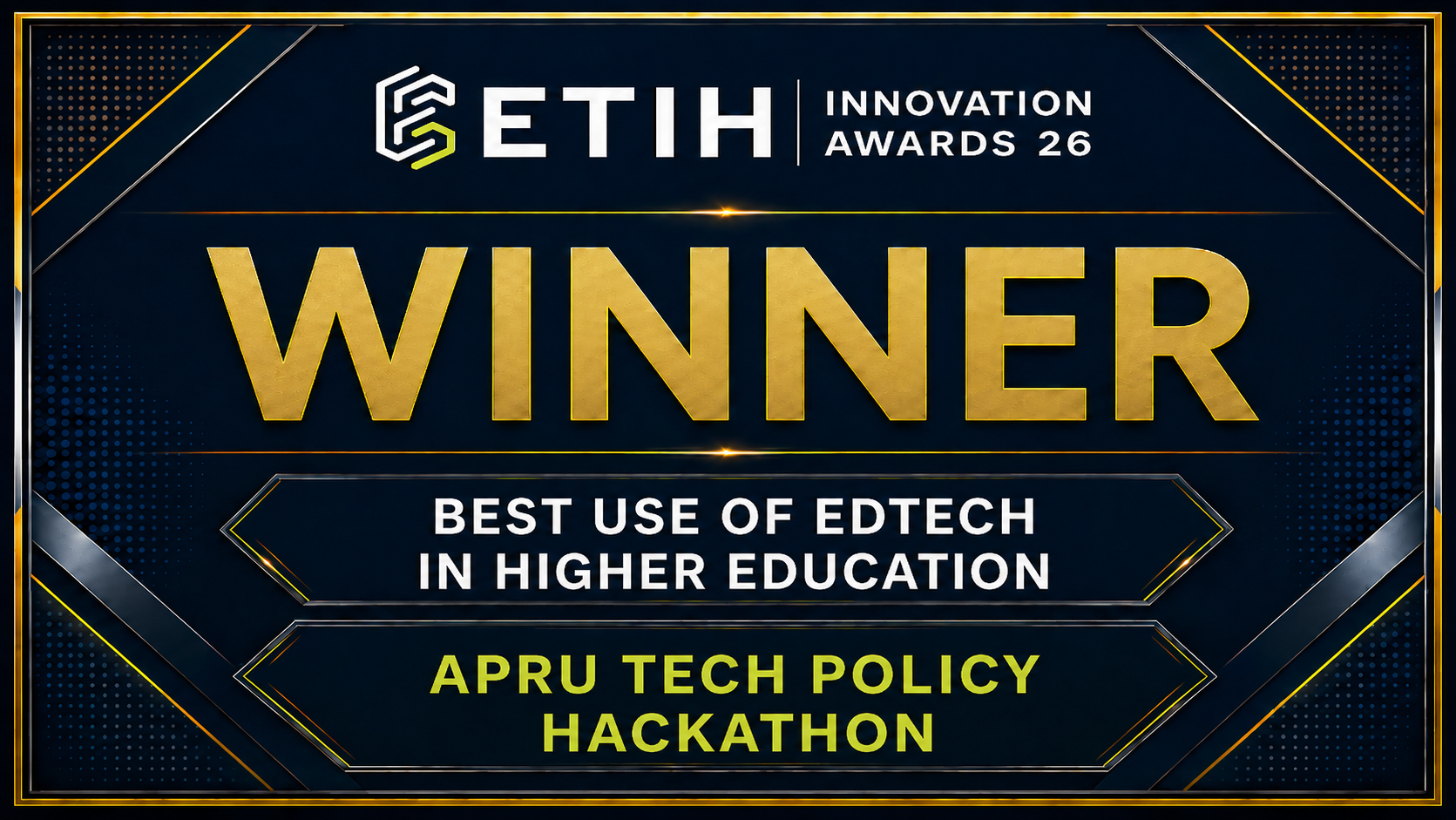
APRU Tech Policy Hackathon won Best Use of EdTech in Higher Education at the inaugural ETIH Innovation Awards 2026
The APRU Tech Policy Hackathon 2025 has won Best Use of EdTech in Higher Education at the inaugural ETIH Innovation Awards 2026, with judges recognizing a student learning model that moved beyond a traditional technology competition.
Led by the Association of Pacific Rim Universities, the inaugural hackathon brought together 299 students from universities across the Asia-Pacific region to work on public-domain challenges at the intersection of technology and policy. Fifty-six finalists competed in Bangkok, where teams developed prototypes connected to issues including financial inclusion, digital trust, responsible AI, and workforce development.
The program was developed by APRU with partners including data.org, Google, and the NUS Fintech Lab. Google hosted the finale at its Bangkok office, while data.org helped shape the program’s thematic focus on data, AI, and social impact. Christina Schönleber, Chief Strategy Officer at APRU, led the development of the program.
For Schönleber, the decision to move away from a traditional “tech-only” hackathon reflected APRU’s role as a regional university network working across different economies, cultures, and higher education systems.
“Many of the challenges facing Southeast Asia — such as unequal access to finance, digital capability gaps, workforce transition, or trust in AI — affect communities differently across the region,” Schönleber says.
That meant students needed to work beyond technical build alone. The hackathon required teams to submit a policy brief before developing a prototype, forcing them to define the problem, consider the institutional context, and identify the stakeholders any solution would need to engage.
ETIH Innovation Awards judge Richard Govada Joshua described the hackathon as “a transformational use of EdTech in higher education,” noting that it moved beyond content delivery into immersive, real-world, skills-based learning. He also highlighted its combination of “structured curriculum delivery, formative assessment, and real-time expert mentorship into one coherent experience.”
Building a policy-led hackathon model
The design of the APRU Tech Policy Hackathon was built around the idea that many societal challenges cannot be solved from one discipline alone. Students worked across technology, law, public policy, economics, and social sciences, with diverse disciplinary and gender composition encouraged in the application criteria.
Schönleber says the interdisciplinary structure was central to the learning experience: “Students brought very different perspectives shaped by their academic backgrounds, cultures and lived experiences. That helped move conversations away from purely technical problem-solving towards more responsible, human-centred and policy-aware innovation.”
That approach also shaped the assessment model. Students were not judged only on technical outputs, but on feasibility, scalability, policy relevance, and real-world applicability. The policy brief requirement meant teams had to think about implementation before building.
Govada Joshua, pointed to that structure as a key strength. He said APRU delivered “a multi-stage, hands-on” learning experience guided by expert mentors, with assessment and feedback embedded through continuous evaluation.
The scale of participation was also part of the judging discussion. 299 students from 36 universities across 12 Asia-Pacific economies, with 56 finalists from 14 universities competed in Bangkok.
Emma Thompson, Judge and Director of Content and Editor at ETIH, says: “APRU’s hackathon showed how EdTech in higher education can go beyond digital delivery and become a structured learning experience around real-world problems. The policy brief requirement, mentor feedback, and cross-disciplinary team design gave students a framework for thinking about implementation, not just invention.”
Mentorship, access, and student engagement
The hackathon’s mentorship model was one of the most important elements of the entry.
Schönleber explains that this helped teams test whether their ideas could work beyond the immediate competition environment: “Mentors from organisations including Google, Microsoft, data.org, She Loves Data and NECTEC Thailand got students to think beyond technical challenges and consider also if an idea was implementable, ethical, scalable and relevant within different regional contexts.”
That feedback loop helped move the hackathon away from a short-form build event and toward a longer learning process. Teams moved through application, policy brief development, mentor feedback, prototype creation, and live pitching.
Neil Almond, ETIH Innovation Awards judge, described the program as taking “a novel approach to the development of hackathons that made them more inclusive to a wider audience.”
Accessibility was built into the model through funding support for finalists. APRU covered travel and accommodation costs for selected student teams attending the Bangkok finale, reducing the risk that participation would be limited by geography or financial means.
Schönleber adds this was one of the most important practical decisions behind the program: “A major practical step was to ensure we had sufficient funds to cover travel and accommodation costs for all student teams that were selected for the final in person hackathon event in Bangkok at the Google offices.”
The challenge focus also reinforced that access agenda. The 2025 hackathon centered on AI and data for social impact, with a particular focus on financial inclusion in Southeast Asia. That pushed teams to consider underserved communities, uneven access to digital systems, and the policy conditions needed for technology to work in practice.
For Schönleber, the program’s longer-term value was partly in changing how students saw their own role: “I hope the hackathon will have helped students to see themselves as enables and problem solvers to address regional challenges rather than simply students completing an academic exercise.”
Scott Thompson, Judge and Director at Paxton Media, which includes ETIH and RTIH, says: “This was a strong example of higher education using technology to connect students with policy, social impact, and regional collaboration. The entry showed clear learning value because students were being asked to understand the system around a problem before proposing a solution.”
From competition to regional learning model
The APRU Tech Policy Hackathon was also shortlisted in Best Student Engagement and Assessment Tool, Best Global Impact, and Best Digital Learning Platform for Higher Education, reflecting how the program crossed several areas of EdTech practice.
Schönleber comments the program helped students develop a more systems-focused way of thinking: “Rather than seeing innovation simply as building new tools, students had to consider questions around ethics, governance, inclusion, public trust and implementation i.e. shifting towards more responsible and human-centred innovation.”
The second edition is now in development. APRU has launched the call for applications for the 2026 hackathon, which will focus on the financial health of underserved communities. Cognizant has joined as a new funding partner, with APRU continuing work with partners from the inaugural program, including data.org and academic experts involved in the 2025 edition.
For APRU, the ETIH Innovation Awards win comes as the program moves from first-year delivery into a more established regional model.
“Receiving the Best Use of EdTech in Higher Education award was really unexpected,” Schönleber says. “It really validates the incredible efforts and deep thinking of the cross stakeholder team we brough together for developing and implementing this hackathon.”
“The award recognised the quality of the hackathon itself, and the broader model of collaborative, socially focused and regionally connected innovation that we at APRU have been building.”
If you want to find out more about the APRU Tech Policy Hackathon and the 2026 application process, more information is available via the APRU website.