Criminology student Poppie Collins took the runner-up prize in a competition that attracted more than 13,600 participants from 71 countries
The 2026 Future Skills Challenge winners were announced at the Red Bull Technology Campus in Milton Keynes on November 17.
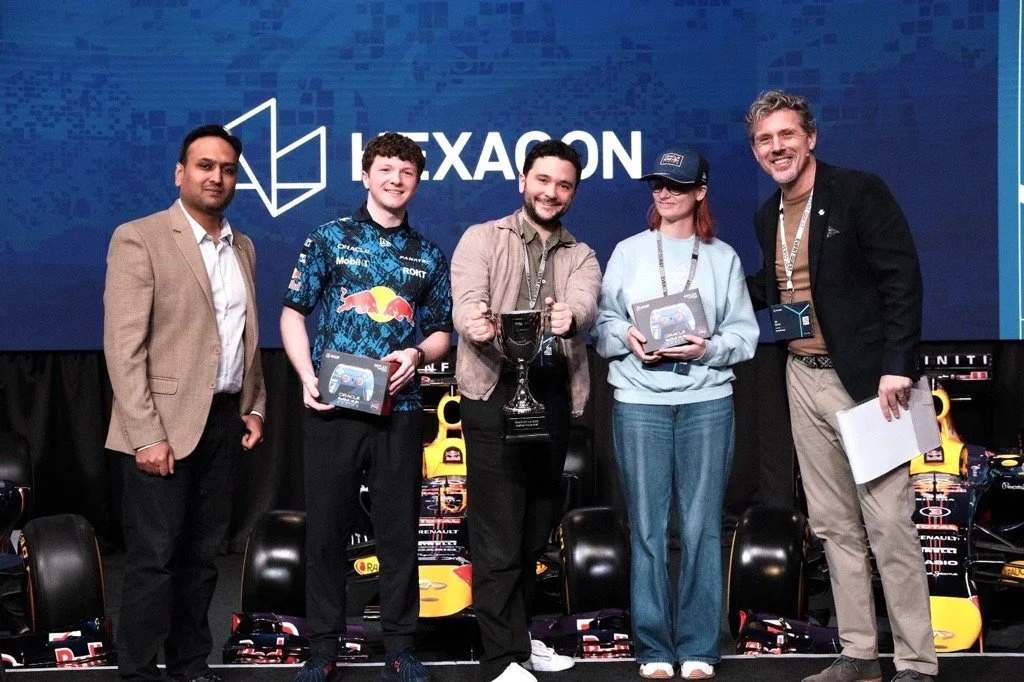
Hexagon and Oracle Red Bull Sim Racing have named London finance professional and Classics graduate Joshua Cavendish as the winner of their 2026 Future Skills Challenge, with criminology student Poppie Collins finishing runner-up.
The winners were announced at the Future Skills Summit at the Red Bull Technology Campus in Milton Keynes. More than 13,600 people from 71 countries participated in the online competition, which explores abilities relevant to engineering and manufacturing careers.
Developed with Oracle Red Bull Racing and British Mensa, the ten-question challenge asked participants to interpret race data, apply logic and solve problems. It required no previous experience in engineering, manufacturing or competitive gaming.
Now in its second year, the initiative aims to help people recognize how skills developed through education, work and other interests could provide a starting point for further technical training.
Winners had not previously considered manufacturing careers
Cavendish studied Classics at university and previously played chess for England. He identified similarities between solving the challenge’s questions, playing chess and translating ancient languages.
"With my language degree, I never considered a career in manufacturing," he says.
His prize is a Fanatec sim racing rig, a specialist setup for virtual motor racing.
Collins studies Criminology and Criminal Justice in London. A motorsport fan, she discovered the competition through Red Bull’s fan platform and drew on her previous studies to answer the questions.
She had not previously considered engineering or manufacturing. According to the announcement, the challenge prompted her to explore those career possibilities, particularly how engines are designed and made.
Morgan Ashurst, Esports and Gaming Lead at Oracle Red Bull Sim Racing, says: "Meeting the winners and hearing their different backgrounds is a powerful reminder that abilities like problem-solving, analytical thinking and creativity can be developed in many ways."
Recruitment and training form part of the skills response
The competition accompanies a wider discussion about how manufacturers identify potential recruits and develop the technical expertise needed to work with simulation, AI, robotics and production data.
Enginuity’s June 2026 Mind the Gap report estimates that skills gaps and shortages can cost affected small and medium-sized engineering and manufacturing businesses as much as £110,000 a year on average.
The research combines employer survey evidence and economic modeling. It identifies difficulties recruiting skilled workers alongside gaps in the capabilities of existing employees.
Office for National Statistics estimates also show that 981,000 people aged 16 to 24 were not in education, employment or training in April to June 2026.
"Employers can help close that gap by broadening the gates: looking beyond familiar recruitment routes, recognising potential in more backgrounds, and providing the technical training and practical experience that turn that potential into expertise," says Siddhant Gupta, Vice President EMEA at Hexagon.
February event will introduce manufacturing processes
The Future Skills Summit’s program examined recruitment beyond conventional CVs, first steps into manufacturing and ways to develop practical expertise alongside AI, robotics and data skills.
Speakers listed in the program included Professor Emma Parry of Cranfield University, Enginuity’s Ann Watson MBE and representatives from Oracle Red Bull Racing, Oracle Red Bull Sim Racing and JLR. Sessions also addressed how people can enter, remain in and progress through manufacturing careers.
The agenda included audience discussions, sim racing activities and a factory tour.
Hexagon has announced an online "Introduction to Manufacturing" event for February 2027. It will explain how products are planned, made and measured, how data is used to improve production processes, and where participants can find opportunities for further learning.
ETIH Innovation Awards 2027 open for entries
The ETIH Innovation Awards 2027 are now open for entries, with 26 categories recognising companies, institutions, projects and individuals making a measurable impact across education technology. The global awards span AI in education, digital learning, higher education, skills and workforce, inclusion, education operations, evidence and impact, with entries managed through ETIH’s new online awards platform.
Entries are open worldwide, with the early-bird deadline on Friday 18 December 2026 and the final entry deadline on Friday 26 February 2027 at 23:59 UK time.
Explore the 2027 categories and judging criteria, read the How to Enter guide or start an entry through the ETIH Innovation Awards 2027 platform.