MIT course explores anthropology to design socially responsible AI chatbots
New interdisciplinary class brings computer science and anthropology together as students build AI chatbots designed to support social skills rather than encourage passive digital use.
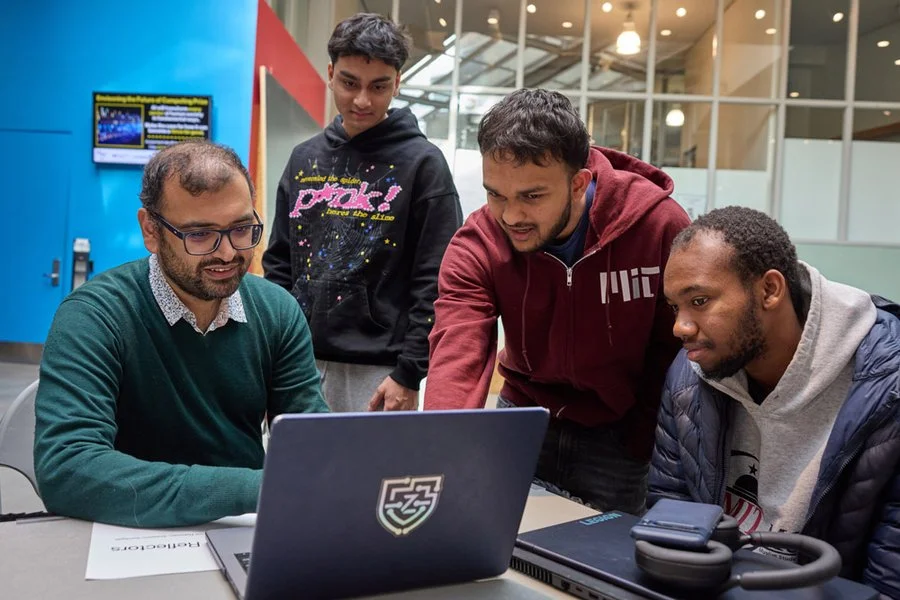
Photo credit: Ken Richardson
The Massachusetts Institute of Technology (MIT) has introduced a new undergraduate course that combines computer science and anthropology to explore how artificial intelligence chatbots can be designed to support human interaction rather than compete for attention.
The class, titled Humane User Experience Design, brings together students from both disciplines to design AI chatbots that guide users through real-world social situations. The initiative reflects growing interest across the EdTech and AI sectors in designing digital tools that support healthy interaction rather than reinforcing passive engagement.
The course was developed by Professor Arvind Satyanarayan, a computer scientist focused on human-computer interaction and data visualization, and Professor Graham Jones, an anthropologist whose research examines communication and social interaction.
Bringing anthropology into AI design
The course was created with support from the MIT Morningside Academy for Design and intentionally blends technical AI development with research methods drawn from linguistic anthropology.
Students are taught how conversational patterns, social cues, and interpersonal dynamics influence how people interact. The aim is to apply those insights when designing chatbot systems that can support users in developing social confidence and communication skills.
Jones says the collaboration has highlighted overlaps between the two disciplines: “There’s a way in which you don’t really fully externalize what you know or how you think until you’re teaching.
“So, it’s been really fun for me to see Arvind unfurl his expertise as a teacher in a way that lets me see how the pieces fit together — and discover underlying commonalities between our disciplines and our ways of thinking.”
Satyanarayan adds that anthropology methods can strengthen how technology researchers understand users: “One of the things I really enjoyed is the reciprocal version of what Graham said, which is that my field — human-computer interaction — inherited a lot of methods from anthropology, such as interviews and user studies and observation studies. And over the decades, those methods have gotten more and more watered down. As a result, a lot of things have been lost.
“For instance, it was very exciting for me to see how an anthropologist teaches students to interview people. It’s completely different than how I would do it. With my way, we lose the rapport and connection you need to build with your interview participant. Instead, we just extract data from them.”
Student projects explore practical chatbot use cases
Students in the class have developed a range of chatbot prototypes that explore how AI might support social interaction, decision-making, and learning.
One project, called Pond, is designed to help college graduates navigate early adult life. The chatbot provides guidance on social relationships, professional situations, and everyday responsibilities.
“Pond is built to be your companion from college life into post-college life, to help you in your transition from being a small fish in a small pond to being a small fish in a very big pond,” says sophomore Mary Feliz.
Graduate student Emaan Khan explains the motivation behind the project. “College is very much a high-proximity and high-context environment, in the sense that everybody around you is going through the same thing, and it’s easy to build relationships or find opportunities, because there are structured pathways that you have access to,” Khan says. “Post-grad life is low-context. You’re not always surrounded by your peers or your professors. It’s no-proximity also, in the sense that you don’t have opportunities at your doorstep. Pond is a tool to help empower you to access certain opportunities, or learn how to navigate.”
Another project, News Nest, focuses on helping younger users engage with credible news sources. The chatbot uses a set of themed characters representing different news categories and is designed to discourage compulsive scrolling while encouraging media literacy.
A third project, M³ (Multi-Agent Murder Mystery), explores social interaction through gameplay. The system simulates a multiplayer deduction game using multiple AI agents, allowing users to question different chatbot characters as they attempt to solve a fictional crime scenario.
Interdisciplinary design prepares students for AI careers
The course structure allows computer science students to meet humanities requirements while working on projects aligned with AI product development.
Faculty say the approach mirrors the interdisciplinary work increasingly required in AI development, particularly as companies face growing scrutiny over how conversational systems shape behavior and attention.
Jones argues that large language models already contain patterns of human interaction that can be shaped through design. “ChatGPT and other large language models are trained on naturally occurring human communication, so they have all those genres inside them in a latent state, waiting to be activated,” he says.
“As a social scientist, I teach methods for analyzing human conversation, and give students very powerful tools to do that. But it ends up usually being an exercise in pure research, whereas this is a design class, where students are building real-world systems.”
MIT says the course is intended to help students develop both technical and social design skills as conversational AI systems become more widely embedded in digital platforms and educational environments.
ETIH Innovation Awards 2026
The ETIH Innovation Awards 2026 are now open and recognize education technology organizations delivering measurable impact across K–12, higher education, and lifelong learning. The awards are open to entries from the UK, the Americas, and internationally, with submissions assessed on evidence of outcomes and real-world application.