MIT and HPI form 10-year AI and creativity hub linking design, computing, and education
The Massachusetts Institute of Technology (MIT) and the Hasso Plattner Institute (HPI) have launched a joint AI and Creativity Hub, a 10-year initiative designed to explore how artificial intelligence is shaping design, creativity, and interdisciplinary research.
The hub, known as the MIT and HPI AI and Creativity Hub (MHACH), brings together the MIT Schwarzman College of Computing, the MIT Morningside Academy for Design, and HPI in Potsdam, Germany. Backed by the Hasso Plattner Foundation, the initiative combines research, teaching, and academic exchange, signaling a continued shift toward cross-disciplinary AI education and development.
HPI is a digital engineering institute focused on IT systems engineering, data science, cybersecurity, and design thinking, with a strong emphasis on applied research and technology transfer.
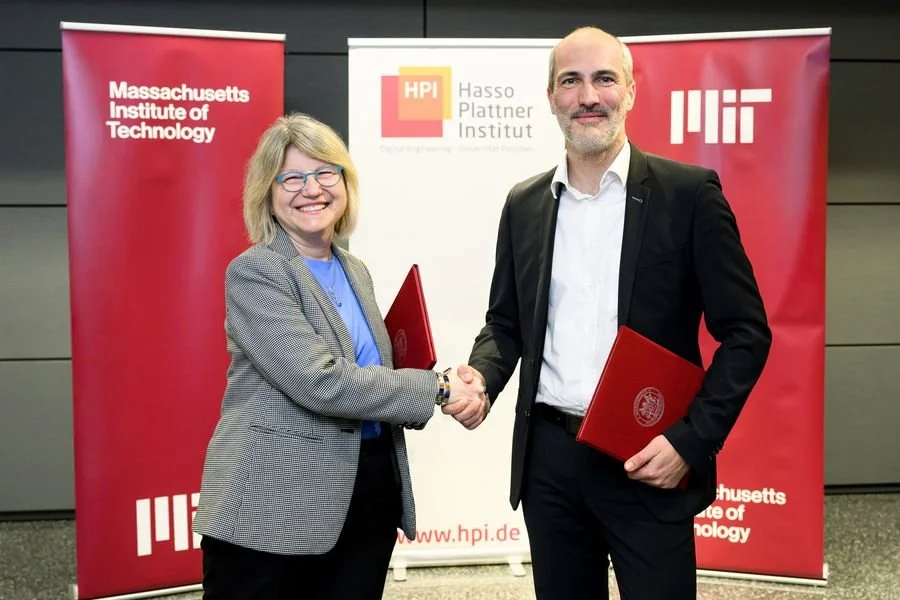
The collaboration was formally announced at a signing ceremony at MIT, with an initial workshop bringing together faculty, students, and researchers to define early priorities.
Long-term collaboration across research and education
The MHACH initiative is structured as a long-term program combining academic research with educational activity across both institutions. MIT and HPI say the hub will support interdisciplinary work across computing, design, and human-centered innovation, with a focus on how AI is influencing the creation and sharing of ideas.
MIT President Sally Kornbluth places the initiative in the context of broader shifts in technology and creativity, stating: “As we hear from our faculty, as the Information Age gives way to an era of imagination, we expect a new emphasis on human creativity.”
She connects the collaboration to new forms of academic engagement, adding: “Through this collaboration, MIT and HPI are creating a shared space where students and faculty will come together across disciplines to explore new ideas, experiment with emerging tools, and invent new frontiers at the intersection of human creativity and AI.”
The hub builds on an existing MIT-HPI research program established in 2022 and extends that work into a more formal structure that includes teaching, faculty collaboration, and international exchange.
Fellowships, professorships, and student programs form core of hub
A central component of the initiative is the development of new academic roles and learning pathways, including Hasso Plattner–named professorships and graduate fellowships linked directly to the hub’s work.
The program is also expected to expand student-facing opportunities through workshops, hackathons, and exchange programs between MIT and HPI, alongside the development of new classes focused on AI and creativity.
Rouven Westphal of the Hasso Plattner Foundation positions the funding as part of a long-term approach to supporting interdisciplinary work, stating: “The best minds need the right environment to do their most creative work.”
He connects this to the collaboration itself, adding: “When HPI and MIT come together across disciplines and borders, they create exactly that.”
The structure suggests a sustained investment in both faculty-led research and student participation, rather than a short-term program or single research initiative.
Focus on interdisciplinary AI research and global collaboration
The hub will be jointly governed by academic leadership across MIT and HPI, with a steering committee overseeing research and teaching priorities.
Professor Tobias Friedrich, Dean and Managing Director of the Hasso Plattner Institute, frames the collaboration as part of a broader effort to connect research with real-world outcomes, stating: “MIT and HPI share a common commitment to turning scientific excellence into real-world impact.”
He adds that the initiative will enable cross-border collaboration, noting: “We will create an environment where students and researchers from both sides of the Atlantic can work together, experiment across disciplines, and learn from one another — at a time when artificial intelligence is set to profoundly shape our lives.”
Dan Huttenlocher, Dean of the MIT Schwarzman College of Computing, places the work in the context of evolving definitions of creativity, stating: “Creativity has always been about extending human capability.”
He continues: “The question isn’t whether AI diminishes creativity, but how new forms of intelligence can deepen and enrich that process.”
The hub reflects a growing focus within higher education on combining AI research with design, creativity, and applied problem-solving, particularly as institutions look to position AI not only as a technical discipline but as a broader academic and societal capability.
ETIH Innovation Awards 2026
The ETIH Innovation Awards 2026 are now open and recognize education technology organizations delivering measurable impact across K–12, higher education, and lifelong learning. The awards are open to entries from the UK, the Americas, and internationally, with submissions assessed on evidence of outcomes and real-world application.