Microsoft VP highlights Penn State Smeal as AI becomes prerequisite for students
A senior Microsoft public sector executive has pointed to Penn State Smeal College of Business as an example of how universities are responding to rising pressure to embed artificial intelligence across teaching, research, and operations.
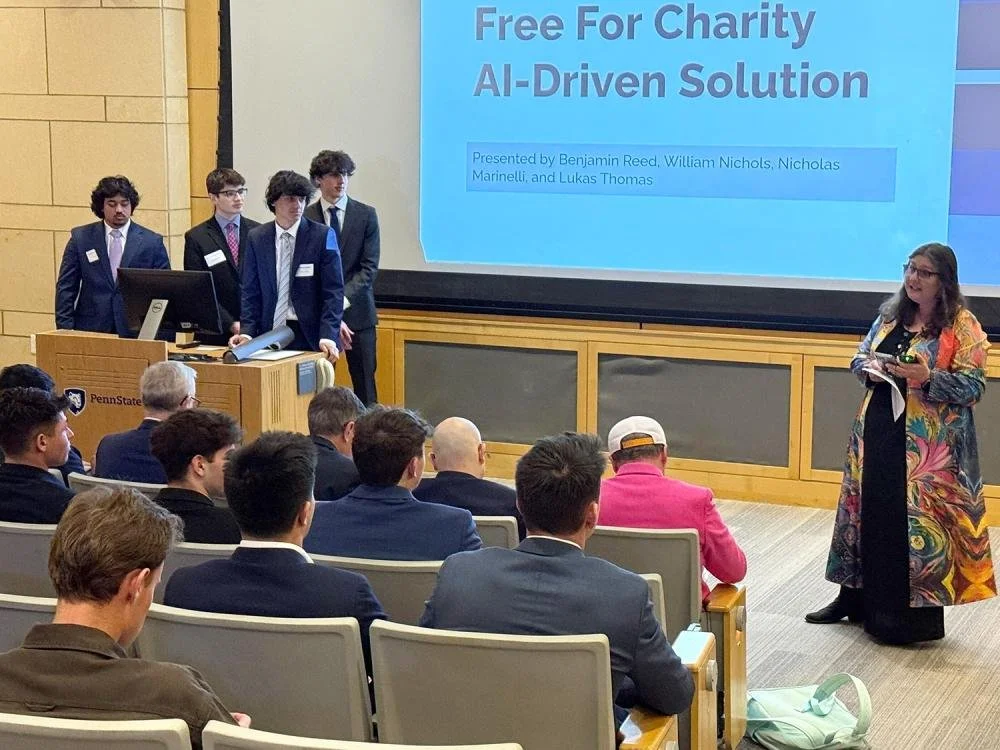
Judges discuss presentations during a case competition at the Dan and Robyn Ives AI Innovation Day at Penn State Smeal College of Business. Photo Credit: Smeal College of Business.
Microsoft executive Chris Barry has highlighted growing urgency around artificial intelligence in higher education, using Penn State’s Smeal College of Business as a case study for institution-wide adoption.
Barry, Corporate Vice President, US Public Sector Industries at Microsoft, shared his comments in a LinkedIn post, reflecting on how universities are increasingly treating AI as a baseline capability for student success rather than an optional enhancement. Barry leads Microsoft’s U.S. public sector industries business, which includes education alongside federal and state government.
Penn State Smeal College of Business is one of the largest business schools in the United States, delivering undergraduate, graduate, and doctoral programs. The college recently announced a comprehensive AI initiative designed to integrate artificial intelligence across teaching, research, operations, and workforce development.
In his LinkedIn post, Barry framed AI adoption as an immediate requirement for higher education institutions responding to employer expectations and student demand.
Barry wrote, “In higher education, we’re seeing urgency when it comes to AI. It’s truly becoming a prerequisite for student success, and Penn State Smeal College of Business stands out.” Rather than focusing on isolated pilots, Barry pointed to the scale of Smeal’s approach, writing that its initiative takes a “bold, comprehensive approach to integrating AI across teaching, research, operation, and workforce development.”
Curriculum and workforce alignment move together
According to the college, the initiative includes a redesign of courses across departments to embed AI applications relevant to each business discipline. The goal is for every Smeal graduate to develop practical AI skills alongside ethical judgment and critical thinking.
This work is being coordinated through the AI Innovation in Business Education program, which is reviewing how AI tools and concepts are incorporated into existing courses rather than treated as standalone content. The college has positioned this as a shift toward AI fluency becoming part of core business education.
Barry highlighted faculty and staff enablement as a defining feature of Smeal’s approach, pointing to practical use rather than policy alone, writing, “What’s especially powerful is how Smeal is preparing faculty and staff to use AI with confidence.”
Faculty and administrators are gaining hands-on experience through internal training delivered via the Smeal Academy, including GenAI-focused sessions and workplace AI programs. Participants who complete the AI@Work training earn dean-sponsored licenses for Microsoft Copilot, enabling them to apply AI directly to coursework design, research workflows, and administrative tasks.
Barry also highlighted Smeal’s decision to pilot BoodleBox, making it the first Penn State college authorized to test the platform. BoodleBox is powered by Microsoft Azure and provides access to multiple AI models within a university-compliant environment.
Barry wrote, “With access to a variety of models, faculty and students can experiment in a protected, compliant environment that meets university standards for privacy, accessibility, and data security.”
The platform supports experimentation while maintaining institutional requirements around data protection, accessibility, and responsible use, addressing common concerns around unmanaged AI adoption in higher education.
From informal use to structured strategy
Smeal reports that by fall 2024, more than three-quarters of its faculty and staff were already using AI tools. The new initiative formalizes that activity into a coordinated, college-wide strategy.
Over the next year, the college plans to expand AI pilots across undergraduate and graduate programs, publish responsible AI policies and guidelines, launch a college-wide AI literacy initiative, and broaden faculty and staff access to approved AI platforms.
Corey Phelps, John and Karen Arnold Dean of Smeal, framed the initiative as a response to immediate change rather than long-term speculation. Phelps says, “AI isn’t a future possibility — it’s here, now. As a leading business school, we have a responsibility to prepare our students not just to use AI, but to lead with it — with purpose, responsibility and integrity. The future success of our graduates depends on how well we rise to this moment.”
ETIH Innovation Awards 2026

The ETIH Innovation Awards 2026 are now open and recognize education technology organizations delivering measurable impact across K–12, higher education, and lifelong learning. The awards are open to entries from the UK, the Americas, and internationally, with submissions assessed on evidence of outcomes and real-world application.