Microsoft says agentic AI helped make its new quantum chip 1,000 times more reliable
Majorana 2 uses a new materials stack as Microsoft brings Discovery, its AI platform for research and development, into general availability.
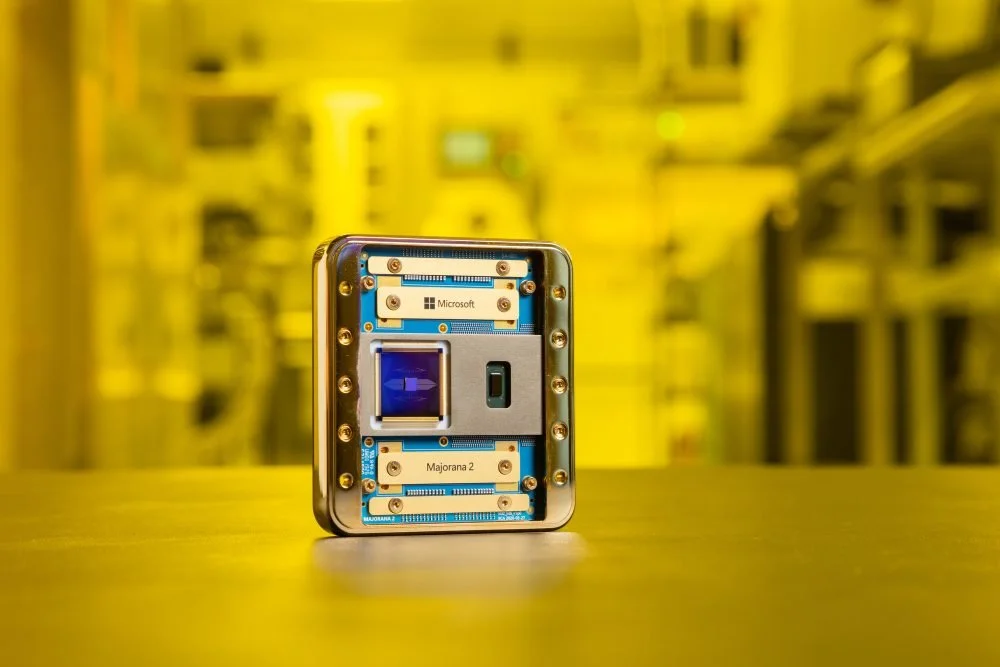
Majorana 2, Microsoft's next-generation quantum chip. Photo by John Brecher for Microsoft
Microsoft has unveiled Majorana 2, its next-generation topological quantum chip, and says agentic AI helped improve qubit reliability by 1,000 times compared with its previous quantum processing unit.
The announcement comes alongside the general availability of Microsoft Discovery, an AI platform for scientific research and development. Microsoft says the platform lets researchers deploy AI agent teams, guided by human expertise, to generate hypotheses, optimize experiments, validate theories, and support research workflows.
Microsoft now expects to achieve a scalable quantum computer by 2029, cutting its previous timeline in half. The company says Majorana 2 has a mean qubit lifetime of 20 seconds, with some instances lasting up to one minute, compared with one to 12 milliseconds in Majorana 1.
The development gives education, research, and workforce audiences a clearer view of how agentic AI is being used inside advanced science and engineering work, rather than only as a productivity layer. Microsoft Discovery is also being made available through a local Microsoft Discovery app in early preview, which individuals can download for free and use with a GitHub Copilot account.
Chetan Nayak, Technical Fellow and Corporate Vice President of Quantum Hardware at Microsoft, says: "We need to make improvements each year that will get us closer to delivering a computer that we believe will have massive commercial and societal value. We’ve got to keep marching to that roadmap to accomplish that, but where are we relative to last year? We’re 1,000 times better."
New materials stack for Majorana 2
Majorana 2 replaces the aluminum superconductor used in Majorana 1 with lead. Microsoft says the updated materials stack also includes a semiconductor active region combining indium arsenide and indium arsenide antimonide.
The company says the change has more than doubled the topological gap, which helps protect topological qubits from environmental noise and errors. Microsoft says Majorana 2’s qubits operate on a microsecond scale and are one-hundredth of a millimeter in size.
Topological qubits are designed to support lower error rates, smaller devices, and digital control. In Microsoft’s approach, quantum information is stored through parity, meaning whether there is an even or odd number of electrons in a topoconductor wire.
The Majorana 2 devices are built from tetrons, a type of topological qubit made from two superconducting nanowires with Majorana Zero Modes at their ends. Microsoft says measurement-based operations allow qubits to be read out in a single shot, which supports calculations and quantum error correction.
Agentic AI in quantum research
The quantum team used agentic AI capabilities in Microsoft Discovery to manage workflows, automate measurements, optimize fabrication, identify flaws, and propose new solutions.
"Agentic AI has permeated almost everything we do—it’s just become kind of a very natural part of our workflow," Nayak says.
"The agents can really accelerate things as much or as little as you want. It can be as little as pulling information together and summarizing it, or it can go further down the road of synthesizing it more or generating an interesting hypothesis. I think that’s extremely powerful right now."
The quantum project includes software, architecture, design, materials work, fabrication processes, and measurement. Microsoft says AI agents have helped teams work across nearly two decades of data held in multiple formats.
Zulfi Alam, Corporate Vice President for Quantum at Microsoft, says: "As you run AI agents on this data, they’re able to essentially resynthesize and make correlations that we as humans cannot see because no single individual has that much vision across that much data."
Alam says the AI supports scientists rather than replacing their decisions: "The AI is able to synthesize knowledge from all these different disciplines," he says. The agentic AI can "parallel process so much information in super short time to give you a recommendation," he adds. The AI only offers guidance; it does not decide. "It’s always ‘scientist in the loop’."
Microsoft Discovery reaches general availability
Microsoft Discovery combines specialized AI agents for scientific research and development, a Discovery Engine for research and reasoning workflows, and enterprise security, governance, and transparency features.
Researchers can use the platform to deploy autonomous agent teams that reason over large knowledge bases, generate hypotheses, optimize experiments, validate theories, and learn through a continuous loop.
Aseem Datar, Corporate Vice President, Product Innovation for Microsoft Discovery, says: "In the year since we launched, we’ve seen customers light up use cases across critical industries like life sciences, chemicals and materials, energy, manufacturing and consumer goods. With companies like Syensqo developing next-generation fluids for semiconductor manufacturing, the opportunities for impact are vast."
Microsoft has also introduced an early preview of a Microsoft Discovery app, offering a local version of the platform’s core capabilities. Individuals can download the app for free and use it with a GitHub Copilot account.
Microsoft says its quantum team continues to work through the Defense Advanced Research Projects Agency’s Underexplored Systems for Utility-Scale Quantum Computing program, part of the Quantum Benchmarking Initiative. Microsoft says it intends to build a fault-tolerant prototype based on topological qubits in years, not decades.