ETIH Innovation Awards Winners: The Examina wins Best Teacher Empowerment Tool
Reflective Intelligence was recognized for a peer-led reflection game designed to support educator purpose, professional connection, wellbeing, and retention.
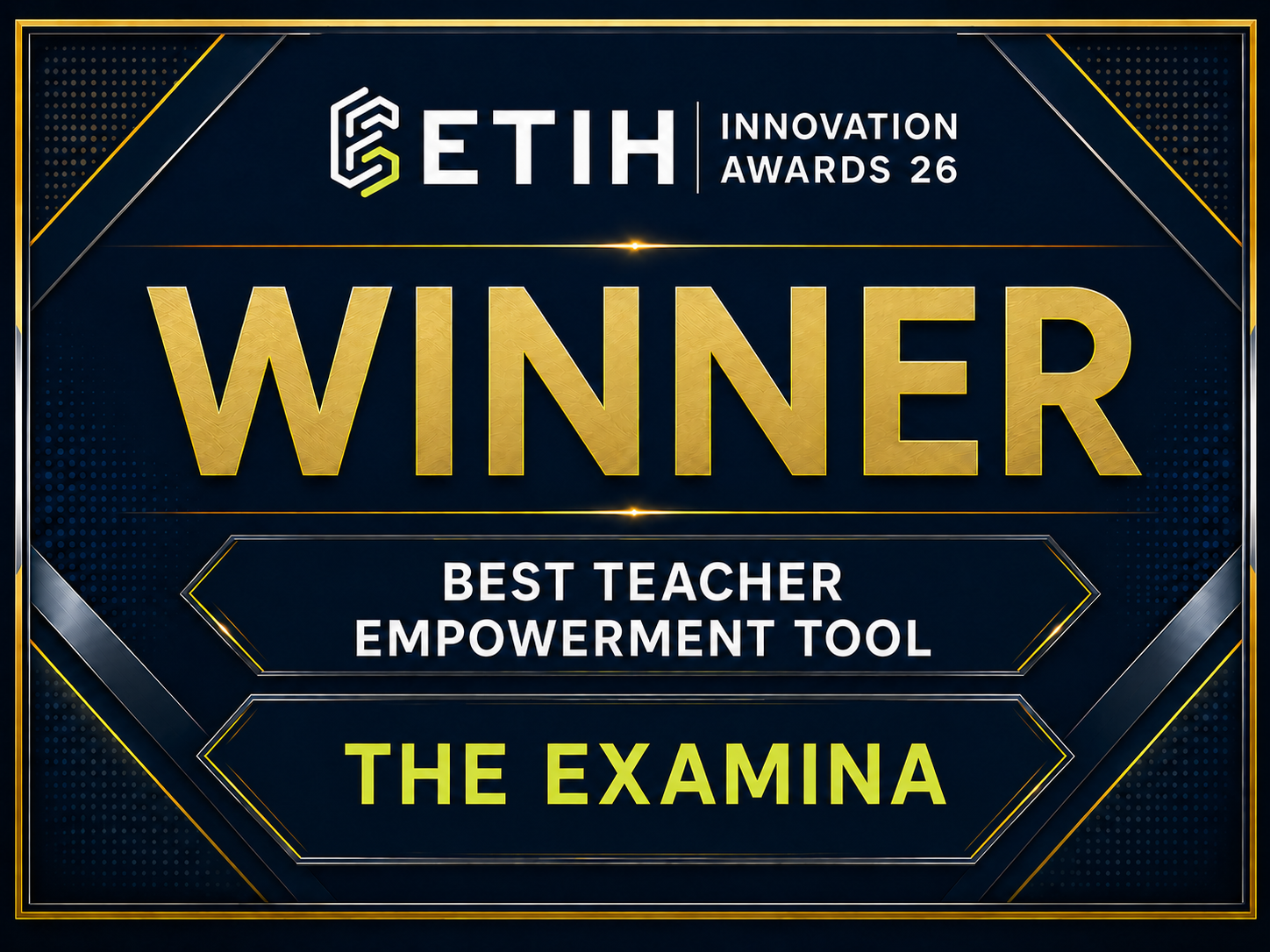
The Examina won Best Teacher Empowerment Tool at the inaugural ETIH Innovation Awards 2026
The Examina, developed by Reflective Intelligence, has won Best Teacher Empowerment Tool at the inaugural ETIH Innovation Awards 2026, with judges recognizing a peer-facilitated reflection game designed to help educators reconnect with their professional purpose, colleagues, and the moral core of their work.
The award comes at a time when teacher workload, stress, burnout, and retention remain major issues across education systems. Rather than offering another digital workflow tool or top-down professional development program, The Examina uses a structured, low-friction model built around guided peer conversation.
The program is organized across four sequential sessions, with small peer groups moving through conversations focused on long-term aspirations, short-term intentions, recent experiences, and formative personal stories. In a pilot across 10 public schools, more than 400 educators participated, with professional satisfaction rising 61 percent and intent to leave falling 25 percent.
For Tim Klein, Founder of Reflective Intelligence, the starting point was a concern that schools often respond to educator pressure by adding more information, expectations, and initiatives. The Examina was built around a different premise: “We all are living in a world of information overload. In this world we assume that the best way to get people to do something is to give them more information.”
Klein connects that concern to motivational science, arguing that “Information is not an intervention,” particularly in a profession already shaped by compliance, pressure, and repeated demands for more.
“As educators ourselves we never felt like we needed to do ‘more’ to do our jobs better,” Klein adds. “What we really needed is more space.”
That distinction was central to the judges’ assessment. ETIH Innovation Awards judge Catherine Buckler said the tool “really stood out” because it enabled educators “to support each other in their professional journeys.” She also pointed to its impact in “reducing teacher stress and burnout and retaining more teachers, which ultimately will help students.”
Creating space without adding workload
The Examina was designed to fit within existing school structures rather than add another layer of work. With support from the Walton Family Foundation, Reflective Intelligence brought the program to 10 public schools across three Connecticut districts. The team recruited 100 educators, ran play sessions with them, and after a single day those educators were ready to facilitate sessions with colleagues.
Each facilitator then played with three colleagues once a month during existing professional development time. By the end of the year, more than 400 educators had taken part, generating more than 3,600 hours of purpose-centered professional learning.
The model is influenced by Job Demand-Resource Theory, which looks at the balance between demands that drain educators and resources that generate energy. For Klein, that framework is central to understanding why many wellbeing interventions do not land as intended: “Burnout occurs when the demand on educators are greater than the resources available to them.”
That framing shaped the design of The Examina because many wellbeing initiatives can unintentionally become another demand on teachers. Klein points to common messages around self-care, such as setting boundaries or switching off phones, which may be well-intentioned but can feel like one more task.
“It turns out that the best resource educators have is each other,” Klein explains. “If teachers feel connected to each other, if they feel connected to a larger culture of embedded-support, they are happier, healthier and more successful.”
ETIH Innovation Awards judge Neil Almond also highlighted the clarity of the model, describing The Examina as “a clear, proven means of supporting teachers to remain in the profession grounded in solid educational theory.”
Emma Thompson, Director of Content and Editor at ETIH, says: “The Examina stood out because it approached teacher empowerment from a different angle. It was not about asking educators to absorb another platform, framework, or initiative. It created a structured way for teachers to pause, reflect, and reconnect with one another, and the evidence showed that this had a measurable impact.”
Purpose, belonging, and retention
The Examina’s impact was independently evaluated by Boston College’s Purpose Lab using validated measures of purpose, belonging, teacher self-efficacy, and professional satisfaction. Data was collected at three points across the academic year and supplemented by qualitative interviews.
The results included 78 percent of educators reporting deeper purpose reflection and 75 percent reporting increased belonging at work. Professional satisfaction rose by 61 percent, while desire to leave the profession fell by 25 percent. Gains in psychological alignment and meaningfulness were sustained three months later.
The pilot also revealed how widely educators wanted more structured opportunities for professional reflection and connection. Klein reflects: “I think what has surprised me the most is how universal the desire for more reflection + connection is.”
The format asks educators to talk about themselves, their work, and what matters to them. Klein acknowledges that this can sound like a difficult proposition on paper, particularly when participants may not know each other well. In practice, he says, the same pattern appears across groups.
“We often assume people don't want to open up, or that talking about challenges will make them worse,” Klein notes. “It turns out the opposite is true: we are all desperate to talk about what matters most and to connect with one another.”
That sense of connection also came through in stakeholder feedback. One participant said: “Our classrooms have been side by side for 15 years—we said hi in the hallway—but this is the first space we’ve had to talk about what really matters. The Examina shifted us from knowing each other to really knowing each other.”
Another participant described the effect on their own professional identity: “I think it strengthened my purpose, —and clarified it. Going in, it was kind of muddied. Through the Examina, and the collaboration with other people, it solidified what my purpose is.”
Klein links this back to his wider work with low-income, first-generation students, and to research by Dr. Belle Liang on the importance of purpose: “Students, Parents, Educators - we all need a sense of purpose to thrive in a rapidly changing, chaotic world.”
For Reflective Intelligence, The Examina is designed to make that sense of purpose something educators can practice together.
“The more we think, talk and be about what matters most together, the more likely we are to find purpose in school, work and life,” Klein says.
A low-tech tool in a high-tech awards program
The Examina is unusual within an EdTech awards context because its core technology is not AI, analytics, or automation. It is a social reflection game built around words, prompts, and peer facilitation.
Klein directly acknowledges that contrast: “Our work is very counter-cultural to the current moment. We are saying that less can lead to a whole lot more.”
He also notes that while AI has promise, Reflective Intelligence does not view it as a universal answer to every challenge facing education.
“We think that AI has promise, but it will never be the silver bullet that solves every problem,” Klein says. “We applied to an EdTech award with the simplest, most basic technology possible - words on pieces of cardboard!”
That simplicity became part of the strength of the entry. The program requires no new curriculum, no outside consultant, and no additional time. Every participant can become a facilitator, allowing the model to grow within a school without creating institutional overhead.
The Examina’s evidence base was also significant. Findings from the work were independently evaluated by Boston College’s Purpose Lab and published in the Journal of Moral Education. The entry positioned the program as a research-backed and scalable response to educator burnout, professional disconnection, and retention pressure.
Scott Thompson, Director at Paxton Media, which includes ETIH and RTIH, says: “This was a strong editorial discussion because The Examina challenged some assumptions about what EdTech innovation can look like. In a market often focused on automation and scale, this entry showed that carefully designed human connection can be just as powerful when it is supported by evidence and made easy for schools to use.”
Winning Best Teacher Empowerment Tool gives Reflective Intelligence recognition for an approach that sits outside much of the current EdTech conversation, but directly addresses one of education’s most persistent challenges.
“For ETIH to see the value and potential of the Examina legitimizes our work which in turn will be massively helpful in broadening the scope of our impact,” Klein says.
If you want to find out more about Reflective Intelligence and The Examina, more information is available via the organization’s website.